Live data from Hacker News

The four-day workweek in Australia: insights from early adopters of 100:80:100

scienceaim.com

91–100 of 268 posts

Re: The four-day workweek in Australia: insights from early adopters of 100:80:100

#91
Given the gargantuan amount of data showing productivity relative to wage gains, or productivity relative to time worked, or productivity relative to physical office proximity, and the absolute staunch refusal of business to listen to any of it, I can only assume one thing:

The point was never productivity, it was about humiliation and control.

If it were about productivity, workers would be paid substantially more to reflect the immense productivity gains we’ve created through automation; we are not.

If it were about effective time management or efficiency, we would be on four-day, 32 hour work weeks to reflect the real productive output of labor; we are not.

Just like how RTO excuses of “mentoring Juniors” and “improving team cohesion” went out the door for mass layoffs, despite data showing that a flexible schedule adapting to the needs of the team rather than whims of leadership have better outcomes and higher productivity; we now pay higher commute costs, fuel costs, energy costs, and opportunity costs so real estate investments don’t invert.

It’s all bullshit and lies, and this is one more study to add to the Alexandria-esque library of research proving that there is no single good way of working, and the insistence of refusing to change how we work is ultimately costing us more than if we just learned to adapt.
Re: The four-day workweek in Australia: insights from early adopters of 100:80:100

#92
post #81

Earlier quoted context omitted.

How did the 40-hour workweek come about? (Certainly not "naturally")

Unions.

More completely the 8 hour work day movement. Loosely, 8hrs each for work, sleep, and everything else with everything else often being called recreation. Add in a 5 day work week and 40hrs. There's monument in Melbourne commemorating stonemasons winning an 8 hour work day in 1856 but they were working 6 days a week.

Re: The four-day workweek in Australia: insights from early adopters of 100:80:100

#93

Speaking as an American, I don’t give a shit if it increases productivity or not. Productivity has gone up exponentially with technological advancement since the advent of the 5 day work week. We, as a species, should be minimizing work to 3 or 4 days a week with equal overall pay. Corporations should be fined heavily for contacting an employee after working hours. On call should require corporations to pay hefty ove…

This all sounds great until you've actually had your own small business and experienced things from the other side. Employees are expensive, good employees are hard to find, and sometimes things need to be fixed outside 9-5 to avoid having an angry client on your hands.

You should hire people to cover those hours outside of the 9-5 then. Or do you expect your employees to slave away for your benefit without getting anything but the bare minimum from you?

Re: The four-day workweek in Australia: insights from early adopters of 100:80:100

#94
post #34

Earlier quoted context omitted.

Not if that country also legislates heavy penalties for companies that produce their goods in countries with worse labor laws.

You're just going to Galapagos your economy. Consumers won't put up with high prices and inferior goods. Unless you want to restrict internet/information access so your consumers don't know what they are missing out on.

Nah, I live in the UK, prices are higher than eu, public service is much worse, but public are voting for the party with members that brought this about.

Humans are weird.

Re: The four-day workweek in Australia: insights from early adopters of 100:80:100

#95
post #67

Earlier quoted context omitted.

But, if there exist poorer countries, why is there a five-day work week instead of a seven-day one? Why aren't we all just working 24/7?

In most poor countries workers are doing 10 hours per day 6 days a week. With a significant number of them doing 7 days a week.

The argument (maybe in a sibling comment) was that, if the US switched to a 4-day workweek, companies would simply offshore their work to poorer countries who work 5 days, so my question is, then why isn't the current workweek 7 days?

Re: The four-day workweek in Australia: insights from early adopters of 100:80:100

#96
post #83

Earlier quoted context omitted.

Tax changes that have been overdue for twenty-odd years to address house prices and attempt to level the playing field between labour and capital. Pity they didn't also change the gas tax.

The tax is already bad here, even without it. I paid $89,000 taxes just for the last financial year because stock gains are added up on top of the income and my partner doesn’t work and there’s no family support allowance here. I can apply Australian citizenship next year but I will leave ASAP after becoming a citizen for Singapore, Dubai or Hong Kong where the tax is < 20%

Why are you not leaving right now?

Re: The four-day workweek in Australia: insights from early adopters of 100:80:100

#97
Here in NL lots of people do 32 hour weeks (legally your employer cannot deny you this if you ask for it), and I've literally never seen it be an issue productivity/team-wise, and people's QoL raises dramatically having an entire extra day free to themselves.

Re: The four-day workweek in Australia: insights from early adopters of 100:80:100

#98

Speaking as an American, I don’t give a shit if it increases productivity or not. Productivity has gone up exponentially with technological advancement since the advent of the 5 day work week. We, as a species, should be minimizing work to 3 or 4 days a week with equal overall pay. Corporations should be fined heavily for contacting an employee after working hours. On call should require corporations to pay hefty ove…

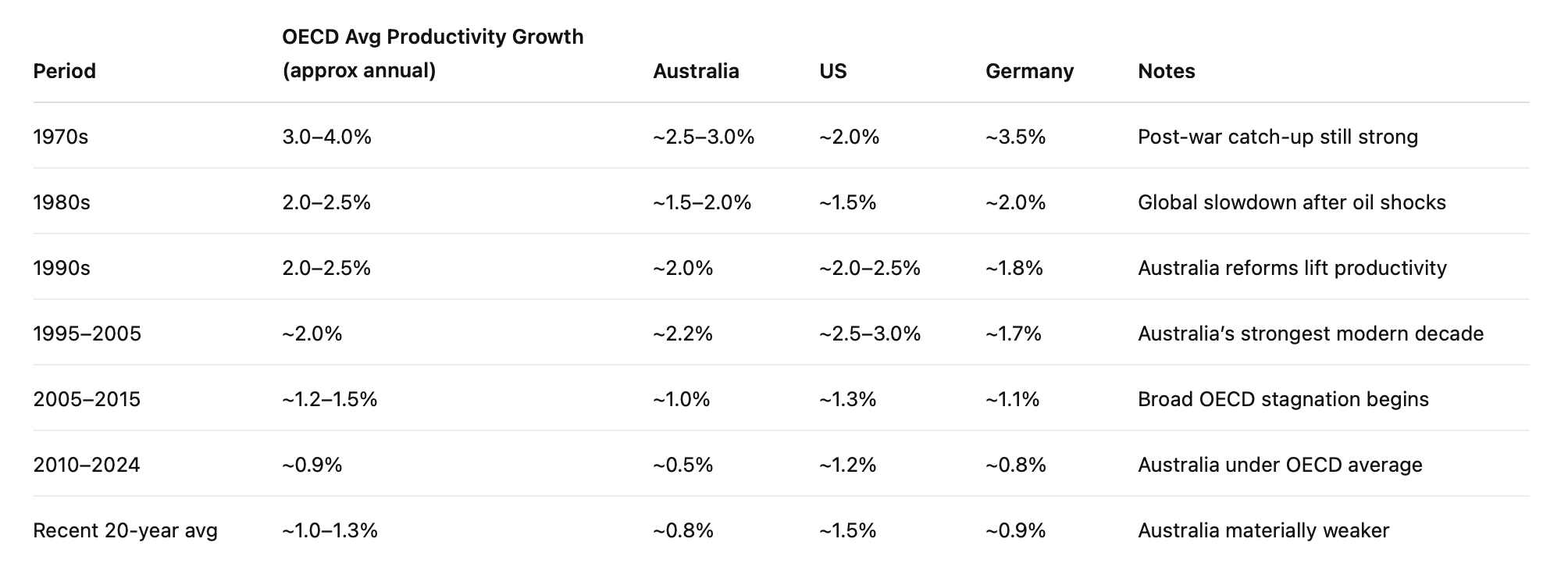
Speaking as an Australian, our productivity has been lagging[1] compared to the US, largely due to the availability of cheap labour (attributed by economists to foreign students)[2].

I heard one economist on the ABC give the example of carwashes[2]. From the 1990s to the early 2000s, car washes in Australia were largely automated and hand-wash car washes were relatively uncommon. However, the abundance of cheap labour has since led to a proliferation of hand-wash car washes.

1. https://files.littlebird.com.au/SCR-20260525-ietj.png

2. https://www.abc.net.au/listen/programs/abc-news-daily/the-pr...

Re: The four-day workweek in Australia: insights from early adopters of 100:80:100

#99

Speaking as an American, I don’t give a shit if it increases productivity or not. Productivity has gone up exponentially with technological advancement since the advent of the 5 day work week. We, as a species, should be minimizing work to 3 or 4 days a week with equal overall pay. Corporations should be fined heavily for contacting an employee after working hours. On call should require corporations to pay hefty ove…

That would be ok in a non-globalized world. In our world, any country that implements those laws will see a lot more offshoring.

So then all the productivity improvements are nothing more than boosting the hashrate of your crypto miner? You have to do it to not fall behind, but once everyone has done it, we all end up back in the same spot where we started?

Re: The four-day workweek in Australia: insights from early adopters of 100:80:100

#100
post #3

Papers like this should be called opinion surveys. Calling it a study is a disservice to science. As Feynman said, anything where they have to put science as a suffix is usually not science.

What a hollow dismissal of based on acrobatic leaps of semantics. The word 'study' is no sacred possession exclusive to the natural sciences, and there is nothing wrong with properly conducted surveys as a method in sociology, economics or psychology. If surveys targeting the very people responsible for optimising their businesses' productivity, with no incentive to falsify their conclusions, is good evidence. Withou…

I did read it, thus my comment. Did you actually read the methods? This is what you're defending:

"Methods This study took a qualitative approach, using semi-structured interviews with n=15 industry leaders" .. "Participants were identified via media reports " .. "A total of n=15 key informants participated in this study" .. "Recent research into appropriate sample sizes for qualitative research found saturation typically occurs between 9 and 17 interviews and the researchers agreed that no fresh insights or themes arose after the twelfth interview in this study (Hennink & Kaiser, 2022)"

The interviews contain invaluable insights such as: “adopting the 4DWW takes work” “Productivity up, waste removed” “Management -led/employee -driven,” “Train for leisure,”

I stand by my statement.

Post reply on HN