Live data from Hacker News

New stainless steel can survive conditions for hydrogen production in seawater

sciencedaily.com

91–100 of 153 posts

Re: New stainless steel can survive conditions for hydrogen production in seawater

#91
post #24

Earlier quoted context omitted.

> unless government policies mandate it or restrict batteries or blue hydrogen Yes, but I think this the most likely outcome. Natural gas is only cheap in certain areas, and the past few years have made everyone very, very aware of the geopolitics involved in getting hold of it. While global warming is not going away, and I question the extent to which CCS actually happens with blue hydrogen. Batteries are capital eq…

With CO2 emitting option is priced out or banned, direct hydrogen production using high temperature sulfur–iodine cycle without H2 electrolysers could be economic option. The heat could be supplied from high temperature nuclear reactor.

> With CO2 emitting option is priced out or banned

GP was talking about injecting the CO2 back into the well, not releasing it to the environment. There are even standards for specific injection wells used for long term storage (EPA Class VI).
Re: New stainless steel can survive conditions for hydrogen production in seawater

#92

> That is what makes the finding so striking. Manganese is usually not viewed as a friend of stainless steel corrosion resistance. In fact, the prevailing view has been that manganese weakens it. > "Initially, we did not believe it because the prevailing view is that Mn impairs the corrosion resistance of stainless steel. Mn-based passivation is a counter-intuitive discovery, which cannot be explained by current know…

> which cannot be explained by current knowledge in corrosion science The three stooges effect I see. Too many corrosive elements, they stop each other from getting through the door.

I was thinking of the Mr Burns sickness bit which references the stooges [1]

[1] https://www.youtube.com/watch?v=aI0euMFAWF8

Re: New stainless steel can survive conditions for hydrogen production in seawater

#93

This would be great for other use cases too like climbing bolts and anchors in coastal areas. Lots of areas are switching to titanium glue-ins which are expensive, but I wonder if this could enable more affordable option. A climber recently died in Greece after multiple bolts failed: https://gripped.com/news/rock-climber-dies-in-kalymnos-after...

Good point, not only is titanium expensive but the glue-in part is tricky to get right as the glue has to completely surround the bolt. Not only that, but early efforts at titanium rebolting sometimes didn’t use glue at all. In Thailand, I pulled out some titanium bolts with my fingers because they weren’t glued in.

Re: New stainless steel can survive conditions for hydrogen production in seawater

#94

This would be great for other use cases too like climbing bolts and anchors in coastal areas. Lots of areas are switching to titanium glue-ins which are expensive, but I wonder if this could enable more affordable option. A climber recently died in Greece after multiple bolts failed: https://gripped.com/news/rock-climber-dies-in-kalymnos-after...

3 10mm bolts failing simultaneously after two decades (on direct it seems) is unexpected! If it were an installation problem, I can’t imagine it would take that long and that they’d all go at the same time. Ditto for corrosion… people take victory whips all the time.

Re: New stainless steel can survive conditions for hydrogen production in seawater

#95
post #38

Earlier quoted context omitted.

How does this refute the comment you replied to? That comment was implying that Toyota Mirai et al are ill-advised, so seems like your "nope" should be a "yep."

Nope. It's important to always appear to be argumentative, even when in agreement.

Nope.

I've noticed this too, even when agreeing lots of comments start with a negative.

Re: New stainless steel can survive conditions for hydrogen production in seawater

#96
post #42

Earlier quoted context omitted.

>> Mn-based passivation is a counter-intuitive discovery, which cannot be explained by current knowledge in corrosion science. This statement sounds like the type of language one uses when trying to get a patent.

The part with "cannot be explained by current knowledge" is an exaggeration, because the abstract of the research article explains it very well, based on the current knowledge. However, "a counter-intuitive discovery" is true. Manganese is frequently used in stainless steels, but only as a cheap substitute for nickel, when this is considered as giving up the superior resistance to corrosion provided by nickel in exch…

A paper is hardly worth publishing if "cannot be explained by current knowledge" isn't true.

It is, however, incredibly tacky to talk about your research like this.

Re: New stainless steel can survive conditions for hydrogen production in seawater

#97

Earlier quoted context omitted.

Assuming we're talking about cars/trucks, one major reason hydrogen doesn't make sense is efficiency: https://cdn.motor1.com/images/mgl/OrLRA/s1/efficiency-compar... If we manage to get enough solar such that energy essentially becomes infinite then the inefficiency would no longer matter. Otherwise, it would only make sense in vehicles that require high energy density like airplanes.

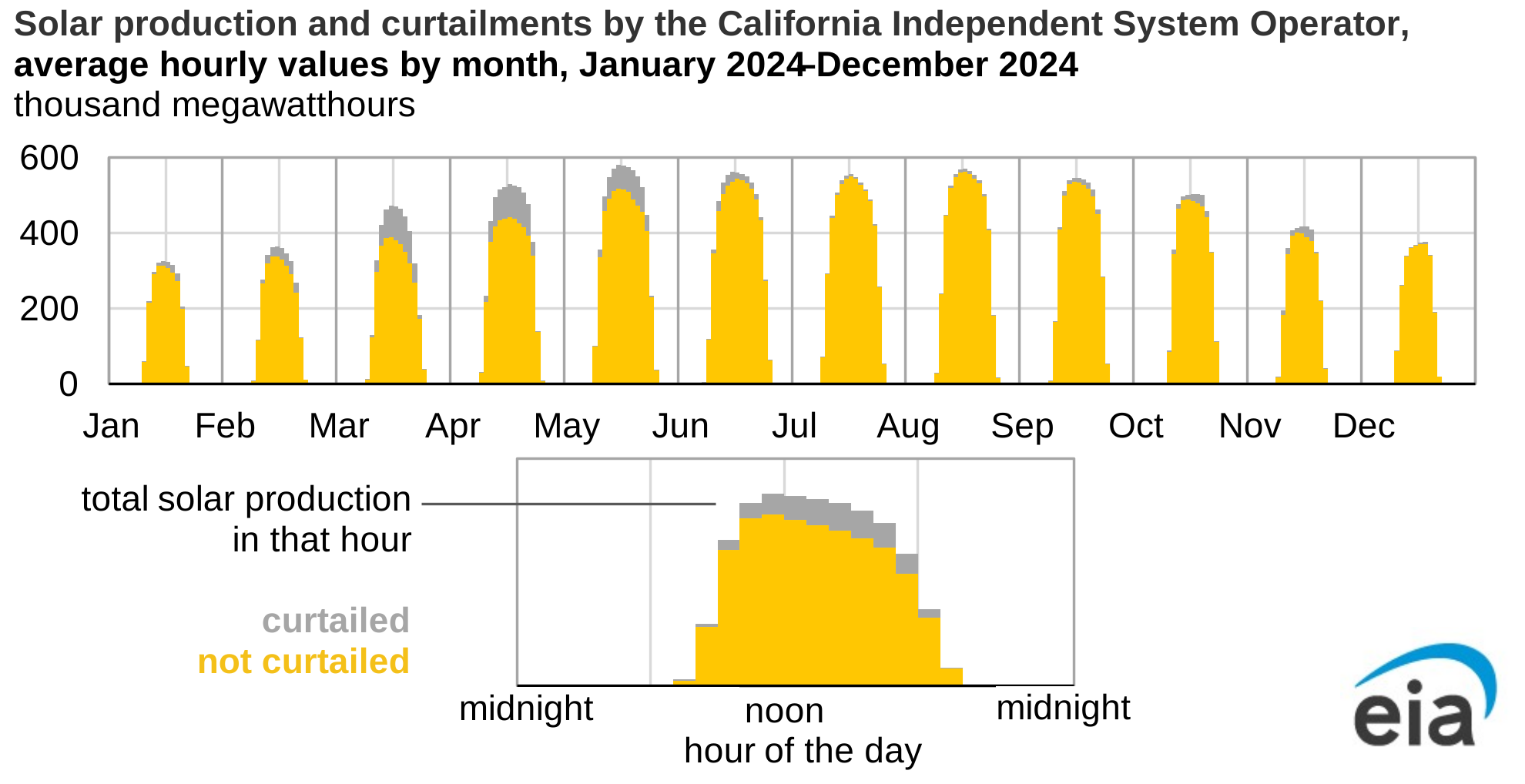
There is already free energy. In 2024, California curtailed 3400 GWh of solar. Hydrogen is one of the easier ways to load shift that to winter or processes which need something denser than batteries. I actually prefer synthetic methane (worse efficiency) because it is more immediately usable. https://www.eia.gov/todayinenergy/detail.php?id=65364

Looking at the charts[0], load shifting all the way to winter seems unnecessary. You only need to load shift until ~6pm, in which case there are plenty of better options out there like grid-scale batteries, flywheels, pumped storage hydro, etc.

[0] The 2nd chart on https://www.eia.gov/todayinenergy/images/2025.05.28/chart2.s...

Re: New stainless steel can survive conditions for hydrogen production in seawater

#98

> That is what makes the finding so striking. Manganese is usually not viewed as a friend of stainless steel corrosion resistance. In fact, the prevailing view has been that manganese weakens it. > "Initially, we did not believe it because the prevailing view is that Mn impairs the corrosion resistance of stainless steel. Mn-based passivation is a counter-intuitive discovery, which cannot be explained by current know…

Will be interesting to see if, in hindsight, there are clues to this in the preexisting literature that we just hadn't quite recognized.

This is one of the areas where AI will accelerate scientific research, by scanning through the journal archives to make connections that no one had noticed before.

Re: New stainless steel can survive conditions for hydrogen production in seawater

#99
post #38

Earlier quoted context omitted.

Nope. It's important to always appear to be argumentative, even when in agreement.

Nope. I've noticed this too, even when agreeing lots of comments start with a negative.

Not really.

Perhaps it's reflexive.

Re: New stainless steel can survive conditions for hydrogen production in seawater

#100

Earlier quoted context omitted.

The part with "cannot be explained by current knowledge" is an exaggeration, because the abstract of the research article explains it very well, based on the current knowledge. However, "a counter-intuitive discovery" is true. Manganese is frequently used in stainless steels, but only as a cheap substitute for nickel, when this is considered as giving up the superior resistance to corrosion provided by nickel in exch…

A paper is hardly worth publishing if "cannot be explained by current knowledge" isn't true. It is, however, incredibly tacky to talk about your research like this.

you should know how to spin it. Take Müller/Bednorz for example, their paper just said "_Possible_ high Tc superconductivity in the Ba−La−Cu−O system" and they got the Nobel Prize in Physics one year later
Post reply on HN