Live data from Hacker News

A 12,000-year-old obelisk with a human face was found in Karahan Tepe

trthaber.com

91–100 of 199 posts

Re: A 12,000-year-old obelisk with a human face was found in Karahan Tepe

#91
post #25

Earlier quoted context omitted.

I read this comment before clicking, and half expected it to be sarcasm exactly because of how common that is

[flagged]

That's clearly Turkish, which would make sense for an obelisk in an ancient site in Turkey, not Thailand

Re: A 12,000-year-old obelisk with a human face was found in Karahan Tepe

#92
post #71

Earlier quoted context omitted.

How are we so certain that they had no social hierarchy at all? I thought that that was the main theory but that very little is certain at this point.

mostly because all the bones of all the dead were mixed in with all the others. implying no concept of "this guy was THE guy in my lifetime". but they presumably still had a meritocracy because while the bones were mixed in with all others of all generations, not everyone would have their bones were mixed in upon death. it was likely only the craftsmen or shamans that achieved that honor. but being honored is differe…

I don't see why you couldn't have a highly hierarchical society that also has a "in death we're all the same" philosophy when it comes to burial.

Re: A 12,000-year-old obelisk with a human face was found in Karahan Tepe

#93

The Tepe sites are really fascinating. Every discovery leads to so many more questions - how did they construct these sites, what were they using some of the structures for, and so on. At Karahan Tepe is the pit full of pillars, with the human-face head on the outer rim .. whenever I see this pit, I get a picture in my mind that the entire site was green and fertile, and this pit was filled with water. It would be th…

The fact that there was a skeleton in one of the rectangular-ish holes made me think it was a burial ground, with the obelisk as the headstone. But I am not an archeologist so idk

Re: A 12,000-year-old obelisk with a human face was found in Karahan Tepe

#94
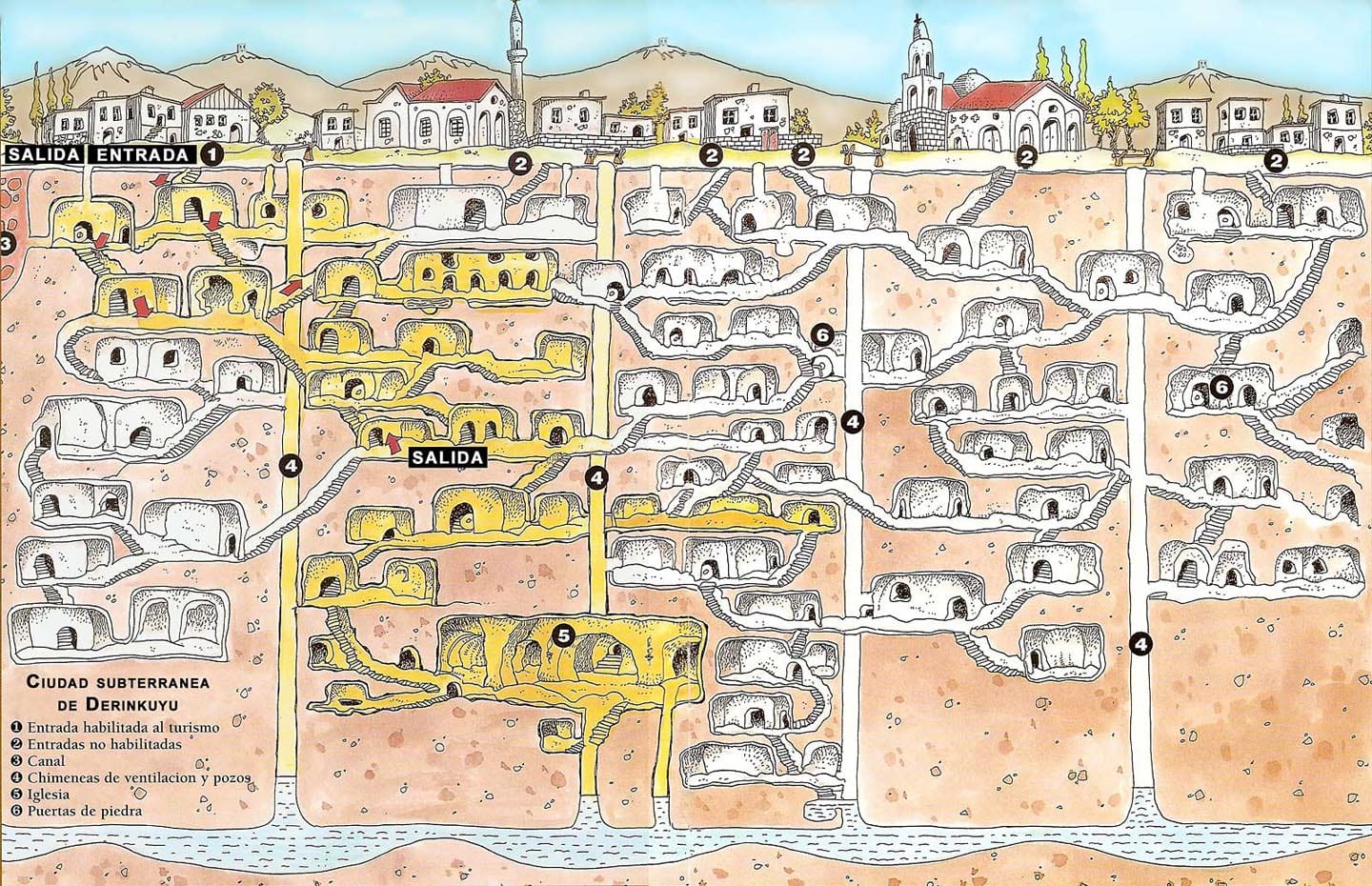
Don't take the following as an obnoxious distraction. I've not fully imbibed the featured article yet, but the entire area (region) is verily a bedlam of magnificence and wonder.

Those unfamiliar with Derinkuyu must change this hastily. Do your own research, but please see this image (pardon the url - I've been flagged for... browsing the Internet and can't access it directly):

https://external-content.duckduckgo.com/iu/?u=https%3A%2F%2F...

And an underground map here: https://www.lolaapp.com/wp-content/uploads/2024/09/derinkuyu...

There is/are video/s available and they are more than worth watching.

I can't remember how to spell the many other regional wonders, so won't try.

Edit: ignore anyone who comes along and tries to dismiss this particular example or the surrounding region as trivial, insignificant etc. Explore for yourself and be rewarded accordingly.

Re: A 12,000-year-old obelisk with a human face was found in Karahan Tepe

#95

Earlier quoted context omitted.

I got pretty into this alt archaeology stuff and eventually had to move away from it. I totally agree that the tepes challenge our timeline of when humans made cities and whatnot, but so much of their arguments is the perfect fit of stones or how flat stones are and saying it _must_ be done by modern tools. I think they have left out how much you can get done from a construction standpoint when you have forced labor…

just to nitpick: the Tepe sites definitely did not have forced labor. they had no social hierarchy at all. hunter-gatherers were fairly egalitarian. definitely sedentary neolithic people had forced labor. all the Sumerian legal texts that were some of the first writings ever included legal definitions of slaves, for example. but the pre-neolithic Anatolian people were nomadic animistic people with no social hierarchy…

Any sort of tribal situation would result in forced labor, and cultures would have formalized notions of slavery, indentured service, arbitrary terms based on religious or traditional ideas. The tradeoff of survival for forced labor is an economic plight that happens frequently throughout history. Chattel slavery is inherently degrading, but it has ranged from ritualistic and formal to downright horrifically malicious - the idea that hunter gatherers were egalitarian and peaceful is basically the whole "noble savage" trope.

The truth is, we don't have much but speculation and narrative about the people of Gobekle Tepe, and even assumptions about them being hunter gatherers at all are based on centuries of bias and assumptions, with a whole lot of cultural chauvinism and religious nuttery baked in for good measure.

We're going to have to start analyzing humans more skeptically and rationally, as opposed to taking most of the modern historical narratives as gospel.

Modern humans have existed genetically for 300k+ years. At one point about a million years ago, the Early Pleistocene bottleneck had the population of human ancestors under 2000 individuals. 700k years later, the first modern humans were born, and the first situations in which we had the opportunity to establish culture.

We know from the great north american megafauna die off, climate records, and archaelogical evidence that something happened around 13k years ago to basically reset whatever human civilization there was. It took around 3000 years before the "neolithic revolution" , cultures demonstrating mastery of stone tools, pottery, more sedentary lifestyles, specialization, and so forth. It took another 4,000 years to reach the point where we had started creating written records again, started creating monuments and technology sufficiently durable to last to modern days, and then so on and so forth, with relatively uninterrupted and steady progress to the present day, each culture and age building upon the previous.

I think it's silly to think that it's only in this last 12-13,000 year period that we reached any of the cultural and technological milestones, and that every culture previous to that must have been hunter gatherer, because hunter gatherer are the default "feral human" prototype culture.

We bred dogs from wolves successfully around 45k years ago. That would have taken a generation or two in a nomadic context, or one really spectacular single lifetime for a sedentary person. Even so, you think that for the 250k years prior to that, not a single culture developed writing, wheels, pumps, discovered metal forming, or other technologies?

The human population was scarce, and because of that scarcity, the majority stayed in the absolute best, premium locations - beachfront. A vast proportion of settlements would now be well off the coast, and we have indeed discovered artifacts and evidence of such in various places where researchers have looked.

I'd be willing to bet good money that over the last 300k years there are many 10,000 year cycles and catastrophes where civilizations have risen and fallen, many achieving high levels of technology, perhaps even discovering electricity, advanced chemistry, medicine, and so on, but due to catastrophes, small populations, they got reset back to baseline. I'd bet that it didn't happen 30 times, as often as possible during the course of events, but I'll also make the claim that our current peak of civilization isn't the only good run that human race has ever made.

We are probably the only ones that made it to mass production, definitely the only ones that succeeded in scaling up resource extraction to the levels we saw back in the 1800s. I think there are probably caches of artifacts, evidence left out offshore that technology will make visible to us, that will show a much richer tapestry of events and cultures and history than the somewhat limited and biased narrative that modern historians have put forth as definitive.

Re: A 12,000-year-old obelisk with a human face was found in Karahan Tepe

#97

Earlier quoted context omitted.

I got pretty into this alt archaeology stuff and eventually had to move away from it. I totally agree that the tepes challenge our timeline of when humans made cities and whatnot, but so much of their arguments is the perfect fit of stones or how flat stones are and saying it _must_ be done by modern tools. I think they have left out how much you can get done from a construction standpoint when you have forced labor…

I also feel that people then were about as smart as we are now, so they could have solved problems in inventive ways they way we do now. Just because they didn’t have an electric stone flattener, it doesn’t mean that stones cannot be made flat in a fairly repeatable way.

And there were no video games, which I think is a huge source of brain-drain these days. I read somewhere once that people played more solitaire on Windows 95 per year than it took in man-hours to send people to the moon (something like that, I don't remember the original statistic). And that's just a shitty game on an old OS.

Re: A 12,000-year-old obelisk with a human face was found in Karahan Tepe

#98
post #70

Earlier quoted context omitted.

We find similarly old structures across Eurasia, like the epigravettian mammoth bone huts. The late PPNA when KT/GT were seemingly built is when we find the first monumental, stone structures that we know of. It's entirely possible that ancient near east is where these kinds of things were first built. There's reasons I can go into why that's thought to be the case, but we can't rule out that there could be a streetl…

To what extent is our understanding of this period limited by survivorship? Granite doesn't weather significantly, so we see lots of metalithic stone structures with ambiguous dating. The near east had significant changes in inland climates so we find ancient cities that were not built over there. Soft rock/mud Brick structures can survive in dry climates - so we see evidence of the oldest civilizations in deserts. C…

> Colonial New England barely exists outside of active preservation attempts.

As someone who grew up there, this isn't really true. It's more that buildings have been upgraded/replaced over time by choice, resulting in a sparse patchwork of old buildings rather than large old cities. Places like the Wayside Inn[0] predate the country by a century, and have been "preserved" only because they have more-or-less continuously operating as an in since 1686.

The New England climate isn't all that different than the original England. I think the cultural and legal climate around old buildings is more impactful here. I would be curious to know about the comparative longevity of 17th-century wooden buildings in Europe.

[0] https://en.wikipedia.org/wiki/The_Wayside_Inn_%28Sudbury%29

Re: A 12,000-year-old obelisk with a human face was found in Karahan Tepe

#99

Earlier quoted context omitted.

I got pretty into this alt archaeology stuff and eventually had to move away from it. I totally agree that the tepes challenge our timeline of when humans made cities and whatnot, but so much of their arguments is the perfect fit of stones or how flat stones are and saying it _must_ be done by modern tools. I think they have left out how much you can get done from a construction standpoint when you have forced labor…

The Crystal Palace was built and designed in 11 months, 1850-1851. I'm not sure what the key factors making this possible were, but I suspect low wages and complete disregard for worker safety figured.

Sure that's part of it. A lot of the delays in modern construction are due to labor cost optimization and supplier delays. A lot of the time parts of construction sites are idle because some specialized group of skilled workers is at another site or they're waiting for a delivery.

I saw a video where as a stunt a residential construction crew went from a vacant lot to a complete single-family house ready to occupy in less than two days. And that wasn't a prefab house, it was a regular wooden frame suburban house built using all the usual construction methods. They did it by staging all the materials right there and having all of the carpenters, roofers, painters, electricians, plumbers, etc standing around ready to jump in as soon as they were needed. Granted that was a small project, but the point is that with a sense of urgency construction can proceed quickly, and it doesn't require sacrificing worker safety.

Re: A 12,000-year-old obelisk with a human face was found in Karahan Tepe

#100

Earlier quoted context omitted.

just to nitpick: the Tepe sites definitely did not have forced labor. they had no social hierarchy at all. hunter-gatherers were fairly egalitarian. definitely sedentary neolithic people had forced labor. all the Sumerian legal texts that were some of the first writings ever included legal definitions of slaves, for example. but the pre-neolithic Anatolian people were nomadic animistic people with no social hierarchy…

Any sort of tribal situation would result in forced labor, and cultures would have formalized notions of slavery, indentured service, arbitrary terms based on religious or traditional ideas. The tradeoff of survival for forced labor is an economic plight that happens frequently throughout history. Chattel slavery is inherently degrading, but it has ranged from ritualistic and formal to downright horrifically maliciou…

    and even assumptions about them being hunter gatherers at all are based on centuries of bias and assumptions, with a whole lot of cultural chauvinism and religious nuttery baked in for good measure.
It's based on the fact that we don't observe the morphological changes in plant matter we call "domestication" until the PPNB, after the earliest layers of Gobekli Tepe. Moreover, they have a lot of similarities with other ANE foragers, and there's a distinct lack of both water sources and residential structures suitable for sedentary agriculturalists. Plus, pollen samples from the Harran plain indicate widespread mixed deciduous grasslands during that period, with very low levels of the plants that would later become dominant during the agricultural revolution.

Archaeologists are much better about recognizing the complexity of forager lifeways than they were 50 years ago.

Post reply on HN