This reminds me of keeping up with all the latest JavaScript framework trivia circa the ~2010s
OpenAI o3 and o4-mini
91–100 of 527 posts
Re: OpenAI o3 and o4-mini
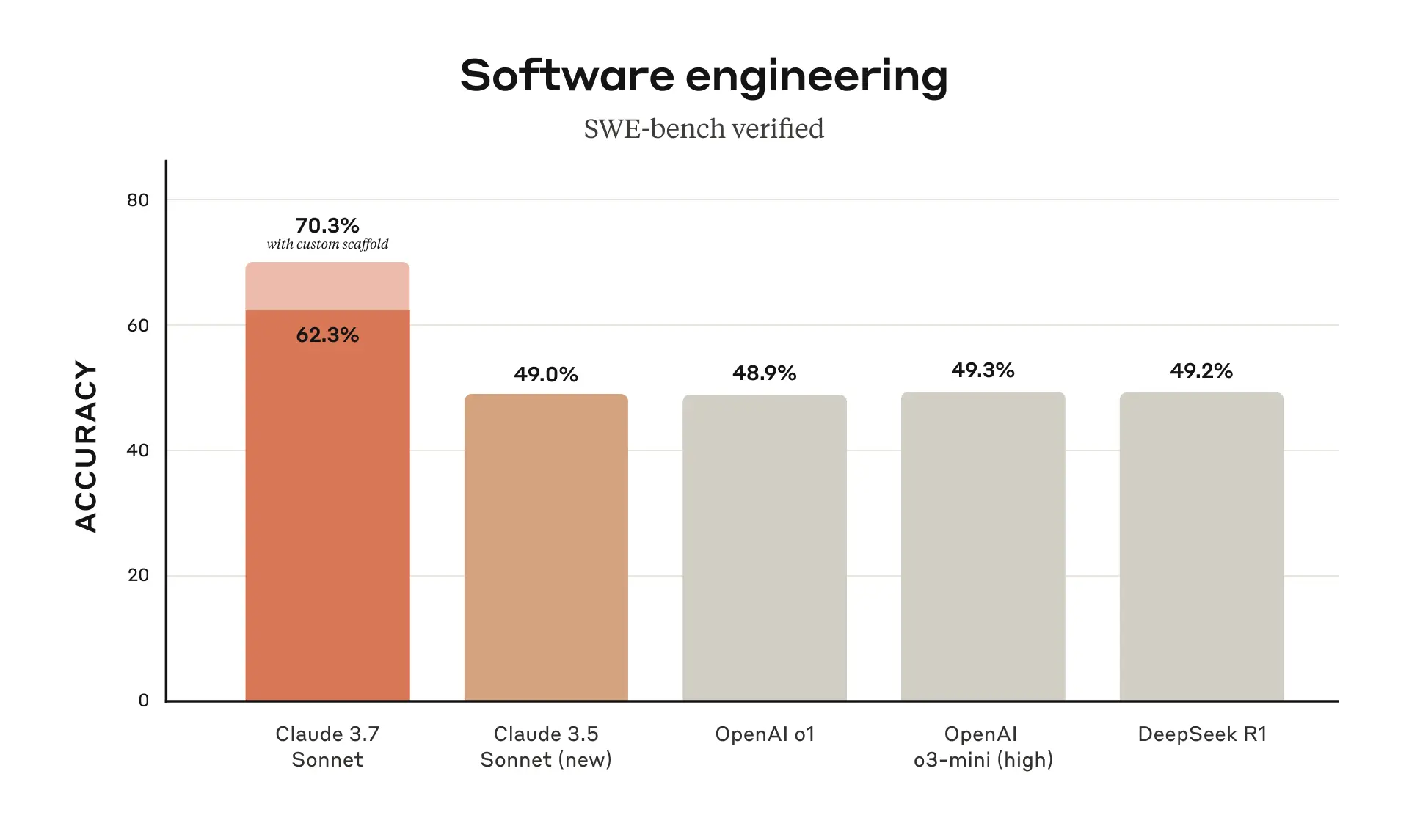
#92Very impressive! But under arguably the most important benchmark -- SWE-bench verified for real-world coding tasks -- Claude 3.7 still remains the champion.[1] Incredible how resilient Claude models have been for best-in-coding class. [1] But by only about 1%, and inclusive of Claude's "custom scaffold" augmentation (which in practice I assume almost no one uses?). The new OpenAI models might still be effectively bes…
Claude got 63.2% according to the swebench.com leaderboard (listed as "Tools + Claude 3.7 Sonnet (2025-02-24)).[0] OpenAI said they got 69.1% in their blog post. [0] swebench.com/#verified
OpenAI have not shown themselves to be trustworthy, I'd take their claims with a few solar masses of salt
Re: OpenAI o3 and o4-mini
#93Very impressive! But under arguably the most important benchmark -- SWE-bench verified for real-world coding tasks -- Claude 3.7 still remains the champion.[1] Incredible how resilient Claude models have been for best-in-coding class. [1] But by only about 1%, and inclusive of Claude's "custom scaffold" augmentation (which in practice I assume almost no one uses?). The new OpenAI models might still be effectively bes…
I haven't been following them that closely, but are people finding these benchmarks relevant? It seems like these companies could just tune their models to do well on particular benchmarks
Re: OpenAI o3 and o4-mini
#94Very impressive! But under arguably the most important benchmark -- SWE-bench verified for real-world coding tasks -- Claude 3.7 still remains the champion.[1] Incredible how resilient Claude models have been for best-in-coding class. [1] But by only about 1%, and inclusive of Claude's "custom scaffold" augmentation (which in practice I assume almost no one uses?). The new OpenAI models might still be effectively bes…
Claude got 63.2% according to the swebench.com leaderboard (listed as "Tools + Claude 3.7 Sonnet (2025-02-24)).[0] OpenAI said they got 69.1% in their blog post. [0] swebench.com/#verified
Yes, however Claude advertised 70.3%[1] on SWE bench verified when using the following scaffolding:
> For Claude 3.7 Sonnet and Claude 3.5 Sonnet (new), we use a much simpler approach with minimal scaffolding, where the model decides which commands to run and files to edit in a single session. Our main “no extended thinking” pass@1 result simply equips the model with the two tools described here—a bash tool, and a file editing tool that operates via string replacements—as well as the “planning tool” mentioned above in our TAU-bench results.
Arguably this shouldn't be counted though?
[1] https://www.anthropic.com/_next/image?url=https%3A%2F%2Fwww-...
Re: OpenAI o3 and o4-mini
#95So it looks like no increase in context window size since it’s not mentioned anywhere.
I assume this announcement is all 256k, while the base model 4.1 just shot up this week to a million.
Re: OpenAI o3 and o4-mini
#96The user experience needs to be massively improved when it comes to model choice. How are average users supposed to know which model to pick? Why shouldn't I just always pick the newest or most powerful one? Why should I have to choose at all? I say this from the perspective of a ChatGPT user - I understand the different pricing on the API side helps people make decisions.
Re: OpenAI o3 and o4-mini
#97As a consumer, it is so exhausting keeping up with what model I should or can be using for the task I want to accomplish.
As another consumer, I think you're overreacting, it's not that bad.
Re: OpenAI o3 and o4-mini
#98Earlier quoted context omitted.
Gemini 2.5 Pro is widely considered superior to 3.7 Sonnet now by heavy users, but they don't have an SWE-bench score. Shows that looking at one such benchmark isn't very telling. Main advantage over Sonnet being that it's better at using a large amount of context, which is enormously helpful during coding tasks. Sonnet is still an incredibly impressive model as it held the crown for 6 months, which may as well be a…
Main advantage over Sonnet is Gemini 2.5 doesn't try to make a bunch of unrelated changes like it's rewriting my project from scratch.
I find Gemini 2.5 truly remarkable and overall better than Claude, which I was a big fan of
Re: OpenAI o3 and o4-mini
#99A suggestion for OpenAI to create more meaningful model names: {Size}-{Quarter/Year}-{Speed/Accuracy}-{Specialty} Where: * Size is XS/S/M/L/XL/XXL to indicate overall capability level * Quarter/Year like Q2-25 * Speed/Accuracy indicated as Fast/Balanced/Precise * Optional specialty tag like Code/Vision/Science/etc Example model names: * L-Q2-25-Fast-Code (Large model from Q2 2025, optimized for speed, specializes in…
This is even more incomprehensible to users who don't understand what this naming scheme is supposed to mean. Right now, most power users are keeping track of all the models and know what they are like, so this naming wouldn't help them. Normal consumers don't really know the difference between the models, but this wouldn't help them either - all those letters and numbers aren't super inviting and friendly. They could try just having a linear slider for amount of intelligence and another one for speed.
Re: OpenAI o3 and o4-mini
#100So at this point OpenAI has 6 reasoning models, 4 flagship chat models, and 7 cost optimized models. So that's 17 models in total and that's not even counting their older models and more specialized ones. Compare this with Anthropic that has 7 models in total and 2 main ones that they promote. This is just getting to be a bit much, seems like they are trying to cover for the fact that they haven't actually done much.…
"haven't actually done much" being popularizing the chat llm and absolutely dwarfing the competition in paid usage
I guess it was related to the last period, rather than the full picture