Earlier quoted context omitted.
You really can't think about single wavelength tunable pixels as something except at the edge HSL. I think about it from the CIE "triangle" where wavelength traces the outer edge, or even the Lab (Luminance a-green/red b-yellow/blue) color space since it's more uniform in perceivable SDR color difference (dE). https://luminusdevices.zendesk.com/hc/article_attachments/44... One key realization is that although 1 sub-p…
Good point, the HSL edge includes magenta which is of course not a wavelength.
Polychromatic Pixels
91–100 of 149 posts
Re: Polychromatic Pixels
#92Re: Polychromatic Pixels
#93A single wavelength can't reproduce all visible colors. These pixels are variable wavelength, but can only produce one at a time, so you'd still need at least 2 of these pixels to reproduce any visible color. The fundamental problem is that color space is 2D[1] (color + brightness is 3D, hence 3 subpixel on traditional displays), but monochromatic light has only 1 dimension to vary for color. [1]: https://en.wikipedi…
Re: Polychromatic Pixels
#94Earlier quoted context omitted.
Color data has three components for the simple reason that the human eye has three different color receptors. You can change the coordinate system of that color space, but three components will remain the most parsimonious representation.
I started working with a hyperspectral imager a while back and the idea of storing image data in 3 wide bands seems so odd to me now. Just the fact that my HSI captures 25 distinct 4nm bands inside a single 100nm band of what we are used to with a 3-band image is awesome. Sorry, I get excited every time I work with hyperspec stuff now and love talking about it to anyone that will listen.
Color is widely taught down to K-2, but content and outcomes are poor. So I was exploring how one might better teach color, with an emphasis on spectra. Using multispectral/hyperspectral images of everyday life, objects, and art, seemed an obvious opportunity. Mousing over images like[1] for example, showing spectra vaguely like[2]. But I found very few (non-terrain) images that were explicitly open-licensed for reuse. It seemed the usual issue - there's so much nice stuff out there, living only on people's disks, for perceived lack of interest in it. So FWIW, I note I would have been delighted to find someone had made such images available. Happy to chat about the area.
[1] http://www.ok.sc.e.titech.ac.jp/res/MSI/MSIdata31.html [2] https://imgur.com/a/teaching-color-using-spectra-zOtxQwe
Re: Polychromatic Pixels
#95A single wavelength can't reproduce all visible colors. These pixels are variable wavelength, but can only produce one at a time, so you'd still need at least 2 of these pixels to reproduce any visible color. The fundamental problem is that color space is 2D[1] (color + brightness is 3D, hence 3 subpixel on traditional displays), but monochromatic light has only 1 dimension to vary for color. [1]: https://en.wikipedi…
> These pixels are variable wavelength, but can only produce one at a time Citation needed. The article doesn't say anything about how the colors are generated, and whether they can only produce one wavelength at a time. Assuming they are indeed restricted to spectral colors, dithering could be used to increase the number of colors further. However, dithering needs at least 8 colors to cover the entire color space: r…
Re: Polychromatic Pixels
#96These still produce a single [adjustable] wavelength, which means some colors that are displayable on displays of today are not representable using just one of these, and multiples will be required.
If the refresh rate is high enough, a single LED could flip between multiple wavelengths to dither to non spectral colors.
Re: Polychromatic Pixels
#97A single wavelength can't reproduce all visible colors. These pixels are variable wavelength, but can only produce one at a time, so you'd still need at least 2 of these pixels to reproduce any visible color. The fundamental problem is that color space is 2D[1] (color + brightness is 3D, hence 3 subpixel on traditional displays), but monochromatic light has only 1 dimension to vary for color. [1]: https://en.wikipedi…
> color space is 2D Human eyes have three different color receptors, each tuned for it's own frequency, so it's already 3d. However, apart from human perception, color, just like sound, can have any combinations of frequencies (when you split the signal with Fourier transform), and may animals do have more receptors than us.
We can distinguish the combination a huge number of frequencies between 20-20000Hz.
But we can only distinguish 3 independent colors of light.
Of course our vision is vastly better than hearing for determining where the sound/light comes from.
Re: Polychromatic Pixels
#98Earlier quoted context omitted.
> These pixels are variable wavelength, but can only produce one at a time Citation needed. The article doesn't say anything about how the colors are generated, and whether they can only produce one wavelength at a time. Assuming they are indeed restricted to spectral colors, dithering could be used to increase the number of colors further. However, dithering needs at least 8 colors to cover the entire color space: r…
Dithering just black, red, green, and blue is sufficient to produce a full-colour image. Everything else is a combination of those. That's effectively how normal LCD or OLED monitors work!
You can check this by trying to dither a full color image in a program like Photoshop. It doesn't work unless you use at least the 8 colors.
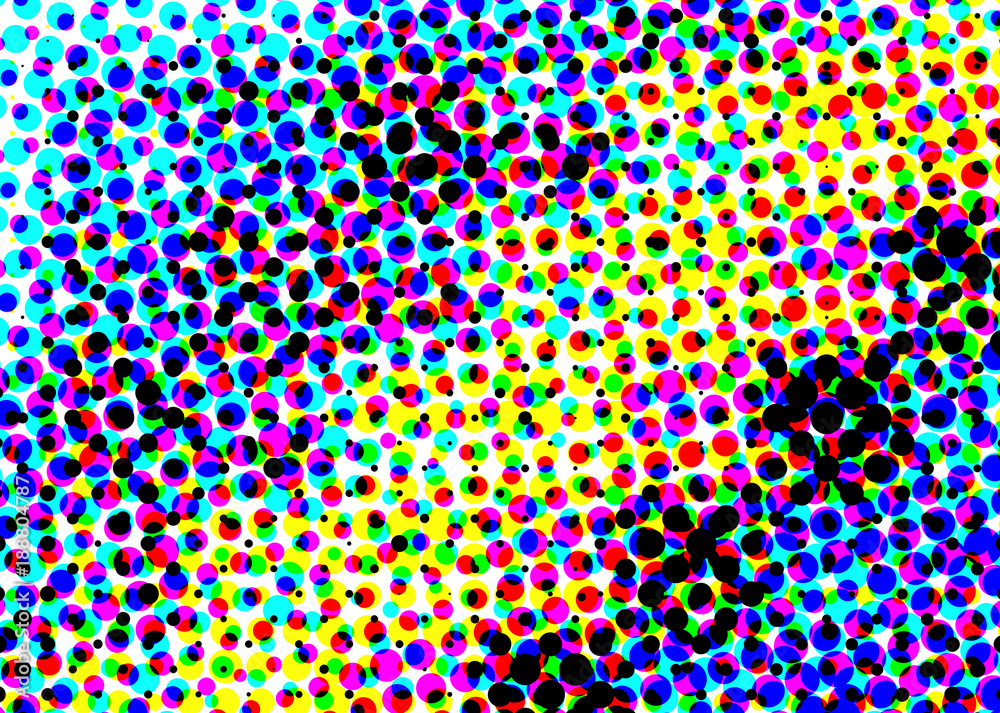
In fact, ink jet printers do something similar: They use subtractive color mixing to create red, green and blue dots (in addition to cyan, magenta, yellow and black ink and white paper), then all the remaining shades are dithered from those eight colors. It looks something like that: https://as2.ftcdn.net/v2/jpg/01/88/80/47/1000_F_188804787_u1... (though there black is also created with subtractive color mixing).
The color mixing type used by dithering is sometimes called "color blending". Apart from dithering it's also used when simulating partial transparency (alpha).
Re: Polychromatic Pixels
#99Earlier quoted context omitted.
Dithering just black, red, green, and blue is sufficient to produce a full-colour image. Everything else is a combination of those. That's effectively how normal LCD or OLED monitors work!
No, normal monitors use additive color mixing, but dithering isn't additive, it's averaging. With just red, green, blue, black you couldn't dither cyan, magenta, yellow, white, just some much darker versions of them. E.g. you get grey instead of white. You can check this by trying to dither a full color image in a program like Photoshop. It doesn't work unless you use at least the 8 colors. In fact, ink jet printers…
Re: Polychromatic Pixels
#100A single wavelength can't reproduce all visible colors. These pixels are variable wavelength, but can only produce one at a time, so you'd still need at least 2 of these pixels to reproduce any visible color. The fundamental problem is that color space is 2D[1] (color + brightness is 3D, hence 3 subpixel on traditional displays), but monochromatic light has only 1 dimension to vary for color. [1]: https://en.wikipedi…
This is definitely a problem; if the control circuitry is up for it you could PWM the pixel color, basically dithering in time instead of space to achieve white or arbitrary non-spectral colors.