Live data from Hacker News

Managing State with Signals

tonsky.me

91–100 of 126 posts

Re: Managing State with Signals

#91

Not sure I like the mixed push/pull approach. If you're already traversing the tree to mark nodes as possibly dirty, you might as well recompute the node's value and store it while you're there. Otherwise on pull/lazy update, you're traversing the tree all over again! Terrible for cache locality, particularly for large graphs. You might be tempted to say that the lazy approach might avoid some recomputations, but if…

Can one not just note the timestamp of last change with a monotonic clock. Then, dependencies check the timestamp of last computation, and pessimistically determine if recomputation is needed.

Seems like the trouble here is you'll have to traverse the tree every time to check timestamps but if the dependency is dirty that needs to happen anyway.
Re: Managing State with Signals

#92
post #88

The author does a lovely job of covering a number of the interesting ideas in this space. But reactive programming is such a tough sell. I know from experience. I maintain a reactive, state management library that overlaps many of the same ideas discussed in this blog post. https://github.com/yahoo/bgjs There are two things I know to be true: 1. Our library does an amazing job of addressing the difficulties that come…

Curious as to choice of 'demands' vs 'dependency' and 'supplies' vs 'provider'. The latter of these are fairly commonly understood and used.

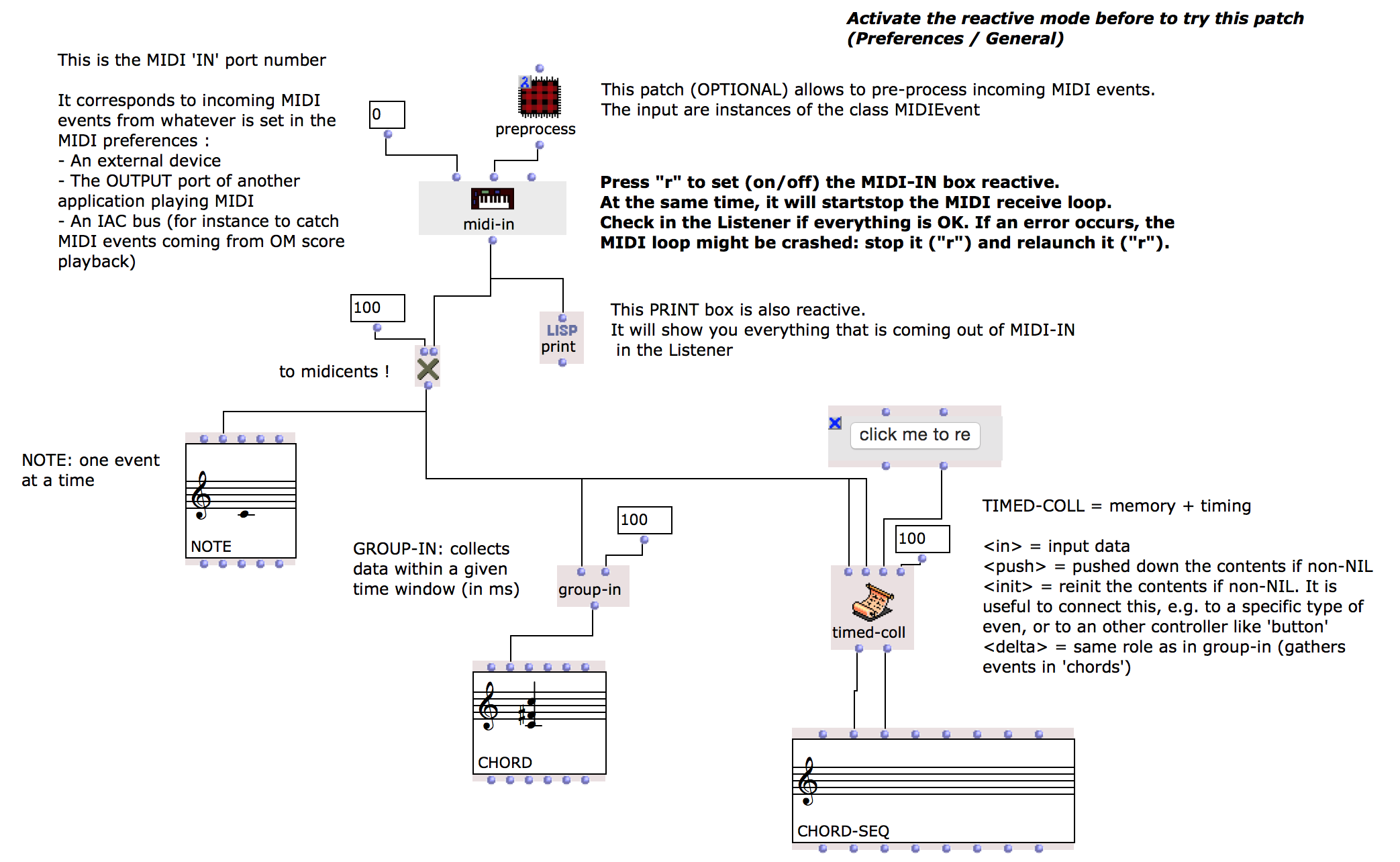
As an aside, "complex, interdependent state" is possibly one of the few areas that lend themselves naturally to visual programming (which is a fail in the general programming case). Why not just draw graphs?

> I've read plenty of reactive blog posts and reactive library documentation sets and they all struggle with communicating the benefits.

I just googled 'visual programming for reactive systems' and this (interesting project) turned up:

https://openmusic-project.github.io/openmusic/doc/reactive.h...

So the approach is specifically addressing complex interaction patterns between components. To highlight the solution, just do what these guys did: here you can see the benefit of 'reactive components' just by looking.

https://openmusic-project.github.io/openmusic/doc/images/mid...

(2c - good luck w/ the project)

Re: Managing State with Signals

#93

Not sure I like the mixed push/pull approach. If you're already traversing the tree to mark nodes as possibly dirty, you might as well recompute the node's value and store it while you're there. Otherwise on pull/lazy update, you're traversing the tree all over again! Terrible for cache locality, particularly for large graphs. You might be tempted to say that the lazy approach might avoid some recomputations, but if…

Can one not just note the timestamp of last change with a monotonic clock. Then, dependencies check the timestamp of last computation, and pessimistically determine if recomputation is needed. Seems like the trouble here is you'll have to traverse the tree every time to check timestamps but if the dependency is dirty that needs to happen anyway.

That's effectively a pull-based system, which works fine but is inefficient. With a binary dependency tree of depth N, you have to touch 2^N nodes in such a pull-based system every time you evaluate it, no matter how many nodes you may have updated.

If you only updated 1 node, a push-based system will only update nodes that have changed, which will be considerably less (likely linear in depth). For instance, consider:

    var evenSeconds = clock.Seconds.Where(x => x % 2 == 0);
    var countEvents = evenSeconds.Count();
    var minutes = clock.Seconds.Count(x => x / 60);
    var hours = minutes.Count(x => x / 60);
Even though evenSeconds and countEvents is only updated every other second, and minutes once every 60 seconds, your pull-based approach will have to check all nodes up to the root every time clock.Seconds changes.

In a push-based system, clock.Seconds would trigger seconds+1. If that's not even, propagation stops there, if it is even then this updates evenSeconds, which would then trigger an update for countEvents. Ditto logic for minutes and hours.

You can see the push-based system permits minimal state changes via early termination if downstream dependents won't see any changes.

Re: Managing State with Signals

#94
post #69

Earlier quoted context omitted.

Thanks for this thoughtful and insightful comment. Many problems can be workflow problems, sometimes even pulling in a rule engine, or require a job queue to do things that can fail. Then you have software such as https://temporal.io/ which is really powerful for resilient workflows. Imagine coordinating the user with a workflow with asynchronous data collection steps. Imagine programming "reaction to user behaviour…

I often wonder about some sort of unified distributed system, encompassing frontend & backend into a single whole. One where user input is just something the system can ask and wait for, no matter which frontend or client it comes from. But I’ve only ever been able to catch glimpses of it. More of a nebulous feeling and intuition than a real understanding of how such a thing would work. Something that feels obviously…

https://github.com/hyperfiddle/electric ?

Re: Managing State with Signals

#96
post #65

Interesting that this is Clojure and it doesn't mention Hoplon/Javelin[0] as prior work. I've used Hoplon/UI[1] to implement a moderately complex web app ~6 years ago. The library is practically a prototype, pretty much dead by now. However, I found the ideas interesting. I find the biggest benefit of using a fringe library like this is the ability to read and understand the whole implementation. It's really simple c…

Well, it’s mentioned in a sense that “Reactive UIs never became mainstream” :( Would be interesting to understand why

Re: Managing State with Signals

#98

The observable syntax is confusing. Lisp uses *earmuffs* syntax for global variables, if you only use one muff for an observable variable, how would you express a global variable that's observable? Using **lopsided muffs*?

Clojure only uses earmuffs for dynamic vars

Re: Managing State with Signals

#99
post #58

Earlier quoted context omitted.

Mathematically, RxJS and Vue/Solid Qwik like FRP are equivalent. There is interesting proof by Meijer (who invented Rx) in the famous "duality and the end of reactive". https://www.youtube.com/watch?v=SVYGmGYXLpY

> Mathematically, RxJS and Vue/Solid Qwik like FRP are equivalent. Yes, these are basically the same thing. However, they have little to do with Conal Elliott's "FRP". Which itself is also badly named. > Meijer (who invented Rx) Well "invented". What's a bit surprising is that with both Rx and the Rx-style "FRP", there either is no public history of the ideas at all (Rx) or it is patently wrong (Rx-style "FRP"). Or a…

I think the important contribution of Meijer and RX is realizing the duality of IEnumerable and IObservable which enabled them to use the same programming constructs. The meat of RX is in all the combinators so you can express complex behaviours very succinctly.

Re: Managing State with Signals

#100
post #23

Earlier quoted context omitted.

Thanks for this thoughtful and insightful comment. Many problems can be workflow problems, sometimes even pulling in a rule engine, or require a job queue to do things that can fail. Then you have software such as https://temporal.io/ which is really powerful for resilient workflows. Imagine coordinating the user with a workflow with asynchronous data collection steps. Imagine programming "reaction to user behaviour…

Thanks for the compliment. Since you seem to like it, i’ll emphasis a little as to how i came to realize that : It’s very common that workflows are suited for data manipulation: write the data to disk, when it’s complete send it to the network, then once it’s completed, etc. I/O are known to be asynchronous, so we’re already equiped for that. What i noticed is that the screen of your app is also a source of asynchron…

> the screen of your app is also a source of asynchrony

Exactly!

That’s why wrapping a “dialog” or “form” or “screen” into a Promise is such a powerful technique. When the user closes the dialog, the promise resolves with a result (e.g. whether the user clicked OK or Cancel), which then you can use for whatever else needs to be done, including invoking another dialog/form/screen!

This makes UI composable, and with async/await “hiding” the promise continuations, the syntax for doing that is essentially the same as when composing ordinary functions.

Post reply on HN