Live data from Hacker News

What the Great Inflation (1965-1982) taught us

imgracehuang.medium.com

91–100 of 125 posts

Re: What the Great Inflation (1965-1982) taught us

#91

Earlier quoted context omitted.

Agreed. Also misses the global effect of the Arab oil embargo over US support for Israel in the 1973 war, which was amplified further by the rise of OPEC and the concommitant rise in international oil prices. This in turn caused a balance-of-payments problem, which in turn led to petrodollar recycling and the military-economic alliance between Gulf Arab states and the USA (and also, though this is largely forgotten,…

full employment surely can't help, if consumer prices going up is caused by too much demand and too little supply.

As I note elsewhere, the U.S. unemployment rate dropped from 10.8% in 1982 (3.8% inflation) to 6.6% in 1986 (1.1% inflation).. so, inflation plunged while employment boomed... doesn't that completely upset that argument?

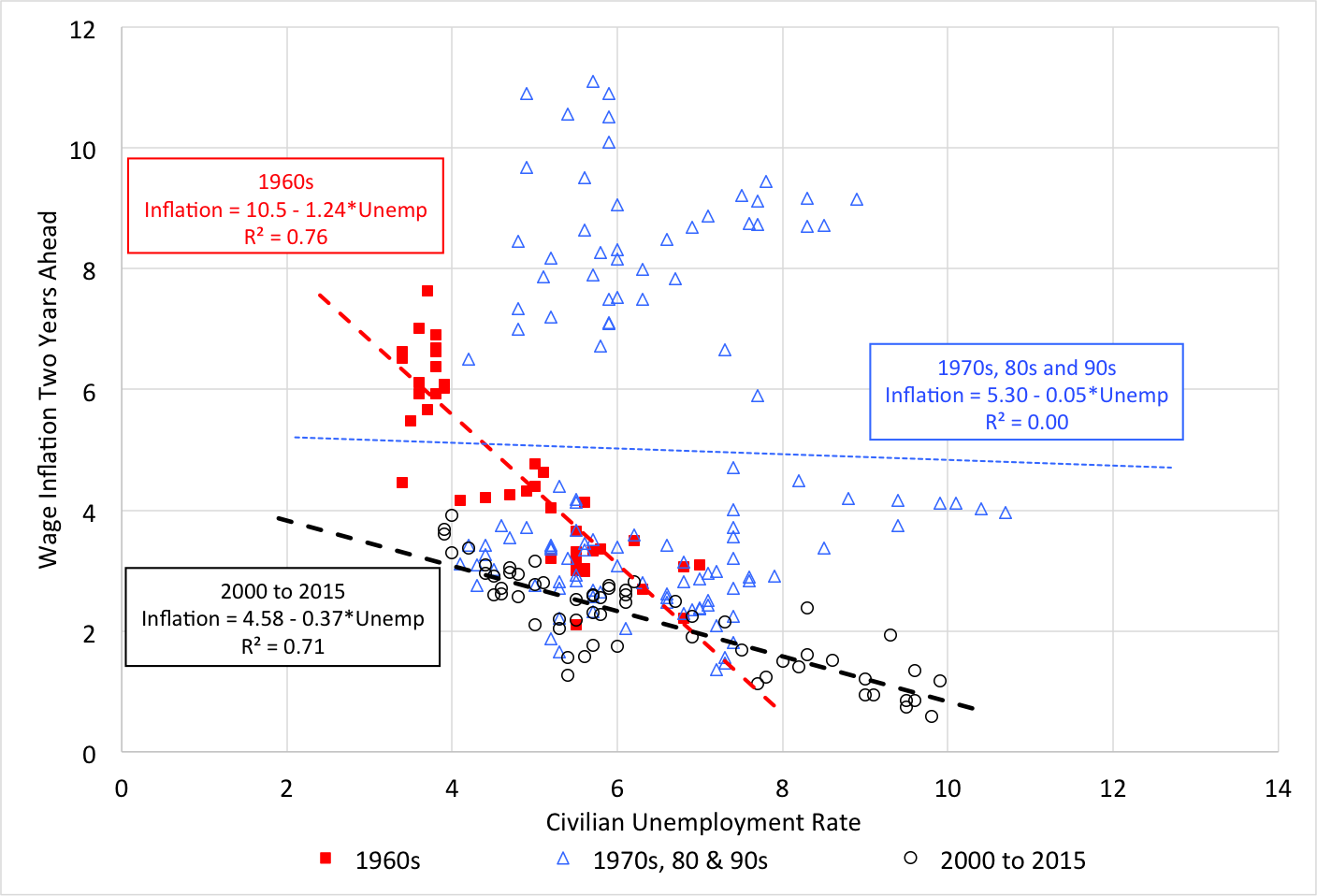
Looking through the data, this doesn't really look like an outlier. The 1950s also had low unemployment and low inflation. (Note also that official unemployment numbers don't count the long-term unemployed, so there's some uncertainty in this data). See the following unemployment vs. inflation table:

https://www.thebalancemoney.com/unemployment-rate-by-year-33...
Re: What the Great Inflation (1965-1982) taught us

#92

Earlier quoted context omitted.

It depends on your individual consumption preferences. Just because the CPI is 7%/year does not mean you are losing 7%. If you have $1 million in cash and your expenses are $40k/year and CPI goes up 10%, then all you need is to invest the $960,000 in fixed income to negate the increase of $4k due to inflation, which is easily doable. If you are taking that $1 million and buying only energy or only food with it, then…

Another perspective, we have 83.45 %/year CPI inflation in Turkey. This is the official number an independent research group of academics claim it is nearing 200%. The official interest rate is 10.5%/year. You get maximum 20-25%/year interest on savings accounts. Real estate market and rents go up 220%/year (by the official numbers). Before doing FIRE purchase your own home or sign a really long term lease with upfro…

I swear I don't ask to be snarky but out of genuine curiosity, but what prevents you from buying USD or USD-denominated assets like TIPS or TIPS ETFs? Do Turkish banks ban such purchases to prevent capital flight?

Obviously, all other things being equal, whether a retiree gets crushed or not by CPI change is going to differ a lot if that change is 7% versus 83%.

Re: What the Great Inflation (1965-1982) taught us

#94

Earlier quoted context omitted.

full employment surely can't help, if consumer prices going up is caused by too much demand and too little supply.

As I note elsewhere, the U.S. unemployment rate dropped from 10.8% in 1982 (3.8% inflation) to 6.6% in 1986 (1.1% inflation).. so, inflation plunged while employment boomed... doesn't that completely upset that argument? Looking through the data, this doesn't really look like an outlier. The 1950s also had low unemployment and low inflation. (Note also that official unemployment numbers don't count the long-term unem…

over many periods there has been a short-run tradeoff.

https://images.squarespace-cdn.com/content/v1/52cdc300e4b012...

the phillips curve can shift, that is of course worthy of study. one interesting thing that happened in that period is oil prices collapsed.

you either believe in supply and demand, or you don't. if you believe in it, then greater than full employment leads to rising wages, and inflation if productivity doesn't follow. if you don't believe in supply and demand, then discussion about a lot of economic theory is pointless.

https://www.moneyandbanking.com/commentary/2017/5/29/the-phi...

Re: What the Great Inflation (1965-1982) taught us

#95

Earlier quoted context omitted.

Another perspective, we have 83.45 %/year CPI inflation in Turkey. This is the official number an independent research group of academics claim it is nearing 200%. The official interest rate is 10.5%/year. You get maximum 20-25%/year interest on savings accounts. Real estate market and rents go up 220%/year (by the official numbers). Before doing FIRE purchase your own home or sign a really long term lease with upfro…

I swear I don't ask to be snarky but out of genuine curiosity, but what prevents you from buying USD or USD-denominated assets like TIPS or TIPS ETFs? Do Turkish banks ban such purchases to prevent capital flight? Obviously, all other things being equal, whether a retiree gets crushed or not by CPI change is going to differ a lot if that change is 7% versus 83%.

To be blunt I never thought of this. We can invest in US equities but US government bonds, I never thought of this.

We can buy eurobonds of Turkish Republic if we don't care about liquidity in short to mid term.

However usd is another battle. The government utilizes strange tactics (ranging from making it mandatory to convert export proceeds into TL, offering government backed USD adjusted savings accounts in TL, bringing cash from "unknown" sources (it gets listed as "net faults and misses" under Central Banks balance sheet.) So there is inflation but usd doesn't keep up with it always. There are news that the government is highly active in narcotics trade for personal gain of ministers, so I presume we get some black money there as well. The government also gives away any asset the country has in exchange for dollars to foreigners. Most of our national reserves (around 130 billion USD) was sold covertly to unknown purchasers at an unknown price during erdogan regime, so I guess some of that quasi-stolen reserves is also making a comeback. With all that said, they manage to keep usd exchange rate flat for now. So TIPS would only benefit us if we invest for a long term. Look at usd/try to see how crazy it is. Nothing is predictable now. When you lose the rule of law and your democracy, anything is possible.

We can easily invest in Us and European stock markets through funds.

As long as we pay income tax, we can invest in whatever we want, there are no country restrictions.

Re: What the Great Inflation (1965-1982) taught us

#96

Earlier quoted context omitted.

Inflation is never caused by there being 'too much money'. It's caused by people spending and choosing to pay the higher prices on offer, rather than shopping around, saying 'no deal' or saving. A $100 in a drawer can't cause inflation. It's not a stock problem; it's a flow problem. Inflation is always, everywhere, a lack of effective competition. In situations of excess supply you have very little to no inflation. F…

> It's not a stock problem; it's a flow problem. It's arguably both a stock problem and a flow problem (MV = PQ). If the stock is constant and the flow increases, you get inflation. If the flow is constant and the stock increases, you get inflation. > Inflation is always, everywhere, a lack of effective competition. In situations of excess supply you have very little to no inflation. Excess supply at a given price le…

What is missing from every discussion like this are the constraints over V.

AFAIK, nobody has ever managed to formalize any. Economists either imposed them by definition and let it float freely... Yet, the thing is very clearly highly constrained on practice. So the flow volume (MV) is somehow highly dependent on M, but not completely defined by it.

Re: What the Great Inflation (1965-1982) taught us

#97

Earlier quoted context omitted.

We lower our standards, lots of middle class families don't eat red meat anymore for example. We don't eat out. We sell assets, take on debt. Young people don't move out in the first place. Lots of people move back in. We got immensely poorer, it is tough out here. You see beggars everywhere, especially low income families were hit the worst. We live under Erdogan, if we try to rise up, we get shut down. All public p…

That sounds bad. Granted, I don't keep up with the news that much, but what I do see (in Germany) is mostly stories on the "I won't buy that car I've been wanting to"-level, absolute poverty is rarely shown (unless with an upbeat story about e.g. enterprising metal collectors). While Erdogan certainly isn't praised, the chilling effects and the expanding authoritarianism are barely mentioned. Fingers crossed that the…

Yeah buying a car is not possible for many. The minimum wage is around 5500 try. An entry level car costs around 850k try now. More than 60% of the population works at minimum wage. So you have to work for 154 months without having any expenses and saving all your salary just to buy a car. Car prices are much higher than europe because of exorbitant taxes. (We have 175% tax on cars, same goes for phones, alcohol etc.)

Re: What the Great Inflation (1965-1982) taught us

#98

Earlier quoted context omitted.

I think you can decompose stock into 'money that is in circulation', and 'money that is not'. In some sense, the only relevant partition is the quantity of money that is actually in circulation. If I take $100bn of cash and bury it and hide the map, I haven't actually decreased the quantity of money (the total amount that exists), but I have effectively decreased the quantity of money (the amount that is in circulati…

> In some sense, the only relevant partition is the quantity of money that is actually in circulation Yeah thats the bit i’m trying to get my ahead around. Specifically: >> It's arguably both a stock problem and a flow problem I’m thinking the key variable here is flow >>> it's a flow problem You cant have inflation without increased flow, but i’m still wondering about stock because it’s not as simple as just excess…

Given that money is just a promise there are endless money things as well.

We can't define money, we can't define velocity, prices are all relative and what is included as a transaction depends on the definition.

The naive QTM is overly abstract. All we can really do is address the root cause - insufficient supply and competition.

Re: What the Great Inflation (1965-1982) taught us

#99
post #51

Earlier quoted context omitted.

In addition, here's one big difference: the Biden Administration printed 1.7T worth of handouts, which was mostly spraying helicopter money directly to the people. During the financial crisis of 2008-2009, TARP was not mostly helicopter money given directly to the people. It was given to institutions, so it was much more indirect. With the Biden Administration's money spraying, a good amount of that taxpayer money we…

I'll try to give you the most charitable read, but even if I do, the simple fact that inflation is happening world wide seems like there's no way the cause can simply be what you said. It also ignores the flip side. COVID relief packages have also helped in many ways, it's unclear what outcome is worse, current inflation or what else would have happened without that assistance. Finally, I tried to do some fact checki…

The reason inflation is happening world-wide is because all major governments are following roughly the same policies. They all gave various forms of financial assistance to their citizens to get through the lockdowns. They also all held interest rates down, below their natural levels, to stimulate economic growth during the recovery. Except for Turkey and Russia, most of them are starting to raise rates again now that the U.S. is.

There's a competitive aspect to central bank policy: if the U.S. drops rates but other countries don't, their exports become more expensive and hence relatively uncompetitive in the world market, their manufacturing sector loses jobs, and they get thrown out of office. If the U.S. raises rates but other countries don't, their currency drops in value relative to the USD, their imports become more expensive, this fuels inflation in their home country, and they get thrown out of office. Therefore there's a strong impulse to mimic U.S. monetary policy. This also makes the reaction of other countries a constraint on the actions of the Fed; they cannot make changes willy-nilly without causing severe dislocations to the global economy.

You're right that this is not a Biden vs. Trump issue, and that Trump also pursued policies that were highly inflationary. This is a "humans are predictably irrational" issue. They nearly always pursue policies that fix the problems they have now, even at the expense of causing problems that are highly likely to occur later.

Re: What the Great Inflation (1965-1982) taught us

#100

Earlier quoted context omitted.

Inflation is never caused by there being 'too much money'. It's caused by people spending and choosing to pay the higher prices on offer, rather than shopping around, saying 'no deal' or saving. A $100 in a drawer can't cause inflation. It's not a stock problem; it's a flow problem. Inflation is always, everywhere, a lack of effective competition. In situations of excess supply you have very little to no inflation. F…

> It's not a stock problem; it's a flow problem. It's arguably both a stock problem and a flow problem (MV = PQ). If the stock is constant and the flow increases, you get inflation. If the flow is constant and the stock increases, you get inflation. > Inflation is always, everywhere, a lack of effective competition. In situations of excess supply you have very little to no inflation. Excess supply at a given price le…

"Excess supply at a given price level almost by definition means prices should trend downwards"

Excess capacity to supply doesn't mean there is excess supply. Supply is restrained due to lack of demand.

With excess supply capacity, Firms don't generally run at full output unless there are orders to fulfil. But that doesn't mean they can't then ramp up if the orders come in.

It's when capacity to supply is exhausted that we get price inflation.

"The price of commodities around the world is going up, by definition this cannot be due to a lack of competition - there must be something else at play."

If prices are going up there is a lack of capacity to supply, therefore there is insufficient supply which is why prices are going up - to eliminate demand.

At root the shortage of energy feeds into everything else.

There is no competition. No supplier gets a 'no deal' bid to their offer. They can sell everything they can make at the price they set.

Post reply on HN