Live data from Hacker News

An unexpected victory: container stacking at the port of Los Angeles

thezvi.wordpress.com

91–100 of 316 posts

Re: An unexpected victory: container stacking at the port of Los Angeles

#91

Or, and this is radical, we could just stop buying cheap Chinese-made crap like inflatable Halloween decorations made from petroleum products and shipped across the sea using bunker oil. Or, we could pass strong right-to-repair legislation and mandate 3-5 year warranties on electronics so that my 55-inch Samsung curved LED TV can be fixed when it dies at 2 years and one month old. Or, even more radical, we could stop…

Hey take a look around in your room and find out where half of the things are made, and then reflect on who these consumers are you are talking about.

Re: An unexpected victory: container stacking at the port of Los Angeles

#92
post #51

I followed this and from my understanding the changes while enacted quickly are still only temporary (rollback in 120 days). If that's the case, I'd like "them" to think about how this situation could have been avoided all together. I can't help but thinking about how all the Asian markets were having similar log jams due to economies reopening and the Suez issue months ago. Surely it was known (or, could have been k…

The problem is "them" in this case is the mayor of Long Beach. The people he worries about are the voters in Long Beach, who probably (given what we know about California...) complain very loudly about having to see container stacks. He has no incentive to care about things that the cities voters don't care about directly like... the global economy. I have to wonder if he got a very angry call from the White House te…

IDK if I'd blame one office or especially the one person currently sitting in that office. This is a (hopefully) extremely rare condition that wasn't seen coming. As we get back to business as usual, I think LB should keep it 2 high if that's what worked and what their residents want. But there needs to be a variable component, temporary permits are common and existing concept. I don't know anything about LB local govt but where I'm from the city council as a whole could vote this in. A state/federal level could force them to if that's what it takes. So I'd say "them" is >1.

Something similar in concept, when evacuating a hurricane inbound lanes can be turned into outbound lanes and double the buffer. Of course the citizens of coastal cities don't want outbound lanes only at all times. This is for extreme situations (skimming but I think this is valid ref: https://en.wikipedia.org/wiki/Contraflow_lane_reversal)

Re: An unexpected victory: container stacking at the port of Los Angeles

#93
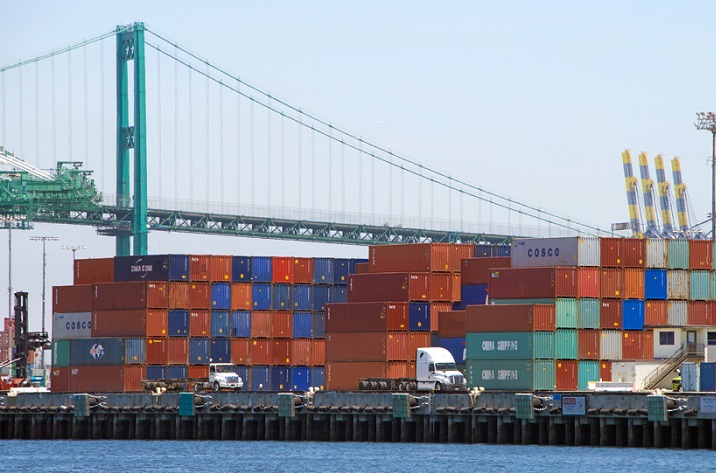
> There was a rule in the Port of Los Angeles saying you could only stack shipping containers two containers high.

This is incorrect. There was a zoning rule which affected truck yards in Long Beach and Los Angeles. Truck yards. Not the port itself.

As stated in the linked tweets actually.

But if you don't believe that you can just google an image of the Port of Los Angeles from let's say 2019 and count how high the container piles go. Here is a randomly selected image from 2019 where 5 high piles can be clearly counted: https://www.joc.com/sites/default/files/field_feature_image/...

Accuracy is important. I'm not an expert on logistics, or zoning laws. But how could I trust the article's author when they clearly unable to parse their own sources?

> Normally one would settle this by changing prices, but for various reasons we won’t get into price mechanisms aren’t working properly to fix supply shortages.

It's nice that the article is not going into that. Instead it hammers on that politicians regulate where and how many containers can you plop down. That is not the real issue.

If you are moving containers into an area, and you are not moving an equal amount out then you are going to run out of space to store the containers. It is that simple. You can tweak rules to make a bit more space, for example by stacking them higher in the truck yards. But the real question is: why are the people who own these containers incentivised to move them back to where they want them to be filled? If you solve that the problem solves itself. If you can't solve that piles of containers will fill up what little more space you won by tweaking. So the very point the article decides to "not go into" is the only one worth going into.
Re: An unexpected victory: container stacking at the port of Los Angeles

#94

Some talk about 'building a new port' as part of the solution. I'm thinking that's a decade project and $100B or some such? PoLA tried to expand for a decade and the impact statements got bogged down and nothing happened if I remember right (my sister-in-law was doing the math on the statements)

Port of Oakland says hi. Is there a reason it does not get the traffic of L.A.? Or is a 3rd large port needed?

LA is a much much larger manufacturing hub than the Bay. Land is also much cheaper. Also I think the train situation is better in LA.

Re: An unexpected victory: container stacking at the port of Los Angeles

#96

Earlier quoted context omitted.

Increasing a buffer size can also make it look like the problem is solved temporarily when you really have a rate issue. It seems that filled containers are coming in at a faster rate than empty containers are going out. We've increased the buffer for empty containers at the dock but did we address the outgoing rate problem? Why wouldn't the buffer just fill again? I wonder if we've reached a point where manufacturin…

Your last point is being reported. It's cheaper for the Chinese to export containers (with subsidized steel) than it is for shipping them back, so they're just making new ones. Conjecture, but policy wise, this could relate to steel tariffs, decrease Chinese steel imports to the US and finding the container market to allow you to keep pumping money into the industry

No way making a new container is cheaper than shipping back the old one.

Re: An unexpected victory: container stacking at the port of Los Angeles

#97
post #42

Earlier quoted context omitted.

Truck-loadings-per-hour will increase, but that does not help shrink the buffer if every truck picking up a container also brings back an empty one. Increasing the buffer size is a temporary relief, but clearly the underlying problem is an ever-increasing number of containers (empty or full), or we wouldn't have gotten into this situation. If we could dispose of the empty containers somewhere then this bottleneck wou…

This seems to be why he suggests a place other than the port to dump empties. It would be better to require that the ships carry away as many empties as fit aboard.

If it's true that ships are refusing to load empties simply because it's more profitable to skip the loading times, then a requirement could actually fix things in the medium term.

Re: An unexpected victory: container stacking at the port of Los Angeles

#99
post #48

All the dismissals here are fascinating to me — and sure seem to be exactly the overarching story of TFA. Yes, this certainly isn't the only problem here, but it's certainly the easiest to fix. And yes, the narrative of the story is definitely important, because it avoided all the rabble you see here that was getting in the way of a simple first step.

We are so used to doom and negativity in the news that we discard any positive news outright... which creates a self-reinforcing feedback loop that everything is terrible all the time.

Re: An unexpected victory: container stacking at the port of Los Angeles

#100
post #71

This article is ridiculous. "It's so easy but nobody expected it to happen!" Most of freight is run off spreadsheets and over the phone or by email. Flexport is built around digitization and optimization. Half of the appeal of their product is that it gives customers improved visibility! It's therefore not surprising that a local city mayor didn't realize he had the power to unclog the US traffic jam. Referring to hi…

It is quite reasonable to make fun of people who required a 2 container limit for aesthetic reasons which accidentally caused a major kink in the global supply chain. It was also inarguably effective to publicly shame them into reversing their decision.
Post reply on HN