Live data from Hacker News

Smart spaces will fine petrol car owners illegally parking in electric bays

thetimes.co.uk

91–100 of 134 posts

Re: Smart spaces will fine petrol car owners illegally parking in electric bays

#91

Earlier quoted context omitted.

I thought that was mainly because red light cameras often lead to an increase in collisions because a driver is more likely to stop unsafely if they are worried about the light changing

Which is, in turn, caused by the unsafe shortening of the yellow light commonly used in combination with red light cameras in order to maximize ticket revenue. Because with an adequately timed yellow light, few people actually run the red light and the cameras become an expensive money pit that can't pay for themselves.

In India, on some newer signals in last 5-6 years, I have seen that when Red is on, & is going to go to Green, the Red will start blinking in last 5 or so seconds. Then Green will be ON.

When Green is ON, & is going to switch off, it will start blinking & then off, & then yellow will start blinking. Its ok to drive through blinking green or yellow if safe. But common training os drive through blinking Green, but if you see blinking Yellow, then stop.

Plus, some of the lights have counter. It shows how many seconds are remaining for the lit color. An experiment led the Bombay Municipality to install Noise Sensors are one busy traffic light with counter. Every time there is a Red Light, & counter is less than 10, normally people start getting impatient & start honking to force the front ones to move. But on this light, if the noise is above certain decibel while Red, the counter resets.

Re: Smart spaces will fine petrol car owners illegally parking in electric bays

#92

Earlier quoted context omitted.

In the UK at least, it's relatively simple. If it's a red circle with a number in it, that's the speed limit - anything else is advisory. In my experience, cars with built in sign readers do an exceptional job of working out the current limit (more reliable than me, certainly!).

So no temporary work zones in the uk? What is the rule if the sign isnt there/visible? Do you then get to race through an obvious construction zone?

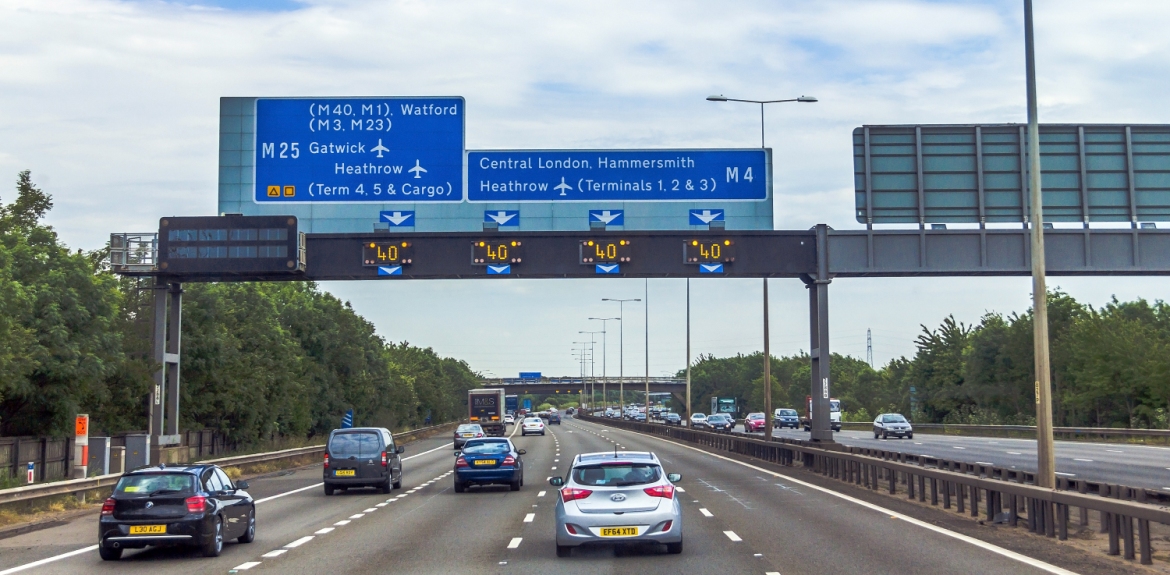
They tie an opaque bag over any incorrect signs, and erect temporary signs (of the same standard, international design) with the new limit. If it's a motorway or similar road, the electronic emergency signs will also show the reduced speed limit [1]. On a motorway, they're often on a gantry, i.e. completely impossible to miss.

I think I read somewhere that it's someone's job to make regular checks that the temporary signs (and covers) are still correct -- they are an important part of the worker safety requirement for the construction crew.

When a speed limit changes, the rule is for the sign to be shown on both sides of the road. There are then repeating signs for the current limit at some regular interval.

The UK is dense enough that having expensive electronic signs on all motorways isn't an unreasonable cost; I understand that's not practical in the USA or Australia.

[1a] https://i2-prod.birminghammail.co.uk/news/midlands-news/arti...

[1b] https://www.ageas.co.uk/globalassets/solved/30072018_road-sa... (possibly this style is no longer used, I drive very rarely in the UK so I'm not sure.)

Re: Smart spaces will fine petrol car owners illegally parking in electric bays

#93

Earlier quoted context omitted.

>>When autonomous vehicles halve the cost of an Uber/Lyft journey, many more people will weigh up the costs/benefits of private vehicle ownership and decide it’s not for them. That's kind of my point - this won't happen, because Uber is already at rock bottom prices. For me to take it to work is about £10. That can't cover anything about the journey and is clearly heavily subsidised by Uber. That cost isn't going dow…

> That's kind of my point - this won't happen, because Uber is already at rock bottom prices. Not really. There are a lot of places to optimize the cost of an Uber competitor. If you have electric self driving cars that pick people up, maintenance and fuel are much less expensive and you aren't paying for a driver. Most of these would only need a 50-100 mile range and could fuel up between passengers. Full self drivi…

>>Full self driving cars is a few years out

More like 50+ years for something that is actually allowed on most roads commercially, but sure. I just don't think the margins are there. Uber already subsidizes the human cost.

Re: Smart spaces will fine petrol car owners illegally parking in electric bays

#94

Earlier quoted context omitted.

If there's no sign to indicate that the speed limit is changed, how are you supposed to know what the speed limit is? I've had speeding tickets forgiven in Australia because the sign simply wasn't visible enough due to overgrown trees and a 2 lane off ramp separating the sign from the road it applied to, let alone the sign missing altogether.

If you are surrounded by people in orange vests, or traffic cones directing you to a detour, you are in a construction zone and better not be doing highway speeds. The fact that the sign wasnt visible, or even wasnt present, will not help. This comes up in AI cars all the time. The camera is blocked from seeing the sign beside the road, perhaps by a truck in the right lane. Or maybe the temporary folding sign is blow…

Well, sure. But in the context of enforcing a limit on a human - by either reporting a breach or actively preventing the car from exceeding the speed limit - and not the car driving itself, I don't see any of that being an issue.

Re: Smart spaces will fine petrol car owners illegally parking in electric bays

#95

Earlier quoted context omitted.

>> if your vehicle detects the limit wrong Welcome to one of the most basic and most difficult problems for AI-driven vehicles: What is the speed limit? Temporary limits, work zones, school/park zones based on sunlight, weather, children/workers present or not, emergency vehicles beside road or not ... it is complex but also something every driver manages every time they get behind the wheel. While it is possible to…

In the UK at least, it's relatively simple. If it's a red circle with a number in it, that's the speed limit - anything else is advisory. In my experience, cars with built in sign readers do an exceptional job of working out the current limit (more reliable than me, certainly!).

It should be trivial to convert every sign to have wireless transponder. Optical guessing sounds awful for wrong angles, wind damage, snow coverage, lighting issue.

Maybe correlate it with central database for sanity. Preferably daily updated git.

Re: Smart spaces will fine petrol car owners illegally parking in electric bays

#96
post #87
post #56

Earlier quoted context omitted.

I live in a city where 48 people were killed by cars last year. I am not fine with that.

Don't get me wrong, you shouldn't. But how many of these deaths would have been prevented by a 20% less speed?

That's a rather distasteful argument to make and reminds me of Covid deniers blaming underlying medical conditions for deaths.

Kinetic energy is m*v^2, so yes 20% makes quite a difference.

Also, what's the point of a speed limit of x if 1.2x (or x+19) is tolerated. There is no good reason for a margin.

Re: Smart spaces will fine petrol car owners illegally parking in electric bays

#97
post #86

Earlier quoted context omitted.

Unsafe driving is a real cause of a substantial amount of death, and unlike most causes of death it is not over represented in the elderly, giving it a massively outsized impact in terms of reduction in expected years of life. Motor vehicle collisions are reliably the leading cause of death of teenagers and young adults in many parts of the world. People are bad at appraising events that are rare with high negative i…

Unsafe driving is not characterized by speeding a slight margin over the limit on good roads (see German Autobahn for statistics, these are among the safest roads on the planet). Similarly, I am pretty certain that driving 40 in a 30 zone (when 30 is safely possible) is not the cause of most, if any, deaths. Causes are varied, but generally the situations where one or two meters of road would make a difference are ob…

The increase in stopping distance from 30km/h to 40km/h is significant, more than 1-2 metres, and much of it is thinking/reacting time, i.e. still travelling at 40km/h. People are much more likely to survive an accident at a lower speed.

"The results from one of these studies is presented in figure 1, which shows a fatality risk of 1.5% at 20 mph [32km/h] versus 8% at 30 mph [48km/h]." [1] (in typically British fashion, the actual data is in km/h, but this general-public version of the document is presented with miles.)

The difference is even greater at the next gap (30mph→40mph, or 48km/h→64km/h). That was the subject of a road safety video a few years ago: [2]

[1] https://www.rospa.com/rospaweb/docs/advice-services/road-saf...

[2] https://www.youtube.com/watch?v=HeUX6LABCEA

Re: Smart spaces will fine petrol car owners illegally parking in electric bays

#98

Earlier quoted context omitted.

The cycle lane on Kensington High Street (a major London East-to-West route) actually sped up car journeys. https://www.theguardian.com/uk-news/2021/jan/01/removed-lond... When it was removed the study "calculated that average trip times eastbound increased from 5min 39sec to 8min 14sec, with those westbound rising from 5min 48sec to 6min 27sec."

... so why the heck did they not un-remove it after that

When a wealthy driver from Kensington or Chelsea sees a person on a bicycle, their face turns red, their heart rate increases, and their body starts to twitch. In extreme situations, they may imagine the letters they'd like to write to the Daily Mail and Daily Telegraph complaining about the abomination -- this is most common when they're driving a vehicle designed for off-road expeditions through central London.

There was a similar issue with articulated buses. These were removed by their leader, Boris Johnson, at colossal expense. Some drivers in Chelsea are still suffering the after-effects of seeing these vehicles on the road.

Re: Smart spaces will fine petrol car owners illegally parking in electric bays

#99
post #54

Earlier quoted context omitted.

Roundabouts. If it's that rural, why put in traffic lights?

Because is it rural. Farmers don't like having corners of their fields clipped to facilitate round intersections. And roundabouts have to be made large enough to facilitate multi-trailer trucks, not to mention farm equipment. Plowing them in the winter is also a real hassle/cost as opposed to strait-through square intersections.

Search "mini roundabout" [1], although these are mostly used in urban areas. In Britain, junctions in rural areas usually just have "Give Way" (i.e. yield) signs for the non-major road.

[1] https://en.wikipedia.org/wiki/Roundabout#Mini-roundabouts

Re: Smart spaces will fine petrol car owners illegally parking in electric bays

#100
post #4

Earlier quoted context omitted.

They're not parking spots. Don't park next to a gas pump if you're not putting gas in the car, even if it has an internal combustion engine.

I did exactly that this morning. I put gas in my car, paid at the pump, then walked in to buy a drink. I certainly wouldn't do that if people were waiting for the pump, but the option is there and used by drivers regularly.

If there was nobody immediately behind you waiting for the pump, would you wander off to the office to work for a few hours then come back to move your car?
Post reply on HN