Live data from Hacker News

Voyager 2’s Discoveries from Interstellar Space

nytimes.com

91–100 of 109 posts

Re: Voyager 2’s Discoveries from Interstellar Space

#91
post #45

Earlier quoted context omitted.

If you need to run a computation that is going to take 100 years with today’s computers, you probably should wait a bit to start it with faster computers.

Unless you can buy both, in which case you should start now and continue with the newer computer.

But then you've spent more money. You could have just bought more hardware in the future.

For a fixed budget, assuming that Moore's Law still holds (dubious, these days), you should wait until the computation will take 26 months on hardware purchased within that budget [0].

[0] https://arxiv.org/abs/astro-ph/9912202

Re: Voyager 2’s Discoveries from Interstellar Space

#92

I'm amazed and still can't get my head around how today we can receive images and valuable data from a device which is currently lightdays away from us and was built with 60's technology & know-how and is operating well beyond it's expected lifetime. I raise my glass to the engineers who worked on this. Makes my daily programming tasks feel stupid in comparison. Edit: corrected, thanks for the numbers

I used to have it in my head that the Voyager probes were about as powerful as an Apple II computer. But it's hard to make a direct comparison as the probes have three computers made of two processors each, running at 1/20th or 1/6th the speed of an Apple. So it's not a one-on-one comparison in any way, but for discussion purposes: An original Apple II used a MOS 6502 8-bit word CPU clocked at 1.023 MHz and typically…

>So maybe the total amount of computing power is equal?

Probably not. Those 18bit words likely contain 2 bit parity to prevent space radiation from making this go bad. Plus, it's only one machine, not two, the two always run in parallel (for the CSS, the FDS only has one running at a time and AACS is turned off if not needed) and redundantly in case on fails, so in total you're running about 180'000 instructions per second, not 360'000. The memory totals 34 kilobytes (18bit words in two of the memories, 16 in the third), with a simple redundancy like the computer itself (ie, each computer has it's own memory).

The CCS is also responsible for managing the memory of the other two systems (MEMLOAD), so their realistic instruction speed may be limited by slower memory access in memory heavy applications.

Even all systems combined, I don't think the voyager is faster than an Apple II within an order of magnitude.

Re: Voyager 2’s Discoveries from Interstellar Space

#93

Earlier quoted context omitted.

> Are they powered via PV Consider that light emitted from the Sun will decay with the square of the distance – as it is irradiated in all directions. To Voyager, the Sun looks like an ordinary star – although one much brighter than the others. Not much energy can be harvested there. Until recently, photovoltaics were useless as far away as Jupiter. Given the tech advancements, we can now use them there (and have). F…

> To Voyager, the Sun looks like an ordinary star – although one much brighter than the others. Not much energy can be harvested there. This blew my mind. Do you have a reference that talks more on this topic?

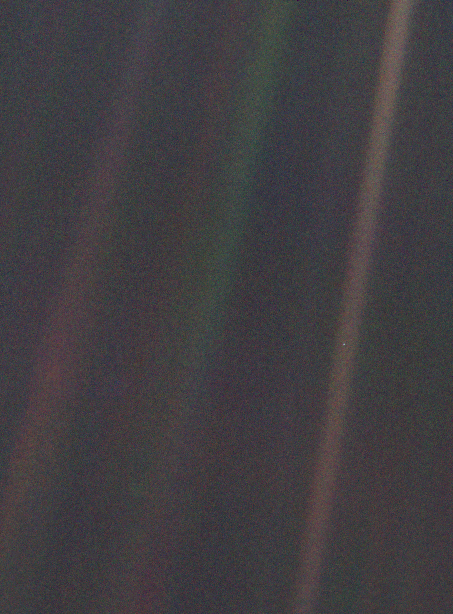
Voyager snapped a picture of our Earch (sorry I thought it was the Sun) in 1990. It's the famous Pale Blue Dot picture. It's the small blue-white speck (or almost pixel) halfway down the brown band on the right. https://en.es-static.us/upl/2012/07/Pale_Blue_Dot.png

EDIT: Ooops, sorry - this is Earth and not Sun :-(.

Re: Voyager 2’s Discoveries from Interstellar Space

#94

Earlier quoted context omitted.

> To Voyager, the Sun looks like an ordinary star – although one much brighter than the others. Not much energy can be harvested there. This blew my mind. Do you have a reference that talks more on this topic?

Voyager snapped a picture of our Earch (sorry I thought it was the Sun) in 1990. It's the famous Pale Blue Dot picture. It's the small blue-white speck (or almost pixel) halfway down the brown band on the right. https://en.es-static.us/upl/2012/07/Pale_Blue_Dot.png EDIT: Ooops, sorry - this is Earth and not Sun :-(.

The pale blue dot is Earth, not our Sun.

Re: Voyager 2’s Discoveries from Interstellar Space

#95

Earlier quoted context omitted.

> To Voyager, the Sun looks like an ordinary star – although one much brighter than the others. Not much energy can be harvested there. This blew my mind. Do you have a reference that talks more on this topic?

Voyager snapped a picture of our Earch (sorry I thought it was the Sun) in 1990. It's the famous Pale Blue Dot picture. It's the small blue-white speck (or almost pixel) halfway down the brown band on the right. https://en.es-static.us/upl/2012/07/Pale_Blue_Dot.png EDIT: Ooops, sorry - this is Earth and not Sun :-(.

That's Earth, not Sun.

Re: Voyager 2’s Discoveries from Interstellar Space

#96
I've always fantasized about drifting out there in person.

Wouldn't a human operator in such spacecraft gather more data by being able to reorient instruments in realtime etc. and spotting minute phenomena that would otherwise be missed?

If NASA or Elon Musk or anyone has considered such a mission but can't imagine asking for volunteers for it, let me know. I don't need a ride back.

Re: Voyager 2’s Discoveries from Interstellar Space

#97

I've always fantasized about drifting out there in person. Wouldn't a human operator in such spacecraft gather more data by being able to reorient instruments in realtime etc. and spotting minute phenomena that would otherwise be missed? If NASA or Elon Musk or anyone has considered such a mission but can't imagine asking for volunteers for it, let me know. I don't need a ride back.

Keeping you alive for the kinds of durations that matter (that is decades) won't be technologically or economically possible for the present.

Re: Voyager 2’s Discoveries from Interstellar Space

#98

I've always fantasized about drifting out there in person. Wouldn't a human operator in such spacecraft gather more data by being able to reorient instruments in realtime etc. and spotting minute phenomena that would otherwise be missed? If NASA or Elon Musk or anyone has considered such a mission but can't imagine asking for volunteers for it, let me know. I don't need a ride back.

Keeping you alive for the kinds of durations that matter (that is decades) won't be technologically or economically possible for the present.

Even better.

Re: Voyager 2’s Discoveries from Interstellar Space

#99

I'm amazed and still can't get my head around how today we can receive images and valuable data from a device which is currently lightdays away from us and was built with 60's technology & know-how and is operating well beyond it's expected lifetime. I raise my glass to the engineers who worked on this. Makes my daily programming tasks feel stupid in comparison. Edit: corrected, thanks for the numbers

Related, and relevant: https://en.wikipedia.org/wiki/Pale_Blue_Dot

Look again at that dot. That's here. That's home. That's us. On it everyone you love, everyone you know, everyone you ever heard of, every human being who ever was, lived out their lives. The aggregate of our joy and suffering, thousands of confident religions, ideologies, and economic doctrines, every hunter and forager, every hero and coward, every creator and destroyer of civilization, every king and peasant, every young couple in love, every mother and father, hopeful child, inventor and explorer, every teacher of morals, every corrupt politician, every "superstar," every "supreme leader," every saint and sinner in the history of our species lived there--on a mote of dust suspended in a sunbeam.

The Earth is a very small stage in a vast cosmic arena. Think of the rivers of blood spilled by all those generals and emperors so that, in glory and triumph, they could become the momentary masters of a fraction of a dot. Think of the endless cruelties visited by the inhabitants of one corner of this pixel on the scarcely distinguishable inhabitants of some other corner, how frequent their misunderstandings, how eager they are to kill one another, how fervent their hatreds.

Our posturings, our imagined self-importance, the delusion that we have some privileged position in the Universe, are challenged by this point of pale light. Our planet is a lonely speck in the great enveloping cosmic dark. In our obscurity, in all this vastness, there is no hint that help will come from elsewhere to save us from ourselves.

The Earth is the only world known so far to harbor life. There is nowhere else, at least in the near future, to which our species could migrate. Visit, yes. Settle, not yet. Like it or not, for the moment the Earth is where we make our stand.

It has been said that astronomy is a humbling and character-building experience. There is perhaps no better demonstration of the folly of human conceits than this distant image of our tiny world. To me, it underscores our responsibility to deal more kindly with one another, and to preserve and cherish the pale blue dot, the only home we've ever known.

— Carl Sagan
Re: Voyager 2’s Discoveries from Interstellar Space

#100

Earlier quoted context omitted.

> Are they powered via PV Consider that light emitted from the Sun will decay with the square of the distance – as it is irradiated in all directions. To Voyager, the Sun looks like an ordinary star – although one much brighter than the others. Not much energy can be harvested there. Until recently, photovoltaics were useless as far away as Jupiter. Given the tech advancements, we can now use them there (and have). F…

> To Voyager, the Sun looks like an ordinary star – although one much brighter than the others. Not much energy can be harvested there. This blew my mind. Do you have a reference that talks more on this topic?

You should look up or play Elite Dangerous, it's (I believe) a fairly accurate / to scale simulation of solar system navigation. You can go at several hundred times the speed of light and you're still waiting for ten minutes to reach your destination.
Post reply on HN