Living paycheck to paycheck is disturbingly common
91–100 of 390 posts
Re: Living paycheck to paycheck is disturbingly common
#92Earlier quoted context omitted.
I think the very fact that people in wildly different circumstances are living paycheck to paycheck is a huge flag that this isn't as simple a problem as "they don't get paid enough". Income and expenses are intricately linked by psychology. It's almost irrelevant what your paycheck is, if you're prone to this problem then somehow expenses will always rise to meet it. If expenses weren't actually determined by payche…
Which is why without tight controls on lending/debt Universal Basic Income will just lead to similarly desperate outcomes subsidized by the state.
I think you misunderstand the "Basic" term in UBI. But if you truly think markets can't provide affordable basic living accommodations to everyone, then we should we not be discussing some non-market solutions for distribution of resources?
Re: Living paycheck to paycheck is disturbingly common
#93Earlier quoted context omitted.
I think the very fact that people in wildly different circumstances are living paycheck to paycheck is a huge flag that this isn't as simple a problem as "they don't get paid enough". Income and expenses are intricately linked by psychology. It's almost irrelevant what your paycheck is, if you're prone to this problem then somehow expenses will always rise to meet it. If expenses weren't actually determined by payche…
Which is why without tight controls on lending/debt Universal Basic Income will just lead to similarly desperate outcomes subsidized by the state.
I think the bigger issue than lending is that if it's not funded with a land value tax then all the increase in income will be eaten up in rent.
Re: Living paycheck to paycheck is disturbingly common
#94Living paycheck-to-paycheck can be representative of good choices being made (and I'd guess it is, in most cases).
Most people can't afford everything they optimally need while minimising their risk, and so have to manage this by optimising as much as they are able within their paycheck. People with limited resources are going to hit a barrier somewhere, and spending your income is often going to be the least bad barrier to hit.
Re: Living paycheck to paycheck is disturbingly common
#95Check out this graph "The erosion of the minimum wage" from The Washington Post as well:
https://pbs.twimg.com/media/DvbrUVCVsAM25XX.jpg
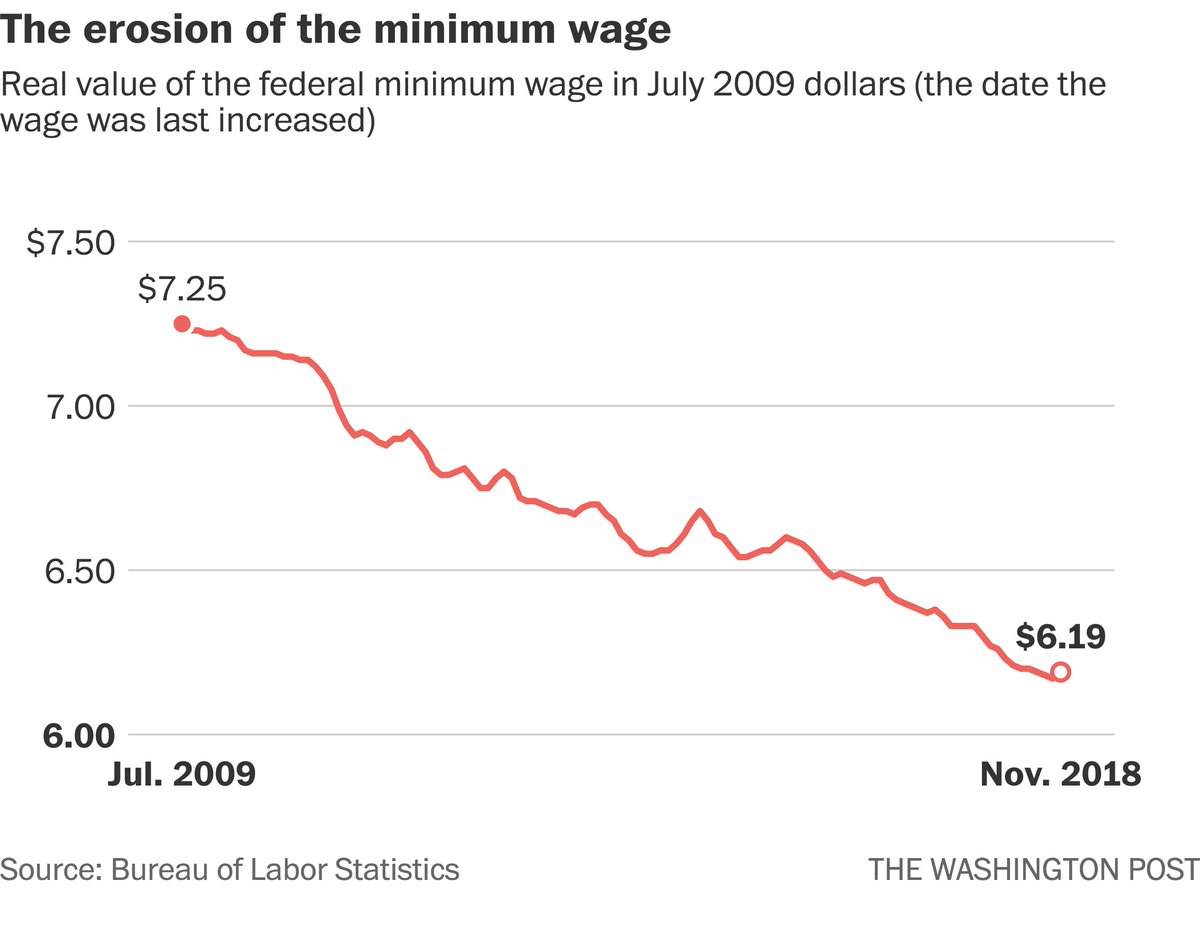
You need to do 47 hours of minimum wage work today to get the same amount of purchasing power as 40 hours of work in 2009.
Re: Living paycheck to paycheck is disturbingly common
#96Don’t discount the weight of emotional trauma and the self-sabotaging habits it has the potential to engender. Most people are slaves to their limbic systems. Most people don’t have self-education or resources to seek the help they need to fix these underlying problems. Society does them no favors. Media and advertising are designed to promote consumption. And not even healthy consumption. The idea that we are black…
>Most people are slaves to their limbic systems.
Excuse me, but would you mind not repeating this meme in the future? The "limbic system" is actually at the core of human consciousness and cognition, and at the core of what "reasoning" really is. The story of the brain as having a "rational human part" and an "emotional animal part" is a myth and a canard.
If you could rephrase or reconsider, you'd have the thanks of everyone in the neuroscience lab where I work ;-).
Re: Living paycheck to paycheck is disturbingly common
#97Don’t discount the weight of emotional trauma and the self-sabotaging habits it has the potential to engender. Most people are slaves to their limbic systems. Most people don’t have self-education or resources to seek the help they need to fix these underlying problems. Society does them no favors. Media and advertising are designed to promote consumption. And not even healthy consumption. The idea that we are black…
While there are many people who do make non-optimal choices, the increasing rate of this, IMHO points to systemic economic fairness issues much more than systemic self-sabotage.
Re: Living paycheck to paycheck is disturbingly common
#98Don’t discount the weight of emotional trauma and the self-sabotaging habits it has the potential to engender. Most people are slaves to their limbic systems. Most people don’t have self-education or resources to seek the help they need to fix these underlying problems. Society does them no favors. Media and advertising are designed to promote consumption. And not even healthy consumption. The idea that we are black…
This is an extremely important point. Everyone deals with these kinds of intrapersonal conflicts and issues on a different breadth and scale, one way or another. It's this coupled with economic distress or anxiety, in addition to a massive income and wealth inequality, that produces the kind of conditions and struggle that people and families go through, like those described in this short article. Sure, there are var…
Many people are very easily falling for the schadenfreude approach to others. It's not helping at all when a teacher who works two jobs gets bashed by their neighbours for not working hard enough.
Somehow, along the way, many people lost all compassion. I am really not sure what do they have to gain from being a-holes to genuinely struggling people. (Not everybody wants to change profession at 40-50 and they should not be forced to.)
As you said, nobody who is working full-time should be below the poverty line. Nobody.
Re: Living paycheck to paycheck is disturbingly common
#99Earlier quoted context omitted.
I think the very fact that people in wildly different circumstances are living paycheck to paycheck is a huge flag that this isn't as simple a problem as "they don't get paid enough". Income and expenses are intricately linked by psychology. It's almost irrelevant what your paycheck is, if you're prone to this problem then somehow expenses will always rise to meet it. If expenses weren't actually determined by payche…
Better: not being paid enough is a sufficient condition, but it is not required. Of course rich people can have such problem, but if you think low wages and the lack of universal health care and free education is not the main issue you are lying to yourself.
I'm not sure lack of healthcare and low wages _is_ the main issue[1]. As the parent comment points out, it seems like that would lead to a pretty different pattern of this phenomenon. It seems to me that there's a couple broad categories that can lead to paycheck-to-paycheck living:
1) Poverty, at the level where spending on a reasonable floor of basics (food, shelter, education, leisure) leaves little for savings. This is a resource constraint, and even a perfectly optimally-run household would end up living paycheck-to-paycheck.
2) Severe exogenous financial shocks that exceed whatever buffer you were able to build, and an inability to adjust consumption downwards due to sticky commitments or psychological reasons. For lower-middle and middle-class households, this is possible simply due to bad luck; one thing the US economy is pretty bad at is providing a solid way to derisk tail risks, the obvious example being healthcare. This is naturally less common the more severe the shock, and irresponsible financial management can be a contributor in some of these cases (ie not saving an emergency fund, etc).
3) Consumption rising to meet one's income. The resource constraint is irrelevant here, as above the poverty level, this is primarily about hedonism and jockeying for status. The big caveat here is that people tend to short-circuit cost-benefit analyses when it comes to their kids: neighborhood safety and public school quality can lead to people substantially (and understandably) overextending themselves wrt housing costs. I'd caution against leaning too blindly on this mitigating factor though, as there are lots of differences between living modestly in a good school district and living generally beyond your means.
There's a degree of freedom around consumption that's likely a lot more significant than your comment assumes; this seems to follow directly from the fact that someone living beyond their means at percentile X would substantially improve their financial security if they spent as much as percentile X-10 (or whatever). For all but the lowest percentiles, this is completely feasible, and yet these low-savings studies consistently find a much larger swathe of people in these categories.
The model that makes the most sense to me is that, excluding the lowest quintile, the habit of clamping consumption to income is one of the biggest factors in our low savings. As mentioned above, the US systemically tends to put a lot more risk on the individual than a lot of societies do; you can be better off if you manage this responsibly (and aren't in the lowest income brackets), but financial illiteracy is IME rampant, even among generally well-educated people.
[1] Lack of access to quality education likely is, but through the mechanism of low numeracy/personal finance skills/critical thinking skills.
Re: Living paycheck to paycheck is disturbingly common
#100A college economics professor would say that this is behavior at the optimal consumer utility boundary.