Funny thing is that Android removed in 5.0 animations in status bar to save power as redrawing frequently will eat battery.
Why doesn’t the clock in the taskbar display seconds? (2003)
91–100 of 124 posts
Re: Why doesn’t the clock in the taskbar display seconds? (2003)
#92This is a good article, but keep in mind the timeframe it writes about. Not only was it 22 years ago, its writing about systems at the bare minimum system requirements. (Personally speaking, I remember speccing out a previous gen Windows 3.1 machine with 8MB of RAM in 92... and this is covering 4MB systems in 1995. By that time, 8-16MB would've been common.) Another story from the time is that I went to CompUSA (as a…
Heh, still recall having to use a special bootloader that would load a BIOS extension, or some such, because the new HDD i got, so that i could run Win95 and still have room for anything else, was not compatible with my 486 otherwise.
Even given that i can't help think computing was less complicated back then.
Re: Why doesn’t the clock in the taskbar display seconds? (2003)
#93[deleted]
Re: Why doesn’t the clock in the taskbar display seconds? (2003)
#94Re: Why doesn’t the clock in the taskbar display seconds? (2003)
#95Earlier quoted context omitted.
The observer pattern isn't sold to everyone... The thing is, Web browsers have been nearly as diverse as OSes both historically and recently... But, you get a mostly compatible UI and runtime engine that's installed on pretty much every personal computing device out there. There's a lot to be said for that. As to the "cool kids", they exist in every corner of things that get done by people. I think WebASM will open u…
> But, you get a mostly compatible UI and runtime engine that's installed on pretty much every personal computing device out there. There's a lot to be said for that. Only "lowest common denominator" comes to mind. But to the point of this thread, what bothers me is the transcendence of web tech outside of browsers, where a technology known historically for terrible practices with a very low barrier to entry is now c…
Well, I take a bit of offense to the last statement... in only that JavaScript is just as, or more valid as a server-side language for development as any other scripting language is. The engines themselves tend to be more optimized than alternatives, and combined with NPM/CJS modules a much nicer experience than many of the alternatives.
As to being able to target mobile/desktop, why not? I mean with Cordova and Electron you can target 4+ platforms with minimal code variance. And in most cases the performance is good enough, until you need more. And React-Native can go even further towards native/compiled language performance, with slightly more variance.
Yes, there is more memory and cpu use than alternatives, but there's also a real cost in developer time, and time to launch. In many cases it's the difference between having platform X, or not... the alternative is nothing, not something better in most cases.
Re: Why doesn’t the clock in the taskbar display seconds? (2003)
#96It might not be the memory concern it once was, but today it might very well be a power concern. Modern laptop display pipelines can save power if they don't have to redraw any of the screen: constantly updating status bar animations break that.[1] 1: https://developer.apple.com/videos/play/wwdc2013/712/ (I think the relatively short graphics section mentions this. Can't seem to find the talk that goes into it in mor…
Does updating 1 frame out of every 60 (or whatever) add significantly to the power expenditure compared to 0 out of 60?
Re: Why doesn’t the clock in the taskbar display seconds? (2003)
#97This is a good article, but keep in mind the timeframe it writes about. Not only was it 22 years ago, its writing about systems at the bare minimum system requirements. (Personally speaking, I remember speccing out a previous gen Windows 3.1 machine with 8MB of RAM in 92... and this is covering 4MB systems in 1995. By that time, 8-16MB would've been common.) Another story from the time is that I went to CompUSA (as a…
People even composed songs about Win95 hardware requirements.
Re: Why doesn’t the clock in the taskbar display seconds? (2003)
#98On a more practical note, why would you want to have seconds on the clock? I find that most of the time I don't want to know the time to a precision of better than 5 minutes. That may just be me, but when someone asks the time and I read it off my phone as 3:56 it really bothers me and sometimes I convert that to 5-to-4 just to avoid what in most cases is arbitrary extra precision. Sure there are times when minutes c…
Some years ago, I would set the clock of my linux (ubuntu? gnome? don't remember specifics) to display a "fuzzy time". It would tell time in that way : a quarter to eleven... two and a half... And it was very good, instead of worrying if I was being productive by checking the time twice every minute, I would just let it go.
Re: Why doesn’t the clock in the taskbar display seconds? (2003)
#99One thing I've always wondered about the taskbar clock is why they didn't just follow an existing time formatting standard... http://3.bp.blogspot.com/-9pDonc_uipU/UEoMOdhA-eI/AAAAAAAABw... ...and invented their own: https://www.groovypost.com/wp-content/uploads/2010/01/image_...
From the screenshot, someone not familiar with strftime would be lost; but most people would be able to figure out the invented format. Also, it looked like users got to choose from a drop down of suggestions -- the "format string" was probably only for users to read, not actually parsed.
Also, it looked like users got to choose from a drop down of suggestions -- the "format string" was probably only for users to read, not actually parsed.
Actually it is possible to write your own format string, since those are comboboxes:
https://www.bleepstatic.com/tutorials/windows/customize-wind...
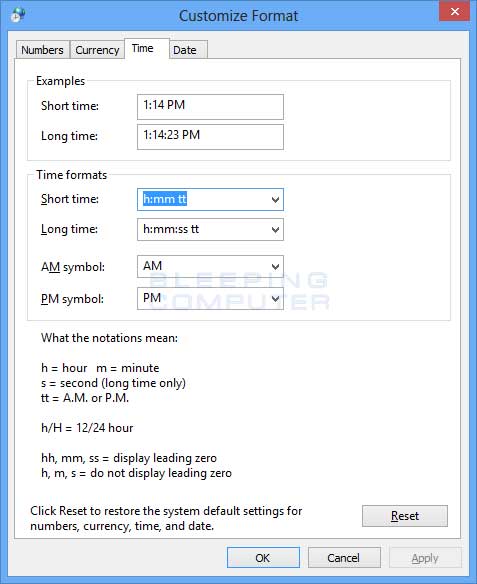
Also, I would agree that the Windows UI is better since it provides a short description of the format letters; but they could've just as easily done that for the commonly-used strftime() specifiers too, with perhaps a link that opens a popup with all of them. The live preview at the top also helps.
Re: Why doesn’t the clock in the taskbar display seconds? (2003)
#100Earlier quoted context omitted.
We are in a different era now, where desktop apps are written in JS. Performance is implicitly thrown out of the window(s) when compared to software written for control over every bit of CPU and memory usage.
But the JS ecosystem learns things! They implement tree shaking and other stuff to improve performance! Obviously real programmers learned all this decades ago - same for the "NoSQL" followers who after years of struggling with piles of cr.p finally (re)discover what a true ACID-capable database is... I'm just waiting for the JS world to rediscover threads and proper multitasking, but given the track record I don't e…
This isn't a JS issue. It's an optimization bug in the CSS rendering.
Holy crap the superiority complex is just gushing out of you. Sometimes it's just incredible seeing how much shit "real programmers" will throw at the "fake programmers."
The Electron platform is popular because it's easy to work with when building portable GUIs. It's especially easier for webdevs who use the same languages all the time. They can accessibly hack on the editor, create plugins, etc. Just like Java devs use Eclipse and IntelliJ, and C# devs use Visual Studio, and Obj-C / Swift devs use XCode.
If it's so easy to build portable GUIs the "right way", why are Slack, WhatsApp, Google, game producers, hardware vendors, browsers, etc all using this technology?
Also, I don't understand why you keep complaining about all of these Electron apps. Do you work on desktop GUIs yourself? Have you built GUIs that hook into mainly CLI programs like many of these Electron apps?