Live data from Hacker News

CERN uses ultra-compact AI models on FPGAs for real-time LHC data filtering

theopenreader.org

81–90 of 166 posts

Re: CERN uses ultra-compact AI models on FPGAs for real-time LHC data filtering

#81
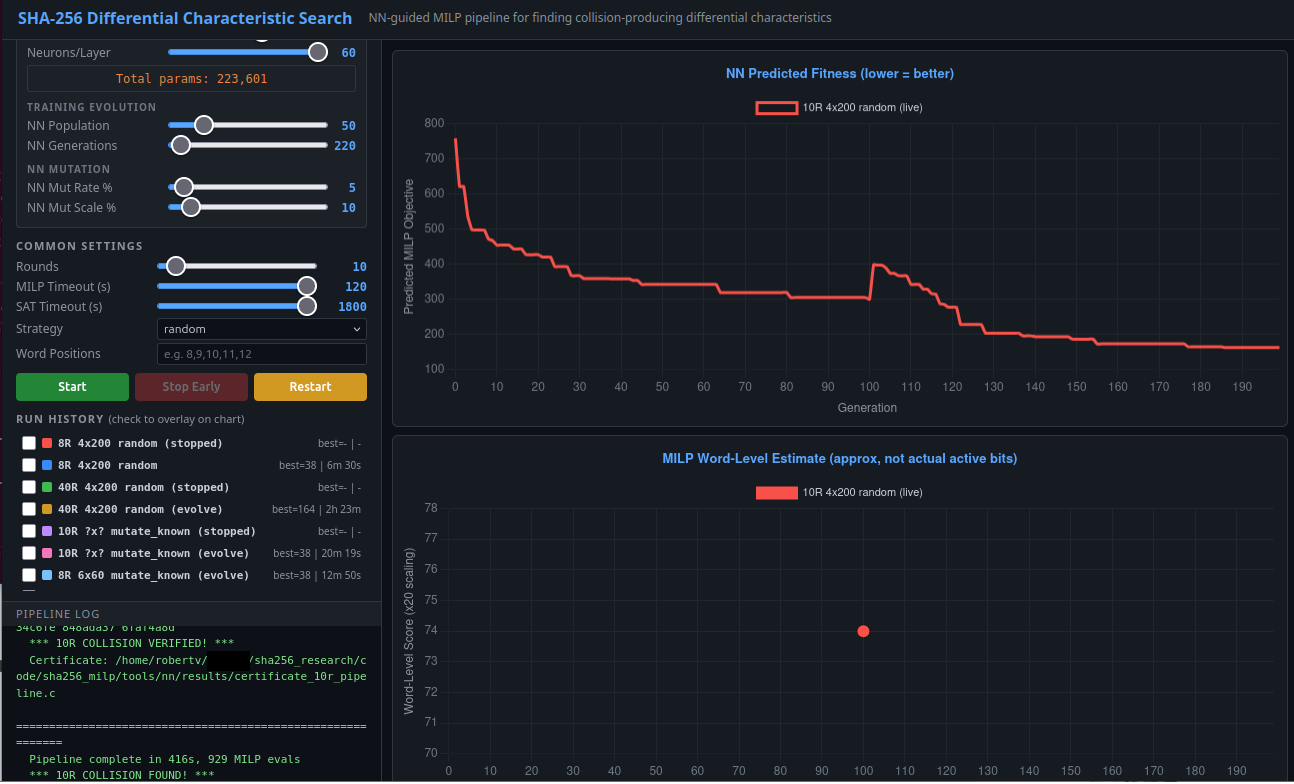
I hope they have good results and keep all the data they need, and identify all the interesting data they're looking for. I do have a cautionary tale about mini neural networks in new experiments. We recently spent a large amount of time training a mini neural network (200k parameters) to make new predictions in a very difficult domain (predicting specific trails for further round collisions in a hash function than anyone did before.) We put up a spiffy internal dashboard[1] where we could tune parameters and see how well the neural network learns the existing results. We got to r^2 of 0.85 (that is very good correlation) on the data that already existed, from other people's records and from the data we solved for previously. It showed such a nicely dropping loss function as it trained, brings tears to the eye, we were pumped to see how it performs on data it didn't see before, data that was too far out to solve for. So many parameters to tune! We thought we could beat the world record by 1 round with it (40 instead of 39 rounds), and then let the community play with it to see if they can train it even better, to predict the inputs that let us brute force 42 round collisions, or even more. We could put up a leaderboard. The possiblities were endless, all it had to do was do extrapolate some input values by one round. We'd take the rest from there with the rest of our solving instrastructure.

After training it fully, we moved on to the inference stage, trying it on the round counts we didn't have data for! It turned out ... to have zero predictive ability on data it didn't see before. This is on well-structured, sensible extrapolations for what worked at lower round counts, and what could be selected based on real algabraic correlations. This mini neural network isn't part of our pipeline now.

[1] screenshot: https://taonexus.com/publicfiles/mar2026/neural-network.png
Re: CERN uses ultra-compact AI models on FPGAs for real-time LHC data filtering

#82
post #56

Earlier quoted context omitted.

I'm half expecting to see "AI model" appearing as stand-in for "linear regression" at this point in the cycle.

I'm half expecting to see "AI model" appearing as stand-in for "if > 0" at this point in the cycle.

This is essentially what any relu based neural network approximately looks like (smoother variants have replaced the original ramp function). AI, even LLMs, essentially reduce to a bunch of code like

    let v0 = 0
    let v1 = 0.40978399*(0.616*u + 0.291*v)
    let v2 = if 0 > v1 then 0 else v1

    let v3 = 0
    let v4 = 0.377928*(0.261*u + 0.468*v)
    let v5 = if 0 > v4 then 0 else v4...

Re: CERN uses ultra-compact AI models on FPGAs for real-time LHC data filtering

#83
post #82
post #56

Earlier quoted context omitted.

I'm half expecting to see "AI model" appearing as stand-in for "if > 0" at this point in the cycle.

This is essentially what any relu based neural network approximately looks like (smoother variants have replaced the original ramp function). AI, even LLMs, essentially reduce to a bunch of code like let v0 = 0 let v1 = 0.40978399*(0.616*u + 0.291*v) let v2 = if 0 > v1 then 0 else v1 let v3 = 0 let v4 = 0.377928*(0.261*u + 0.468*v) let v5 = if 0 > v4 then 0 else v4...

Thats a bit far. Relu does check x>0 but thats just one non-linearity in the linear/non-linear sandwich that makes up universal function approximator theorem. Its more conplex than just x>0

Re: CERN uses ultra-compact AI models on FPGAs for real-time LHC data filtering

#84

How are FPGAs "bruned into silicon"? Would be news to me that there are ASICs being taped out at CERN

Could they.... have someone else do it for them?

Glib, but it wont be cost effective at that small scale

Re: CERN uses ultra-compact AI models on FPGAs for real-time LHC data filtering

#85

They used a custom neural net with autoencoders, which contain convolutional layers. They trained it on previous experiment data. https://arxiv.org/html/2411.19506v1 Why is it so hard to elaborate what AI algorithm / technique they integrate? Would have made this article much better

Because it does not align with LLM Uber Alles.

Re: CERN uses ultra-compact AI models on FPGAs for real-time LHC data filtering

#86

the fact that 99% of LHC data is just gone forever is insane

Not really. Think of the experiment as a very, very high speed camera. They can't store every frame, so they try to capture just the "interesting" ones. They also store some random ones that can be used later as controls or in case they realize they've missed something. That's the whole job of these various layers of algorithms: recognizing interesting frames. Sometimes a new experiment basically just changes the definition of "interesting"

Re: CERN uses ultra-compact AI models on FPGAs for real-time LHC data filtering

#87

They used a custom neural net with autoencoders, which contain convolutional layers. They trained it on previous experiment data. https://arxiv.org/html/2411.19506v1 Why is it so hard to elaborate what AI algorithm / technique they integrate? Would have made this article much better

Thanks for tracking this down. I too am annoyed when so-called technical articles omit the actual techniques.

Re: CERN uses ultra-compact AI models on FPGAs for real-time LHC data filtering

#88

I've got news for you, everybody with a modern cpu uses this, which use a perceptron for branch prediction.

At this point AI basically means "we didn't know how to solve the problem so we just threw a black box at it".

Re: CERN uses ultra-compact AI models on FPGAs for real-time LHC data filtering

#89

Earlier quoted context omitted.

> I'm half expecting to see "AI model" appearing as stand-in for "linear regression" at this point in the cycle. Already the case with consulting companies, have seen it myself

Some career do-nothing-but-make-noise in my organization hired a firm to 'Do AI' on some shitty data and the outcome was basically linear regression. It turns out that you can impressive executives with linear regression if you deliver it enthusiastically enough.

Tbh, often enough, linear regression is exactly what is needed.
Post reply on HN