Live data from Hacker News

At 17, Hannah Cairo solved a major math mystery

quantamagazine.org

81–90 of 186 posts

Re: At 17, Hannah Cairo solved a major math mystery

#81
post #63

Earlier quoted context omitted.

This is ignoring the value of the whole education process, that you go through the years at a university. I disagree that she should skip the general education.

Thinking about my GE requirements at undergrad, I think it would be a waste of this girl's time to be forced to learn about and write about random subjects that don't interest her. She has but one lifetime, and can contribute much to her field. The subjects such as English composition, she should be allowed to test out of if she is already a good writer.

> I think it would be a waste of this girl's time to be forced to learn about and write about random subjects that don't interest her.

This is a common STEM view, but it is inherently wrong. IMHO it dates back to the unfortunate divide between science and the liberal arts, whereas both were once considered a single field, now days there is disdain and mistrust between the two sides.

The point of history classes isn't to memorize the dates of wars, is it to understand the motivations of humans, it is to understand how the world we lived in has been shaped throughout time, and it is to learn how to do, and understand, research about the history of a place.

The point of English classes isn't just to get good at writing, it is to get good at various types of writing, it is to learn how to read different forms of literature, and it is to have a guided tour through a chosen selection of literature to hopefully develop one's character and thoughtfulness.

One of the most valuable classes I ever took at University was the Art Of Listening To Music. We started off around 500ad or so and went forward through time up until about 1920. We learned the vocabulary of music, how to sit down and listen to a piece of music and describe what we were hearing. After I was done with the class I went from appreciating a handfuls of genres of music to appreciating music itself no matter the genre. It was a 3 credit guaranteed A class that had enriched my life by an enormous amount.

If you really love your major, then the point of going to university was NOT your major, odds are you would've studied that field with or without the school. (Barring fields that require large capital investments, chemistry, physics, playing with an entire orchestra, building airplanes, etc) The point is everything else.
Re: At 17, Hannah Cairo solved a major math mystery

#82
post #61

Earlier quoted context omitted.

I think research and higher education does have value for the most part. It's undergrad that's really worthless and something people only do for the experience.

Undergrads who care about learning and research will take the most challenging classes, do research with professors, and surround themselves with other strong students who will push them. Even at top universities, very very few freshmen are capable of doing high-quality research immediately. They'd be better served learning the foundations inside and out with a cohort of similarly strong students to challenge them.

To agree with you: I've worked with several really brilliant undergrads doing and publishing great research. But all of them were rightfully undergrads. Even if they were actually capable of doing great research, they benefited from the breadth.

If you have bright enough undergrads, you change the curriculum for them within their field of expertise, so that they still get the breadth of things outside it while not wasting time with things they know. You let them not take as many classes, take graduate courses, do more research, take more courses from other departments in related areas but with different perspectives, and so on.

When I was an undergrad, in physics, there was a professor in the department who had done his undergrad there and was legendary, as was quietly mentioned in awe, for not taking any undergraduate physics courses while there; the department had let him skip all of them, and instead take graduate courses and do research.

Re: At 17, Hannah Cairo solved a major math mystery

#84

> Only the University of Maryland and Johns Hopkins University were willing to welcome her straight into a doctoral program. She’ll start at Maryland in the fall. When she finishes, it will be her first degree. Jeez... what a damning indictment of today's Universities. She could just use her publication as a dissertation and be done with it!

> Jeez... what a damning indictment of today's Universities.

> She could just use her publication as a dissertation and be done with it.

I’m not suggesting this person is doing anything fraudulent as she seems quite impressive.

However, educational institutions get constant requests from parents who want their children to skip far ahead before they’re ready. It’s a competitive world and they know that being able to claim a child skipped several grades or even skipped undergrad entirely is a unique and very impressive achievement for the resume. It also theoretically provides a few additional years of earning potential by giving a career head start.

The first problem is that many of these parents (again, no accusations for this specific case) see this and want to make it happen for their child at any cost. There are some wild stories about parents trying to cheat their kids forward or falsifying their accomplishments to try to skip grades.

The secondary problem is that it can be hard on kids to be thrust forward so far past their peers. I had several friends who skipped a grade in middle school and most of them didn’t have a great experience for social reasons. Skipping undergrad altogether would thrust someone into a foreign world with a lot of baseline expectations and norms that they hadn’t yet learned, combined with no peers their age to discuss it with.

It creates a high chance for burnout or failure, which could leave them worse off than when they started.

That’s why the recommendation is generally to do undergrad at a challenging institution that allows students some upward mobility in specific areas where they’re ahead. No reasonable undergrad program is going to have this person taking Algebra 101, but there are a lot of opportunities for them to jump right into advanced programs and go deep and broad.

Re: At 17, Hannah Cairo solved a major math mystery

#85

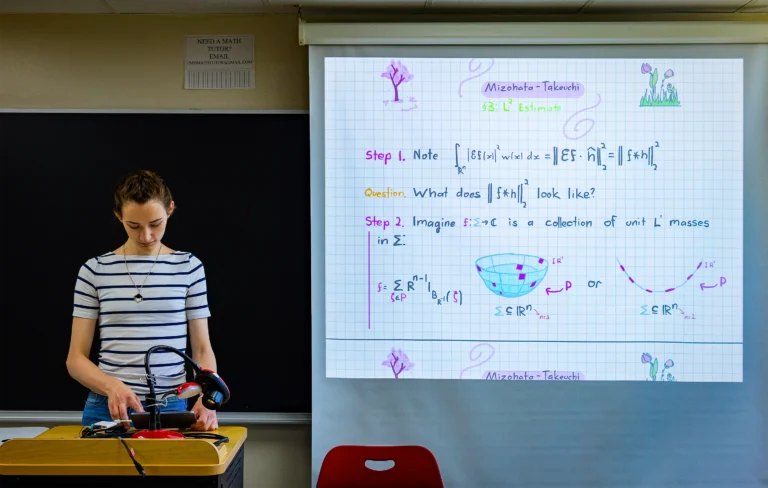
There's so many photos of just her staring off into the distance, and only one photo with her presenting the actual thing that she's supposedly famous for. I don't get the point of just all these random photos of this girl.

It's not very easy to take photos of mathematics, and the girl is the central subject of the article anyway. What images would you expect to see?

Re: At 17, Hannah Cairo solved a major math mystery

#86

“There was this inescapable sameness, in a way. No matter what I did, I was in the same place doing mostly the same things,” she said. “I was very isolated, and nothing I could do could really change that. I’d wake up on certain days and realize, I’m just older.” I finally have something in common with a math prodigy.

Thank God she found math instead of Factorio.

Re: At 17, Hannah Cairo solved a major math mystery

#87

> Only the University of Maryland and Johns Hopkins University were willing to welcome her straight into a doctoral program. She’ll start at Maryland in the fall. When she finishes, it will be her first degree. Jeez... what a damning indictment of today's Universities. She could just use her publication as a dissertation and be done with it!

The interesting part is that two others admitted her but retracted after "higher-ups in those universities’ administrations overrode those decisions". Was she not considered properly conditioned?

Of course she was, but that's not what this is about. Letting her in proves that the bureaucratic credentials offered by schools are meaningless. The university system in its present form in the US is entirely predicated on the fiction that those credentials actually mean something and are worth paying six figures for.

Re: At 17, Hannah Cairo solved a major math mystery

#88
Zvezdalina Stankova who comments on miss Cairo is on her own super out of the ordinary.

https://math.berkeley.edu/~stankova/

Not only she did grow in Bulgaria during the most turbolent times of regime change from communism to democracy, but later graduates with a PHD from Harvard, and later becomes Director and Founder of the Berkeley Math Circle, and is also organizer of math competitions in Bay Area, and publisher of what seems to be a complete set of Math Books, carefully crafted with her peers from BG and presented here

https://archi-math.com/

Curious whether miss Cairo was a student of hers or is to be.

Re: At 17, Hannah Cairo solved a major math mystery

#89
post #81
post #63

Earlier quoted context omitted.

Thinking about my GE requirements at undergrad, I think it would be a waste of this girl's time to be forced to learn about and write about random subjects that don't interest her. She has but one lifetime, and can contribute much to her field. The subjects such as English composition, she should be allowed to test out of if she is already a good writer.

> I think it would be a waste of this girl's time to be forced to learn about and write about random subjects that don't interest her. This is a common STEM view, but it is inherently wrong. IMHO it dates back to the unfortunate divide between science and the liberal arts, whereas both were once considered a single field, now days there is disdain and mistrust between the two sides. The point of history classes isn't…

But that isn't how it works in reality, at least in the US. In reality, outside of their major (and sometimes inside it too), students usually pick the absolute easiest classes that satisfy the requirements. The ones that are known that the teacher doesn't take attendance are heavily desired. And the university is happy to oblige. Departments are funded based on a formula of how many students are in their classes, and they know that if they gain a reputation for being hard, students won't take their classes for GE requirements. It's a race to the bottom. So most departments offer enormous 1 level classes with 200 students taught with minimal rigor, and where you really only have to study a few days before the final to collect your A. And on top of that the frats all keep collections of graded tests from every class for years past, so basically anyone who wants to cheat is able to do so easily. This isn't education. This isn't worth six figures.

Re: At 17, Hannah Cairo solved a major math mystery

#90
post #58

Earlier quoted context omitted.

Is it an important conjecture, or just something someone came up with last week?

This is answered in the article’s second paragraph.

But I don't know that from the proposed re-titling of the article. The importance of the conjecture is more salient for the general reader than the (uninformative) names of the people who conjectured in the first place.
Post reply on HN