Live data from Hacker News

Canon EF and RF Lenses – All Autofocus Motors

exclusivearchitecture.com

81–90 of 147 posts

Re: Canon EF and RF Lenses – All Autofocus Motors

#81
post #74

Earlier quoted context omitted.

The system stops the motors once it reaches focus. Therefore is a closed loop system.

Correct. The AF sensor continually takes more samples even while the motor is moving. You can tell because sometimes the motor overshoots and then you can see it come back.

Yup… but it’s not necessarily in the same state if you do it twice. It’s close, but not identical. Even if the image metadata claims the focus point is identical, the lens in all likelihood is not in the same state and will have some deviation in its intrinsics.
Re: Canon EF and RF Lenses – All Autofocus Motors

#82
post #72

Amazing website. If I didn't know better, I thought this content came from Canon itself. A couple of comments from me: > The following comparison chart shows all of the autofocus drive types that have ever been used in Canon's EF, EF-S, RF, and RF-S lenses. They missed mentioning EF-M, Canon's foray into mirrorless interchangeable-lens cameras. > Although the ultrasonic noise cannot be perceived by the human ear, it…

EF-M is fairly dead at this point isn't it?

Re: Canon EF and RF Lenses – All Autofocus Motors

#83
post #72

Amazing website. If I didn't know better, I thought this content came from Canon itself. A couple of comments from me: > The following comparison chart shows all of the autofocus drive types that have ever been used in Canon's EF, EF-S, RF, and RF-S lenses. They missed mentioning EF-M, Canon's foray into mirrorless interchangeable-lens cameras. > Although the ultrasonic noise cannot be perceived by the human ear, it…

> EF-M, Canon's foray into mirrorless interchangeable-lens cameras

Canon's foray into SMALL mirrorless interchangeable-lens cameras.

The R series are mirrorless, but not that small. too bad.

Re: Canon EF and RF Lenses – All Autofocus Motors

#84
post #72

Amazing website. If I didn't know better, I thought this content came from Canon itself. A couple of comments from me: > The following comparison chart shows all of the autofocus drive types that have ever been used in Canon's EF, EF-S, RF, and RF-S lenses. They missed mentioning EF-M, Canon's foray into mirrorless interchangeable-lens cameras. > Although the ultrasonic noise cannot be perceived by the human ear, it…

[deleted]

Re: Canon EF and RF Lenses – All Autofocus Motors

#86
post #59
post #56

Such a cool website. In case anyone else was looking for it, this article from the same author covers the more algorithm-y question of how a camera body decides to actually use these motors when you press the "focus" button: https://exclusivearchitecture.com/03-technical-articles-DSLR... I can't find any articles on how a camera body decides what is and isn't a desired subject. I'm guessing there's some amount of mac…

Nowadays they use pre-trained pattern recognition AI models, yes, which has become much more impressive (and CPU-intensive) with mirrorless cameras where the entire resolution of the main image sensor is available for analyzing the scene. Some higher-end traditional DSLRs have a "high"-resolution (around 0.1 MPix or so) metering sensor that is used to assist the AF system (eg. what Canon calls iSA and iTR [1]). Tradi…

Sony A9 III even has a configuration setting of whether it should focus on the left or right eye of the person :) It also can remember faces and prioritize them if there other faces. Let's say someone shoots their kid on the football field and wants only them to be in focus.

Re: Canon EF and RF Lenses – All Autofocus Motors

#87
post #45

These piezoelectric drivers are very cool. Here's a video showing the mechanism: https://www.youtube.com/watch?v=7iHL4ZCkCKc And here's a video showing such a motor at full speed: https://www.youtube.com/watch?v=JtttNnmCVmU

Do companies like Canon manufacture these motors or actuators themselves? Or is there some other company that specializes in this sort of thing?

Re: Canon EF and RF Lenses – All Autofocus Motors

#88
post #59
post #56

Such a cool website. In case anyone else was looking for it, this article from the same author covers the more algorithm-y question of how a camera body decides to actually use these motors when you press the "focus" button: https://exclusivearchitecture.com/03-technical-articles-DSLR... I can't find any articles on how a camera body decides what is and isn't a desired subject. I'm guessing there's some amount of mac…

Nowadays they use pre-trained pattern recognition AI models, yes, which has become much more impressive (and CPU-intensive) with mirrorless cameras where the entire resolution of the main image sensor is available for analyzing the scene. Some higher-end traditional DSLRs have a "high"-resolution (around 0.1 MPix or so) metering sensor that is used to assist the AF system (eg. what Canon calls iSA and iTR [1]). Tradi…

The technical term for the "stickiness" you're referring to, where a system is resistant to change or has a memory, is hysteresis.

Re: Canon EF and RF Lenses – All Autofocus Motors

#89
@ExAr - A treasure trove of information, thanks for putting in the effort!

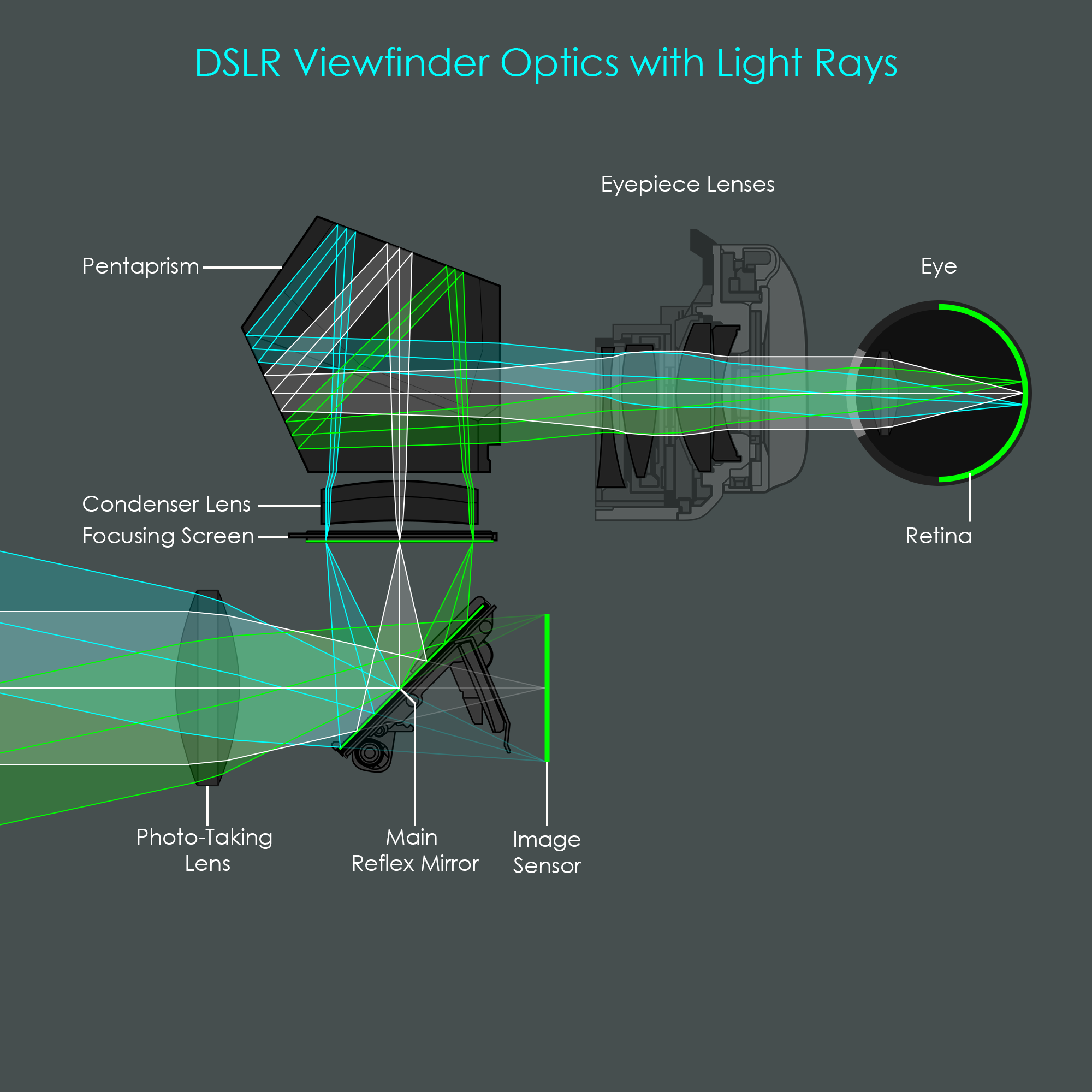
Do you blog about how you go about creating these graphics? For example, this view finder image: https://exclusivearchitecture.com/images/technical-articles/... looks very impressive!

How do you simulate the rays+eye?

Re: Canon EF and RF Lenses – All Autofocus Motors

#90
post #32

Earlier quoted context omitted.

As a Canon owner, Nikon has a much longer back compatibility range. Having autofocus motors and IS in body rather than in lens seems to be a part of their trick.

The traditional Nikon mount has a small screw that is turned. The camera autofocus speed is limited by the amount of torque that can be applied to the screw - which can make focusing some of the heavier lenses slower. https://www.discoverdigitalphotography.com/2012/lens-mounts-... The "AF-D" lenses have contacts back to the camera body that communicate distance information (that is in turn used by the camera body to…

Nikon his shifted almost exclusively to their Z mount lenses. And some of these have in-lens and/or on-camera VR.
Post reply on HN