Live data from Hacker News

The Texas Triangle: A rising megaregion unlike all others (2021)

kinder.rice.edu

81–90 of 139 posts

Re: The Texas Triangle: A rising megaregion unlike all others (2021)

#81

As someone who recently moved to the Texas triangle, I’m baffled by the lack of good transportation options between the three cities. It’s a 3-4 hour drive and while there is a train, freight gets priority. So the train takes anywhere from 3-7 hours. You can fly but with security any sort of delay and it would faster to drive.

Check out Vonlane. They are deluxe buses that cover the Texas triangle. We use them for work to move our guys between Houston / Austin regularly and people seem to love it. It's pretty cheap, comfortable, and has wifi.

Cheap? I just checked there and Austin to Dallas return is 270 dollars... On a bus. That's just incomprehensibly expensive to me (as a European).
Re: The Texas Triangle: A rising megaregion unlike all others (2021)

#82
"Pragmatic politics" is a complete joke when discussed in the context of Texas. Also, Austin is one of the most segregated metropolitan cities in the U.S. in all categories: politically, racially, and economically. It is also, no surprise, one of the grossest examples of gerrymandering.

Re: The Texas Triangle: A rising megaregion unlike all others (2021)

#83
post #14
post #2

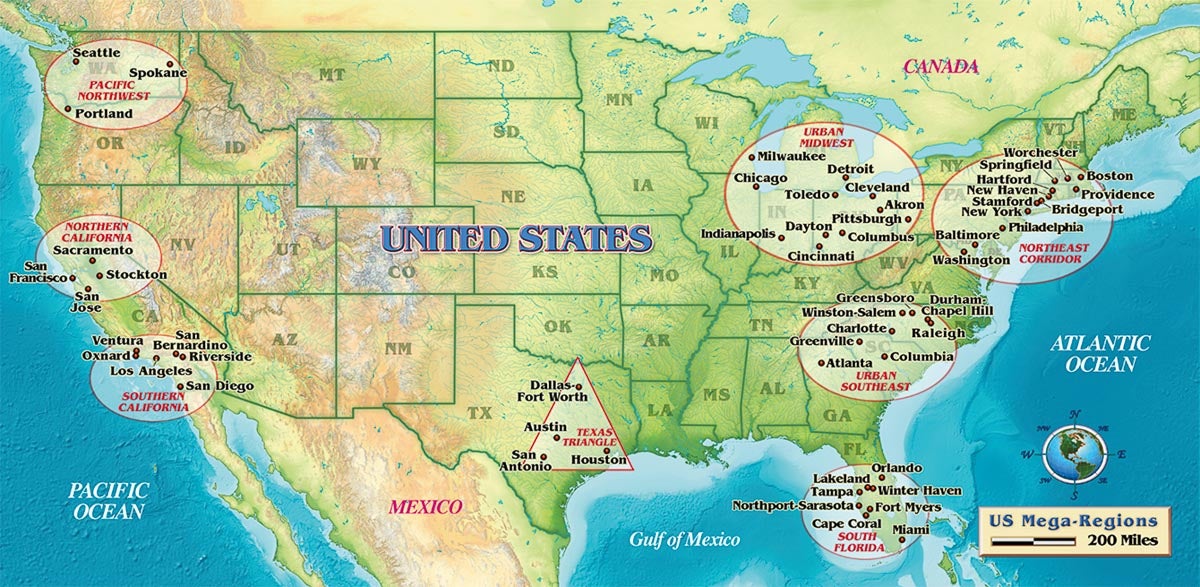
I never thought about it before - but seeing that chart of "Megaregions", almost none of my work travel within the US from the last 15 years has been outside of those regions.

I feel like I'm missing some nuance, because it looks like it's basically just taking the largest population cities in the US and drawing circles around the ones near each other. "Most economic activity happens where the most people live" doesn't seem like a particularly novel insight.

I don't really agree. First, having lived in a few of those "megaregions", I really agree with the author that they each have distinct and unique characters. I also see other nitpicks in some comments here about "there is a lot of wide-open spaces in those circles!" - that seems a bit silly to me given that many of those circles include wide expanses of ocean, and it seems clear to me that the author just means to highlight the related urban areas, not the emptiness in between.

But more to your point, there are plenty of other sizable cities that are not part of the megaregions the author highlights, and I would agree that those cities are less dynamic and less engines of economic growth due to their isolation - places like Phoenix, Salt Lake City, Minneapolis, etc. The only difference I think is that it "feels" to me like there is an emerging megaregion on the eastern slope of the Front Range in Colorado, i.e. Ft. Collins-Boulder-Denver-Colorado Springs area.

Re: The Texas Triangle: A rising megaregion unlike all others (2021)

#84
post #69
post #50

Earlier quoted context omitted.

Plus seceding would probably hand control of the House over to Democrats. (Oh how the tables have toppled).

Rather than succeeding, perhaps Texas could split into 5 and get 10 senators per their annexation agreement to join the US? : https://www.tsl.texas.gov/ref/abouttx/annexation/march1845.h... "Third. New States, of convenient size, not exceeding four in number, in addition to said State of Texas, and having sufficient population, may hereafter, by the consent of said State, be formed out of the territory thereof, which…

What was annexed and what is now Texas are not the same thing. Some of the area of the original Texas already is part of different states (no other state is a majority of old Texas though)

Re: The Texas Triangle: A rising megaregion unlike all others (2021)

#85

Seems like a pretty vacuous article if “megaregions” are so poorly defined. Anyone who has ever driven between Spokane and Portland or Seattle knows it could hardly be considered “mega”.

I think the consensus is that the Portland-Seattle-Vancouver corridor is the "real" megaregion of the PNW. That corridor has ~10 million people and a high per capita GDP, especially the middle part which kind of ties it together.

If you were going to include Spokane, it isn't that much of a stretch to include Boise as well.

Re: The Texas Triangle: A rising megaregion unlike all others (2021)

#86
post #79

Earlier quoted context omitted.

I disagree with the slower than driving. I could take the train from the Valley to downtown SD in less time to drive. The train is a fairly consistent amount of time where driving totally depends on day/time. Leaving the Valley on a Friday afternoon has taken more than 4 hours. On the train, it is very close to 2 hours. As more fine grained details, from my place in Burbank to my friend's place in Carlsbad was 99 mil…

If you're "train stop to train stop" LA to SD is great. I used to use it all the time, it was only faster than driving on Friday afternoons, and even then half the time it would be quite a close cut. Much, much more comfortable and fun! But not exactly faster, especially when I counted getting dropped off in time to catch the train and getting picked up on the other end.

I just took my beach cruiser with me, and took off. No need to be dropped off/picked up.

Edit: to follow up on your Friday comment. I made the mistake of not driving down on a Friday night, and waited until the next morning. The mistake was not knowing anything about the ponies running that weekend, and half of the LA basin was trying to get there. That was the one and only time I was sitting on the highway where I felt like I was in one of those disaster movies where everyone is trying to flee. I kept looking to see if someone was taking advantage and shooting some b-roll. It took me nearly 6 hours that day.

Re: The Texas Triangle: A rising megaregion unlike all others (2021)

#87
post #29

Earlier quoted context omitted.

It's interesting that the government can't convince owners to sell. I mean - we're talking about politicians. They manage to negotiate everything and compromise even in the middle of wars. See prisoner exchange between Russia and Ukraine right now. Or Israel and Hamas. Worst enemies and they can still find a compromise. It can't be just about money - governments successfully negotiate with unions that hold the whole…

Imagine that you had to negotiate with a homeowner. You could find a price where you could buy their property. Now imagine that you had to negotiate with 10,000 homeowners. At least one of them is going to insist that their place is worth one billion dollars and count on you caving because they can hold up the entire project. That's why forced confiscation - because people try to hold the project hostage for ransom.

> because people try to hold the project hostage for ransom

Unions hold countries hostage by closing down rail or airports. Still, a solution that doesn't cost 1 billion dollars per person is always found.

> imagine that you had to negotiate with 10,000 homeowners

Imagine you offer them 2-10x market value. With a confidentiality clause. And the threat of confiscation or project abandonment. I believe an amiable solution would be found in most cases.

Re: The Texas Triangle: A rising megaregion unlike all others (2021)

#88
post #77

Earlier quoted context omitted.

I disagree with the slower than driving. I could take the train from the Valley to downtown SD in less time to drive. The train is a fairly consistent amount of time where driving totally depends on day/time. Leaving the Valley on a Friday afternoon has taken more than 4 hours. On the train, it is very close to 2 hours. As more fine grained details, from my place in Burbank to my friend's place in Carlsbad was 99 mil…

That is context dependent. In Texas traffic outside of the cities isn't that bad and so slow speed trains are much slower than driving. Inside the city of course traffic is a factor, but even then I'd expect in the normal case you get beyond traffic in a short time and then driving is much faster. And of course driving is door to door so you don't have to figure out time to/from the stations, waiting on trains and re…

If a train is fast, it's going through uninhabited areas (no stops). The moment you start having relatively frequent stops is when the average speed goes down.

That's not to say we shouldn't have the trains, it's part of the entire transportation package.

The key is you build the transportation framework first, and let the city grow up around it.

Re: The Texas Triangle: A rising megaregion unlike all others (2021)

#89
post #71

How can they write an article about a triangle, list four relevant locations in it, while also not including a &^%€*#@ map that shows the thing they are talking about? Gaaah.

FWIW they provide this [1] map. Dallas, Austin, and San Antonio are roughly collinear.

[1] https://kinder.rice.edu/sites/g/files/bxs4896/files/images/U...

Re: The Texas Triangle: A rising megaregion unlike all others (2021)

#90

this reads more like content marketing for a private college based in Texas than a substantive academic commentary. The author has several associations, but his official title on LinkedIn is: Director for Economic Growth at George W. Bush Institute https://www.linkedin.com/in/cullum-clark-09549159/

[deleted]
Post reply on HN