Live data from Hacker News

Norwegian: Bokmål vs. Nynorsk

sprakradet.no

81–90 of 163 posts

Re: Norwegian: Bokmål vs. Nynorsk

#81
post #49

Earlier quoted context omitted.

I wish for a bigger revolution in Swedish. It has been rather painful to experience how hard it is for my children to learn to do simple addition in their heads because the language is broken. It's easier to add 30 and 40 in your head for children, than it is to add 13 and 2! Because it's "3 ten and 4 ten" vs " and 2". The special word being "thirteen". The language is irregular for numbers up to 29 as 20 has a speci…

My Danish grandpa used to mock our Norwegian numbers (who is he to speak, with the Danish number system being completely wack, heh), by saying toti-en, toti-to etc as 21, 22, because he found it funny that we had a different word for 20 than for the other tens.

Yea, with Danish they have special words for... let's see: 20, 30, 40, 50, 60, 70, 80, 90.

Ouch. Just absolutely horrible. Swedish is amazingly regular compared to that.
Re: Norwegian: Bokmål vs. Nynorsk

#82
Norwegian here.

Nynorsk, or "New Norwegian", is really just used by a people on the south-western part of Norway. Other than that, it is merely a formality.

You'll have to take the obligatory classes in Jr. HS and HS, but that's it for most people.

A certain percentage of texts published by state agencies have to be in Nynorsk. The vast majority of Norwegians will never use it.

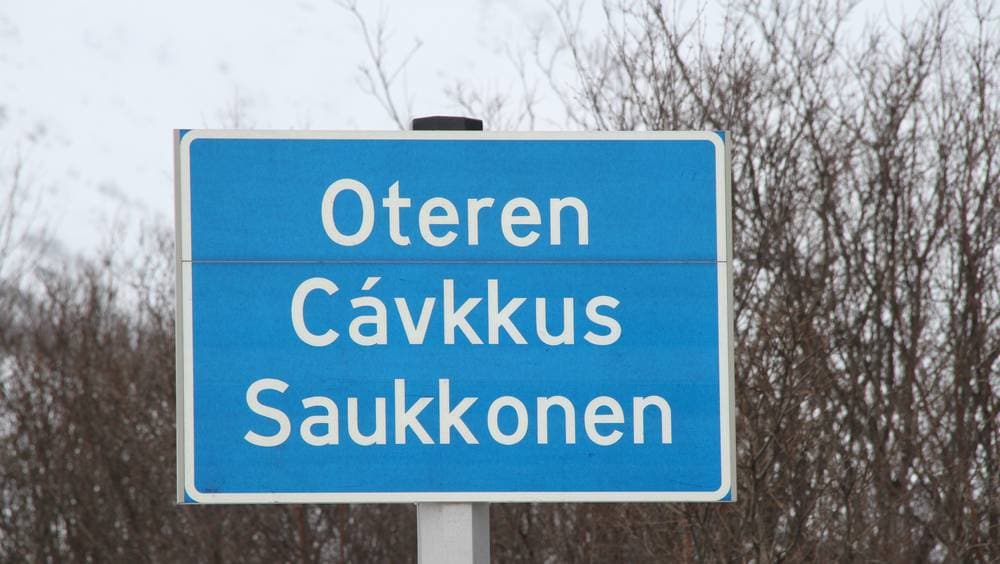
We also have two other languages used here - Sámi, which is the language of the Sámi people - the indigenous people in Norway, and Kven, which is used by Kven people. A Finnish dialect/language use by a small number of people in Northern Norway. That is why you can sometimes see three different signs when traveling up North (example: https://gfx.nrk.no/zDih8cbMibUfJJo4xiPqRQvkcy07eBhmSISFaS0Sc... )

EDIT: And if you travel far enough north-east, to Kirkenes, you will also find some Russian/Cyrillic signs

Re: Norwegian: Bokmål vs. Nynorsk

#85
post #10

Norwegian written and pronounced language was actually changed because one digit was added to phone numbers. Here is the long story: Starting after World War Two, the government made an attempt at _merging_ the two written languages. The imagined outcome was named “Samnorsk” (unified Norwegian), led by Språknemnda (The Language committee). The work mainly consisted of changing the grammar of certain words in the bokm…

The failed samnorsk reform did have a silver lining. Around high school I figured out that because of it, a shocking amount of Nynorsk grammar was secretly optional and the Bokmål version was very often valid Nynorsk. So I started just writing my essays in Bokmål and then fixing the errors in post, so to speak. Initially my teacher tried to fail me for this, but she lost that battle. I vehemently hate Nynorsk, or at…

Nynorsk kept me away from becoming a fighter pilot

Re: Norwegian: Bokmål vs. Nynorsk

#86
post #18

Earlier quoted context omitted.

Nynorsk is not considered higher status other than maybe by tiny groups of its users.

I know nothing about it except what is in the article, and the article characterizes Nynorsk as “cultural elite language”—it looks like the article is not accurate? That aside, “cultural elite” or “status” are always relative, of course…

A small cultural elite within its own user base likes to thumb their nose at Bokmål, but the proportion of the population who uses Nynorsk is only 10%. The vast majority of the "cultural elite" of Norway as a whole uses Bokmål. There are perhaps some small subsets where it might punch above its weight relative to the total number of users, and I think that is what the article is hinting at. E.g. we have had perhaps more prominent authors who use Nynorsk than the proportion of Nynorsk users might have made you expect.

But conversely, you'll if anything be more likely to find people with negative attitudes to Nynorsk, with at least some proportion of people who resent having to deal with a language only used by 10%.

Re: Norwegian: Bokmål vs. Nynorsk

#87
post #72

> Danish pronunciation sounds extremely «blurred» in Norwegian (and Swedish) ears. It does to Dutch ears too. Just a few weeks ago, I passed through some tourist-infested area in Amsterdam. "Are these Swedish tourists drunk at this hour in morning already? Oh, wait, they are sober Danes."

As a Swede I always thought you would relate to Danish more since both Danish and Dutch sounds "blurry" to us.

Re: Norwegian: Bokmål vs. Nynorsk

#88
post #78
post #55

Earlier quoted context omitted.

For some reason many languages use an irregular system for numbers. Well, reasons are historical.. things may have made more sense in (e.g.) Old Norse than modern Danish, for example. Japanese though.. now that's regular. One, two, three, .. nine, ten, ten-one, ten-two,.. ten-eight, ten-nine, two-ten, two-ten-one.. and so on. And then 'hundred', and continue the same way. to-hundred-to-ten-five (225). The only stumbl…

I think every natural language is irregular when it comes to numbers. And about Japanese: you forgot about counters for men, animals, flat things and so on. You have ichi-ippiku-ippon-hitory - issai And absolutely fascinating "system" for "years old" - everything starts with -sai but 20 years is "hatachi"!

Counters are a different story than numbers. The numbers are highly regular, with the tiny exception that numbers 4 and 7 technically have two variants, where in certain areas one is preferred more than the other, and the pronunciation of 9 when talking about time. But that's really minor.

As soon as you're starting to count it's different.

Re: Norwegian: Bokmål vs. Nynorsk

#89

As a student of Bokmål (for immigration and integration), Nynorsk is an ongoing mystery to me. I think that I'm still at the A level (A1/A2). My auditory processing disorder adds an extra variable that I'm still learning how to work with as an adult. If anyone (in Norway) knows of someone who has or is interested in APD ( https://www.statped.no/horsel/andre-utfordringer/auditive-pr... ), please reach out to me. Anywa…

Had a remote meeting with someone from Finland today. She speaks a bit Swedish, so I speak Norwegian and we can understand each other. Then today some other Norwegian joined in on the meeting, but she's from western Norway with a heavy dialect, and we had to switch to English for everyone to understand each other, heh.

Re: Norwegian: Bokmål vs. Nynorsk

#90
post #57

Earlier quoted context omitted.

Nynorsk and Bokmål are both _written_ forms only. Norwegian spoken language is a huge continuum of dialects - there's no official spoken Norwegian (unlike e.g. Swedish, where something called "rikssvensk" was introduced by the authorities - "national spoken Swedish"). What you will find though is that there are a couple of scenarios where people will kind of speak the written form. One is, or at least used to be, new…

If they were solely written languages then you wouldn’t be able to, for example, read the text aloud, right? I don’t have any first-hand knowledge, but according to Wikipedia on Bokmål it looks like it can be spoken as well (Wikipedia uses a phrase “spoken Bokmål”), but without a universally agreed-upon and regulated pronunciation. Isn’t it similar to English in this sense?

Bokmål and Nynorsk are both systems designed as a common form of writing. None of them were ever meant to be a spoken language - they are "best effort" of trying to make a unified way of writing. That doesn't mean that it's not possible to "speak" them, as in e.g. reading aloud (though the intonation and pronunciation may still wary wildly depending on the speaker's actual dialect).
Post reply on HN