The end of the story looks like 'space invaders', and I have the urge to shoot the letters.
[deleted]
81–90 of 136 posts
The end of the story looks like 'space invaders', and I have the urge to shoot the letters.
The end of the story looks like 'space invaders', and I have the urge to shoot the letters.
Omg, there should totally be a game like that to help people learn!
You can move it around with the arrow keys. It says "alien".
Now what should it do?
Earlier quoted context omitted.
think differently. right now our brain processes letter by letter, with dotsies it will become symbol by symbol. i'm reading it for some time, haven't had that difficulty. there will always be letters next to it anyway, easy to see the base, if you have to.
This looks exactly like Chinese. Chinese people don't read line by line, they read paragraph by paragraph. Chinese has the advantage of reading very fast, and in fewer length[1]. The drawbacks however, are much larger character set (which results in higher illiteracy), and slightly slower writing speed. But English/Romantic languages are not best suited for symbolic reading, because there are declensions. In Chinese,…
Looks more like a worse version of Hangul.
There's even a least one font available: http://danielsolisblog.blogspot.fr/2010/09/free-font-marain-...
I really like this approach (even if I'm still not entirely convinced about the benefits of dotsies). For a while, I've had this idea of a book that starts in standard English, and gradually alters the grammar and introduces new words - so that halfway-through it's written in somewhat of a pidgin/creole language, and by the end you're reading a completely different language (e.g. French or Japanese). I'm not aware of…
[1]: https://en.wikipedia.org/wiki/Latino_sine_flexione not to be confused with the other international auxiliary language called Interlingua which is also a generic Romance language. [2]: http://www.gutenberg.org/files/35803/35803-h/35803-h.htm
This seems like it could actually be a real improvement on written Latin if it adopted a real phonetic alphabet. Just transposing all of my existing graphemes for new, smaller ones seems a little silly. (And since what you're really asking is not for people to learn a new alphabet, but to learn a new symbol for every word in their lexicon, it wouldn't be that much more of a leap. Think about it.) Thinking about it--…
This seems like it could actually be a real improvement on written Latin if it adopted a real phonetic alphabet. Just transposing all of my existing graphemes for new, smaller ones seems a little silly. (And since what you're really asking is not for people to learn a new alphabet, but to learn a new symbol for every word in their lexicon, it wouldn't be that much more of a leap. Think about it.) Thinking about it--…
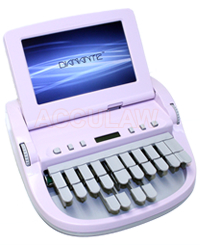
You have to write at 225 words a minute in order to graduate, but some people are able to write at speeds of 300+ words a minute. If you look at the keyboard, the machine is separated into two halves. On the left half there are only 9 keys, but each letter of the alphabet can be written with those 9 keys because it's context sensitive. The letter "t" by itself would be the letter t, but if it's next to a "k", it might become the letter d. You mentioned that we can knock out certain letters such as c, and that's indeed what is done with stenography. The word "car" is written "kar". There are sometimes conflicts, like "sell" and "cell", so you still need a way to write a c, but that's the gist of it.
Worth mentioning is that there are only 4 vowel keys on the machine (the vowels are the keys that are on the bottom), but you can write a lot of different sounds with these four keys. A, O, E, and U are the vowels that are on there, and if you press one of those keys individually, you'd write a short vowel of that key. If you wanted to write a short I, you'd press E and U together. You would write long vowel sounds by combining different vowels together. So for example, if you wanted to write a long e sound, you'd write aoe, long U sound would be aou, long a sound would be ai (or aeu depending on how you look at it), long o is oe, and long i is all the vowels together at once.
It can be hard to read what you've written if you're not extremely good at it. The word dime, for example, you would see as "TKAOEUPL". There are a few different theories out there, and even if everyone learns the same theory, everyone puts their own little spin on it, so if you wanted to read what someone else wrote, it might be tough.
This is the layout of the keyboard if anyone is interested (http://dmc122011.delmar.edu/ba/crtrgallery/images/steno_keyb...)
Earlier quoted context omitted.
Ok, here's a start: http://dotsies.org/game/ You can move it around with the arrow keys. It says "alien". Now what should it do?
I added some characters. Someone give me a plot!
This seems like it could actually be a real improvement on written Latin if it adopted a real phonetic alphabet. Just transposing all of my existing graphemes for new, smaller ones seems a little silly. (And since what you're really asking is not for people to learn a new alphabet, but to learn a new symbol for every word in their lexicon, it wouldn't be that much more of a leap. Think about it.) Thinking about it--…
While it is possible to make a phonemic alphabet (phonetic would capture people's accents as well, which is probably not what you want), this removes the connection words have with their foreign origins. Plus pronunciation might change and you don't want to rewrite all books whenever that happens. You have to learn reading & writing anyway, so it might as well be a separate language to some extent, so that it can be more stable.