Live data from Hacker News

Antarctic sea-ice at 'mind-blowing' low alarms experts

bbc.co.uk

81–90 of 116 posts

Re: Antarctic sea-ice at 'mind-blowing' low alarms experts

#81
post #5

Could we breed trees which capture more CO2? We increased crop yields multifold already: https://ourworldindata.org/crop-yields So maybe we can do the same to carbon yield? Are trees the plants which capture most CO2 per hectare?

There's part of me thinks just let the worst happen and let it end half of humanity, that way we might learn to live more in harmony with our environment. Currently we're a pox on this planet.

> There's part of me thinks just let the worst happen and let it end half of humanity

You first.
Re: Antarctic sea-ice at 'mind-blowing' low alarms experts

#82

Earlier quoted context omitted.

[flagged]

Are you a Chinese troll? If not, you're doing a great job of advocating for China. At this point it's inevitable that solar power and EV's are going to win. They don't need any subsidies to win. But without the subsidies China will take the entire market and we'll be much more dependent on China in the future than we are on Saudi Arabia now.

[deleted]

Re: Antarctic sea-ice at 'mind-blowing' low alarms experts

#83

If you want to show a trend, give us a diagram that shows a trend. A scatter plot with a trend line would be a start, maybe. One can equally interpret the diagram from the article as showing a fairly constant level - somewhat varying within a limited range - with 2023 being an outlier. All it tells about is the variance and without at least more year labels there is no way to read anything about the trend from it. [I…

> trend You can play with the data a bit here: http://nsidc.org/arcticseaicenews/charctic-interactive-sea-i... Be sure to click the Antarctic button. Arctic (the default) shows 2012 as the lowest record. For Antarctica, last year was the previous minimum and was 2-sigma from the mean. Additional iso-sigma curves are not shown but I'd guess this year is at least one more sigma off the mean. I progressively activate pa…

Thanks for pointing to the source data. As much as I would be careful eyeballing a trend I would be with eyeballing the absence of one. I really would love to see a proper analysis of this data, but I am in my phone right now.

Arctic doesn't really matter much in this regard because the arctic ice doesn't influence the sea level, which I think is the main (but not only) point of the article.

Re: Antarctic sea-ice at 'mind-blowing' low alarms experts

#84
post #60

Earlier quoted context omitted.

Because the current climate spending is extremely inefficient and stupid. For example, if we put all this effort into making more energy, e.g. making nuclear actually work, we could soon make the climate do what we want, not the other way around. And of course anything the government gets involved in will get screwed up, so just stop screwing it up and let the bright people do what they are passionate about.

> we could soon make the climate do what we want Can you expand on this? If it's geoengineering you're talking about we don't really need all the energy for it.

Imagine regulatory asphyxiation disappears. Imagine energy tech gets its own Moore's law. Imagine cheap abundant energy, say 10 orders of magnitude from now in a few decades. Heating up or cooling down the planet at will doesn't sound impossible then.

Re: Antarctic sea-ice at 'mind-blowing' low alarms experts

#85

Earlier quoted context omitted.

[flagged]

Are you a Chinese troll? If not, you're doing a great job of advocating for China. At this point it's inevitable that solar power and EV's are going to win. They don't need any subsidies to win. But without the subsidies China will take the entire market and we'll be much more dependent on China in the future than we are on Saudi Arabia now.

[flagged]

Re: Antarctic sea-ice at 'mind-blowing' low alarms experts

#86
post #35
post #20

Earlier quoted context omitted.

Your two quotes don't follow: > We increased crop yields multifold already With catastrophic effects. > Most of it is because of animal agriculture.

As example most soy is used by animal agriculture.

One way to reduce the amount of soy grown is to eat more soy.

Re: Antarctic sea-ice at 'mind-blowing' low alarms experts

#89
post #71

Earlier quoted context omitted.

China is the #1 builder in all renewable (and nuclear too) by a significant margin You are going to need to also propose a solution beyond "stay poor" for the country.

Good intentions do not fix anything. China is still a problem.

How is China a problem? The way of life and the energy intensity of a single individual living in the developed world is the problem. Do I have to point out the US and Europe? (I live in the UK).

Re: Antarctic sea-ice at 'mind-blowing' low alarms experts

#90
post #13
post #5

Could we breed trees which capture more CO2? We increased crop yields multifold already: https://ourworldindata.org/crop-yields So maybe we can do the same to carbon yield? Are trees the plants which capture most CO2 per hectare?

> We increased crop yields multifold already With catastrophic effects. https://www.stockholmresilience.org/research/research-news/2... All planetary boundaries mapped out for the first time, six of nine crossed https://www.researchgate.net/publication/320356605_Agricultu... Agriculture production as a major driver of the Earth system exceeding planetary boundaries Most of it is because of animal agriculture - it use…

> The overshoot threatens our civilization with crop failures. The only realistic way out of it is immediate phase-out of fossil fuels

An "immediate phase-out of fossil fuels" would kill a billion people or more right off the bat. Do you not understand that, or do you simply not care?

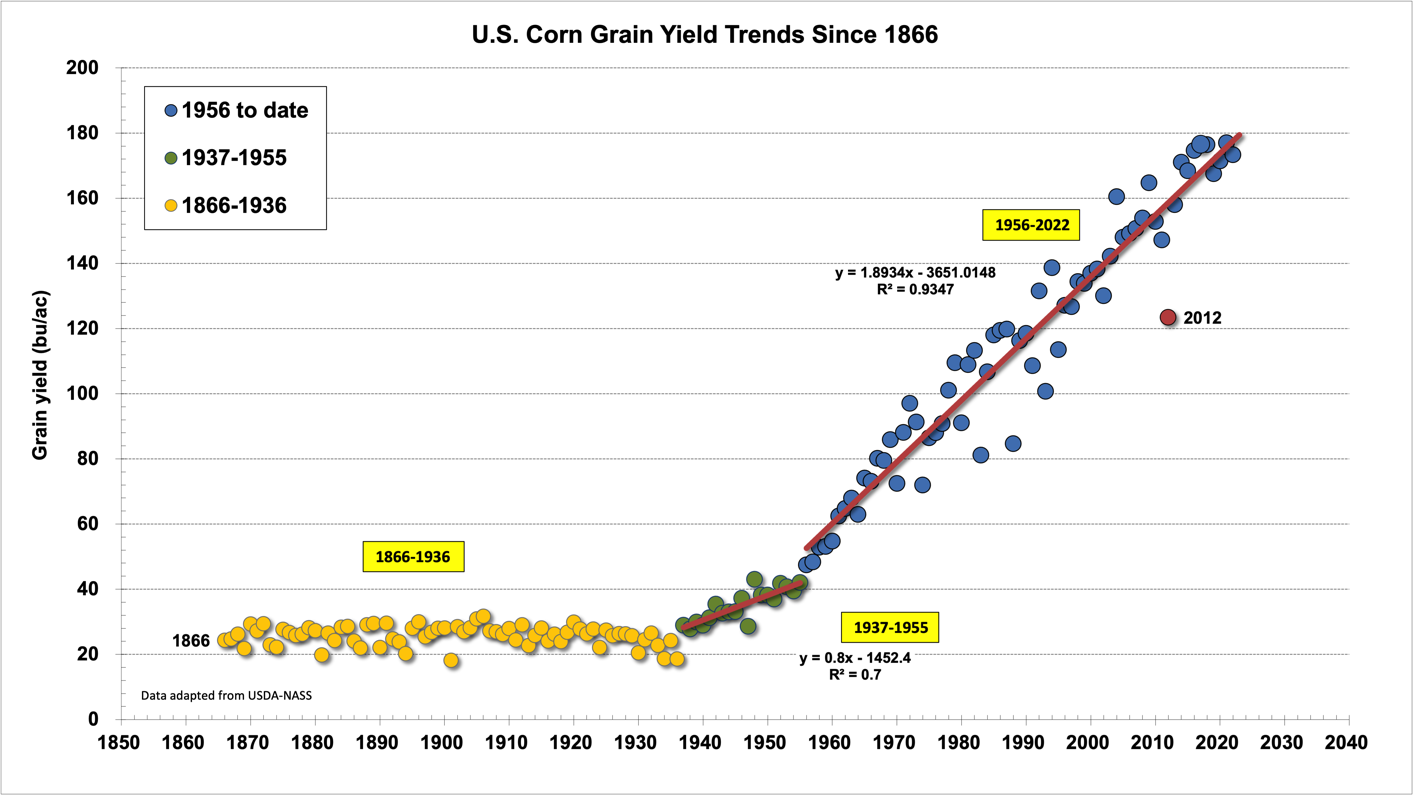
https://www.agry.purdue.edu/ext/corn/news/timeless/images/US...

See how corn yield has increased from around 20 bushels/acre to nearly 180?

That extra 160 bushels of corn per acre is due almost exclusively to fossil fuels and other modern agricultural practices.

That extra 160 bushels is also what feeds a substantial portion of the planet.

The same is true of other crops such as wheat. In the last hundred years or so, the Kansas wheat crop has gone from 12-13 bushels per acre to well over 30 (40 in a good year).

That didn't happen with a peasant poking animal manure into the ground with a digging stick. It happened with tractors, combine harvesters, and petrochemical-derived fertilizers.

Post reply on HN