Live data from Hacker News

Fengari – Lua for the Browser

fengari.io

81–90 of 145 posts

Re: Fengari – Lua for the Browser

#81
post #28

No web assembly?

Not sure why'd you think this would have anything to do with WASM, the homepage is really clear what this is: > Fengari is the Lua VM written in JavaScript. It uses JavaScript's garbage collector so that interoperability with the DOM is non-leaky. WASM wouldn't use JS's GC, nor would provide interop with the DOM, so for the stated goals of this project, WASM would be a non-starter. There is prior art for Lua -> WASM…

Vanessa Freudenberg's brilliant SqueakJS, a Squeak VM in JavaScript, also layers a Smalltalk VM on top of JavaScript in a way that efficiently and elegantly interoperates with JavaScript's garbage collector, because trying to layer one garbage collector on top of another garbage collector would be a disaster.

https://squeak.js.org/

HN discussions:

https://news.ycombinator.com/item?id=29018465

https://news.ycombinator.com/item?id=8982251

My comment about the SqueakJS CG in that later discussion (with updated links and excerpts):

https://news.ycombinator.com/item?id=29019992

One thing that's amazing about SqueakJS (and one reason this VM inside another VM runs so fast) is the way Vanessa Freudenberg elegantly and efficiently created a hybrid Smalltalk garbage collector that works with the JavaScript garbage collector.

SqueakJS: A Modern and Practical Smalltalk That Runs in Any Browser

https://smalltalkzoo.thechm.org/papers/EvolutionOfSmalltalk....

>The fact that SqueakJS represents Squeak objects as plain JavaScript objects and integrates with the JavaScript garbage collection (GC) allows existing JavaScript code to interact with Squeak objects. This has proven useful during development as we could re-use existing JavaScript tools to inspect and manipulate Squeak objects as they appear in the VM. This means that SqueakJS is not only a “Squeak in the browser”, but also that it provides practical support for using Smalltalk in a JavaScript environment.

>[...] a hybrid garbage collection scheme to allow Squeak object enumeration without a dedicated object table, while delegating as much work as possible to the JavaScript GC, [...]

>2.3 Cleaning up Garbage

>Many core functions in Squeak depend on the ability to enumerate objects of a specific class using the firstInstance and nextInstance primitive methods. In Squeak, this is easily implemented since all objects are contiguous in memory, so one can simply scan from the beginning and return the next available instance. This is not possible in a hosted implementation where the host does not provide enumeration, as is the case for Java and JavaScript. Potato used a weak-key object table to keep track of objects to enumerate them. Other implementations, like the R/SqueakVM, use the host garbage collector to trigger a full GC and yield all objects of a certain type. These are then temporarily kept in a list for enumeration. In JavaScript, neither weak references, nor access to the GC is generally available, so neither option was possible for SqueakJS. Instead, we designed a hybrid GC scheme that provides enumeration while not requiring weak pointer support, and still retaining the benefit of the native host GC.

>SqueakJS manages objects in an old and new space, akin to a semi-space GC. When an image is loaded, all objects are created in the old space. Because an image is just a snapshot of the object memory when it was saved, all objects are consecutive in the image. When we convert them into JavaScript objects, we create a linked list of all objects. This means, that as long as an object is in the SqueakJS old-space, it cannot be garbage collected by the JavaScript VM. New objects are created in a virtual new space. However, this space does not really exist for the SqueakJS VM, because it simply consists of Squeak objects that are not part of the old-space linked list. New objects that are dereferenced are simply collected by the JavaScript GC.

>When full GC is triggered in SqueakJS (for example because the nextInstance primitive has been called on an object that does not have a next link) a two-phase collection is started. In the first pass, any new objects that are referenced from surviving objects are added to the end of the linked list, and thus become part of the old space. In a second pass, any objects that are already in the linked list, but were not referenced from surviving objects are removed from the list, and thus become eligible for ordinary JavaScript GC. Note also, that we append objects to the old list in the order of their creation, simply by ordering them by their object identifiers (IDs). In Squeak, these are the memory offsets of the object. To be able to save images that can again be opened with the standard Squeak VM, we generate object IDs that correspond to the offset the object would have in an image. This way, we can serialize our old object space and thus save binary compatible Squeak images from SqueakJS.

>To implement Squeak’s weak references, a similar scheme can be employed: any weak container is simply added to a special list of root objects that do not let their references survive. If, during a full GC, a Squeak object is found to be only referenced from one of those weak roots, that reference is removed, and the Squeak object is again garbage collected by the JavaScript GC.

Also:

The Evolution of Smalltalk: From Smalltalk-72 through Squeak. DANIEL INGALLS, Independent Consultant, USA

http://worrydream.com/refs/Ingalls%20-%20The%20Evolution%20o...

>A.5 Squeak

>Although Squeak is still available for most computers, SqueakJS has become the easiest way to run Squeak for most users. It runs in just about any web browser, which helps in schools that do not allow the installation of non-standard software.

>The germ of the SqueakJS project began not long after I was hired at Sun Microsystems. I felt I should learn Java; casting about for a suitable project, I naturally chose to implement a Squeak VM. This I did; the result still appears to run at http://weather-dimensions.com/Dan/SqueakOnJava.jar .

>This VM is known in the Squeak community as "Potato" because of some difficulty clearing names with the trademark people at Sun. Much later, when I got the Smalltalk-72 interpreter running in JavaScript, Vanessa and I were both surprised at how fast it ran. Vanessa said, "Hmm, I wonder if it’s time to consider trying to run Squeak in JavaScript." I responded with "Hey, JavaScript is pretty similar to Java; you could just start with my Potato code and have something running in no time."

>"No time" turned into a bit more than a week, but the result was enough to get Vanessa excited. The main weakness in Potato had been the memory model, and Vanessa came up with a beautiful scheme to leverage the native JavaScript storage management while providing the kind of control that was needed in the Squeak VM. Anyone interested in hosting a managed-memory language system in JavaScript should read his paper on SqueakJS, presented at the Dynamic Languages Symposium [Freudenberg et al. 2014].

>From there on Vanessa has continued to put more attention on performance and reliability, and SqueakJS now boasts the ability to run every Squeak image since the first release in 1996. To run the system live, visit this url:

https://smalltalkzoo.thechm.org/HOPL-Squeak.html?launch

codefrau 3 months ago | parent [–]

Dan published an updated version of that paper here:

https://smalltalkzoo.thechm.org/papers/EvolutionOfSmalltalk....

Would be great if you could cite that one next time. The main improvement for me is not being deadnamed. There are other corrections as well.
Re: Fengari – Lua for the Browser

#82
post #51

Earlier quoted context omitted.

Why would Lua be significantly faster than Python? Isn't it an interpreted language too?

The Lua interpreter is really lightweight, and for decades has been the go to choice for when you need dynamic code and speed (for example, it's been popular in the games industry for this reason). Probably someone else can shed light on exact numbers, but Lua is faster than Python.

It's also very small. We used it extensively on embedded Linux devices in the 2000s for these reasons as well as easy interop with C/C++.

Re: Fengari – Lua for the Browser

#83
post #43

Earlier quoted context omitted.

I wish Netscape had chosen Lua instead of bothering to invent JavaScript. Python would have also been much better than JavaScript, but Lua would have been perfect. But at least they didn't choose TCL, as Sun was pushing before they switched gears to Java after the Great TCL War. And personally, I would have preferred PostScript (which was the basis of NeWS, with a Smalltalk-like OOP system) or ScriptX (which was like…

> People who are confused about equality shouldn't design programming languages: This is a very dull criticism of JavaScript, everybody uses ===. While it's definitely true the language has some poor decisions (`with`, `==`, etc.). You can write JS without using any of these features (and almost everyone does). Infact, just using a decently strict ESLint config will get you most of the way there. It's controversial,…

> The syntax is dead simple

It really annoys me that people confuse ease of use due to familiarity with simplicity.

Many programmers will be familiar with the typical curly-braced C-style syntax many mainstream programming languages have and so find JS syntax easy to get into but that has nothing to do with simplicity.

Building a parser for JS is not exactly simple nor is teaching new programmers the syntax. Lua is vastly superior in both aspects. People just tend to forget the pain most new programmers have to go through learning a curly braced languages, having to figure what all these weird symbols and different kinds of braces and how to type them.

JS is arguable even worse than other curly braced languages because of weird exceptions like automatically adding semicolons to line endings or these fancy arrow functions. Honestly JS is one of very few languages were I actually need to look up syntax after having not used it for a while.

Re: Fengari – Lua for the Browser

#85
post #43

Earlier quoted context omitted.

> People who are confused about equality shouldn't design programming languages: This is a very dull criticism of JavaScript, everybody uses ===. While it's definitely true the language has some poor decisions (`with`, `==`, etc.). You can write JS without using any of these features (and almost everyone does). Infact, just using a decently strict ESLint config will get you most of the way there. It's controversial,…

Decades later you may believe that "everybody" uses "===", but actually "==" is still there, and many people still use that regardless of what you choose to believe, simply because it's there and 33% shorter and looks like C and Stackoverflow is full of examples of it, and it STILL commonly causes many subtle hard-to-find bugs. People like Roberto Ierusalimschy, Luiz Henrique de Figueiredo, and Waldemar Celes, James…

> But you also missed the reference to how deeply and tragically confused

I couldn’t find this reference in your little essays here. Where is it?

Re: Fengari – Lua for the Browser

#86

I was pleasantly surprised it loaded so fast. So I wanted to check the size of it. I opened the firefox debugger, and it went blank O_o Chrome was ok with it: it's about 220kb, which is not bad at all for a whole runtime + stdlib. Python pyiodide ( https://pyodide.org/en/stable/ ) is several Mb. 220kb is still too much to pay upfront, since I usually want my webpages to be under 1Mb, and I can't justify burning 1/4 o…

>I opened the firefox debugger, and it went blank O_o

No problems here?

Re: Fengari – Lua for the Browser

#87
post #28

No web assembly?

I have to wonder: if one compiled the Lua VM into WASM, would it by any chance run code at speed comparable to JS? Seeing as plain Lua is crazy fast for a dynamic language.

That's assuming that WASM itself works with minimal delays.

Re: Fengari – Lua for the Browser

#88

Lua is the only language I can truly say I love. If more people used it (and used it responsibly, not letting it become a mess of odd libraries), the world would be a better place.

I wish Netscape had chosen Lua instead of bothering to invent JavaScript. Python would have also been much better than JavaScript, but Lua would have been perfect. But at least they didn't choose TCL, as Sun was pushing before they switched gears to Java after the Great TCL War. And personally, I would have preferred PostScript (which was the basis of NeWS, with a Smalltalk-like OOP system) or ScriptX (which was like…

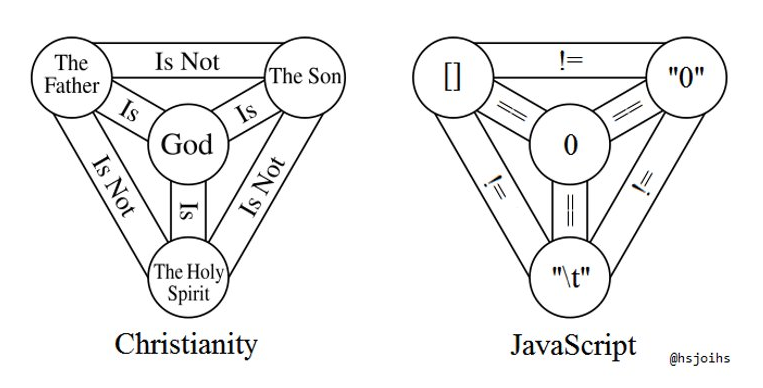
One of the best illustrations of how JS equality works: https://www.codewiz.org/wiki/pictures/jokes/computers/js-tri...

Re: Fengari – Lua for the Browser

#89
post #43

Earlier quoted context omitted.

I wish Netscape had chosen Lua instead of bothering to invent JavaScript. Python would have also been much better than JavaScript, but Lua would have been perfect. But at least they didn't choose TCL, as Sun was pushing before they switched gears to Java after the Great TCL War. And personally, I would have preferred PostScript (which was the basis of NeWS, with a Smalltalk-like OOP system) or ScriptX (which was like…

> People who are confused about equality shouldn't design programming languages: This is a very dull criticism of JavaScript, everybody uses ===. While it's definitely true the language has some poor decisions (`with`, `==`, etc.). You can write JS without using any of these features (and almost everyone does). Infact, just using a decently strict ESLint config will get you most of the way there. It's controversial,…

[deleted]

Re: Fengari – Lua for the Browser

#90
post #37

Earlier quoted context omitted.

> basically no confusing elements. the one confusing element - one-based indexing of arrays! that is something i found hard to adjust, as it makes off-by-one errors more prominent... but otherwise it's a nice language.

iirc, one other confusing element is that tables (hash tables? I don't remember what they're called) return null when a lookup is done for a nonexistent key. This is not necessarily a bad choice. Exceptions and such can be a real pain. However, accidentally getting a null value because you didn't check and then have it propagate much further in your program is extremely difficult to debug. Instead of blowing up at th…

Storing a null value is a legitimate operation. How do you distinguish "never stored a value under key K", and "stored null under key K"?
Post reply on HN