Live data from Hacker News

Renting 'is unaffordable to minimum wage workers in every state,' study finds

money.yahoo.com

81–90 of 108 posts

Re: Renting 'is unaffordable to minimum wage workers in every state,' study finds

#81
post #66

This is the actual source of the article[1]. The methodology does not support the claim the title makes. >LendingTree used U.S. Department of Labor and U.S. Census Bureau data to determine whether owning or renting a home is affordable to a person working a full-time minimum wage job. Assuming a person could afford to spend up to 30% of their gross monthly income on housing, LendingTree calculated how much in monthly…

The title doesn’t make sense at all to me. If the statement was literally true, what would happen to the millions of minimum wage earners? They literally couldn’t afford rent and would be literally living on the street, or in shelters. And I’m using the word literally literally. You can make a case for some sort of relative poverty where they find hardship in renting which is absolutely true, but this clickbait title…

Furthermore, since this article seems to be in support of raising the minimum wage, if there is literally no place to rent then raising the minimum wage doesn't do much. There is literally-literally no marginal housing stock available to rent.

It is like if a merchant has 4 saucepans and 5 people who want to buy a saucepan. It doesn't matter how much money the people have. They cannot all get a saucepan. The housing market is much more complicated by but $15/hr isn't going to fix that sort of problem; if it exists. Where would the extra housing stock for the workers come form?
Re: Renting 'is unaffordable to minimum wage workers in every state,' study finds

#82

Earlier quoted context omitted.

>They also are not arbitrarily constrained to follow good budgeting guidelines which specify not more than 30% of income to housing. poor people are not arbitrarily constrained to spend only 30% of their income for housing? Well that's true I guess, but I mean there's a reason why 30% is assumed as being good budgeting practice. >the arrangement which I very comfortably made it through grad school in is apparently no…

>I am an adult with a family Minimum wage is not meant to support a family

Bullshit.

If that were true, it would be legally specified as "the minimum wage you can pay to someone without a family."

Minimum wage was always intended to be a living wage. It just hasn't kept pace with inflation for the last several decades.

There is absolutely nothing that makes it harder to pay someone with a family minimum wage, or easier for someone with a family to get a job with a better wage.

Re: Renting 'is unaffordable to minimum wage workers in every state,' study finds

#83
post #61

Earlier quoted context omitted.

> This isn't a bad thing. Counterpoint: It absolutely is.

Why?

Sometimes you're forced to live with some truly awful people. It's not always practical to stay with family, e.g. many people moving to the city for work.

Re: Renting 'is unaffordable to minimum wage workers in every state,' study finds

#84
post #28

> They calculated how much in monthly housing costs a person working 40 hours a week for 52 weeks a year at the minimum wage hourly rate in their state could afford. They then compared that to the median monthly homeowner and rent costs derived from the U.S. Census Bureau’s 2019 American Community Survey. This … signifies nothing? Take a hypothetical state that consists of three people and three houses, one rented by…

I think they're using the median instead of the mean for exactly this reason. It's a more robust measure central tendency. Looking at those rental prices it looked very accurate to me. The real problem is why would they compare minimum wage with median rental prices? Both are distributions.

Because many, many people are paid minimum wage: wages are not the same kind of distribution as prices.

I don't know exact figures, but I'm absolutely certain that if you plotted the distribution of wages, you'd see a hugely disproportionate number at or just above the minimum wage. Y'know, because there's an artificial pressure (the law) preventing anyone from paying less.

Housing prices, meanwhile, are not subject to the same kinds of constraints. They likely follow a much more normal distribution (though not, I suspect, a normal distribution in the statistical sense).

Re: Renting 'is unaffordable to minimum wage workers in every state,' study finds

#86

This is the actual source of the article[1]. The methodology does not support the claim the title makes. >LendingTree used U.S. Department of Labor and U.S. Census Bureau data to determine whether owning or renting a home is affordable to a person working a full-time minimum wage job. Assuming a person could afford to spend up to 30% of their gross monthly income on housing, LendingTree calculated how much in monthly…

> This study assumes you must spend less than 30% of your income on housing

I'm not saying the study is good, but the lower the wage, the smaller the percentage of income remaining to spend on rent, because of basic cost of living, after a certain threshold all flexibility with income dissappears and cost of living dictates rent.

For high earners the cost of living is a small dent against their income, so percentage of income to spend on renting is a desicion about savings - this is not true of the lowest earners, it's a choice of eating.

Re: Renting 'is unaffordable to minimum wage workers in every state,' study finds

#87
post #66

This is the actual source of the article[1]. The methodology does not support the claim the title makes. >LendingTree used U.S. Department of Labor and U.S. Census Bureau data to determine whether owning or renting a home is affordable to a person working a full-time minimum wage job. Assuming a person could afford to spend up to 30% of their gross monthly income on housing, LendingTree calculated how much in monthly…

The title doesn’t make sense at all to me. If the statement was literally true, what would happen to the millions of minimum wage earners? They literally couldn’t afford rent and would be literally living on the street, or in shelters. And I’m using the word literally literally. You can make a case for some sort of relative poverty where they find hardship in renting which is absolutely true, but this clickbait title…

> Unaffordable means you cannot pay. It doesn’t mean it’s hard to get by.

That statement does not make sense in the case of housing. For most people, housing is their top priority. Not only is shelter a necessity in the survivalist sense, but there are cascading consequences for those who don't have housing. This ranges from it being extraordinarily difficult to secure and maintain employment to driving up the cost for other necessities such as food and clothing.

Put in other terms: if you have the choice between food and housing, your money goes towards housing. Technically speaking, food is more important since it is literally impossible to survive without it. Realistically speaking, food is still available from other sources (e.g. food banks). While there is a loss of dignity, there are fewer cascading consequences.

Even if a person can pay for their housing, I would argue that the word unaffordable still applies when they have to accept handouts for other necessities. I would also go a step further and suggest the unaffordable label applies when it impacts any socially imposed expense that will contribute to a downwards spiral that can lead to homelessness.

Re: Renting 'is unaffordable to minimum wage workers in every state,' study finds

#88
post #82

Earlier quoted context omitted.

>I am an adult with a family Minimum wage is not meant to support a family

Bullshit. If that were true, it would be legally specified as "the minimum wage you can pay to someone without a family." Minimum wage was always intended to be a living wage. It just hasn't kept pace with inflation for the last several decades. There is absolutely nothing that makes it harder to pay someone with a family minimum wage, or easier for someone with a family to get a job with a better wage.

That's because having a family is a choice, plain and simple, and this would incentivize having more kids to get paid more.

Re: Renting 'is unaffordable to minimum wage workers in every state,' study finds

#89
post #18

Earlier quoted context omitted.

Why would there not be a market for housing people with low wages? There are markets for cheap food, cheap clothes, cheap entertainment, ... Everything except lodging. There's a hiccup somewhere in the "free market" of many countries that prevents it from providing cheap housing, even though there's clearly a huge business opportunity.

Maybe there is a bare minimum on comfort what people are willing to accept? I lived in Asia for a while. There were some many options. From a 3m2 room (if you wanted to sit, you had to open the door and sit on your bed) to a full mansion. I'm back in a major capital in Europe and there is pretty much nothing you can rent under 1000EUR (70-80% of minimum wage)

Yes, the problem with those bare minimums is that they're imposed from rich people (legislative class) onto poor people.

This results in a cut-off point, below which you lose the security of a stable, regulated, lodging situation, and are instead forced to operate outside the protection of the law, into a variety of more or less precarious situations.

Everyone has different priorities and aspirations. I personally would have preferred securing a stable space, even if it's closet-sized, than carrying my luggage between temporary accommodations or sharing my living space with strangers. Some people prefer the later options. There's no fundamental reason the basic freedom of having agency over your living accommodations should be denied to those below a certain level of wealth.

Re: Renting 'is unaffordable to minimum wage workers in every state,' study finds

#90
post #84

Earlier quoted context omitted.

I think they're using the median instead of the mean for exactly this reason. It's a more robust measure central tendency. Looking at those rental prices it looked very accurate to me. The real problem is why would they compare minimum wage with median rental prices? Both are distributions.

Because many, many people are paid minimum wage: wages are not the same kind of distribution as prices. I don't know exact figures, but I'm absolutely certain that if you plotted the distribution of wages, you'd see a hugely disproportionate number at or just above the minimum wage. Y'know, because there's an artificial pressure (the law) preventing anyone from paying less. Housing prices, meanwhile, are not subject…

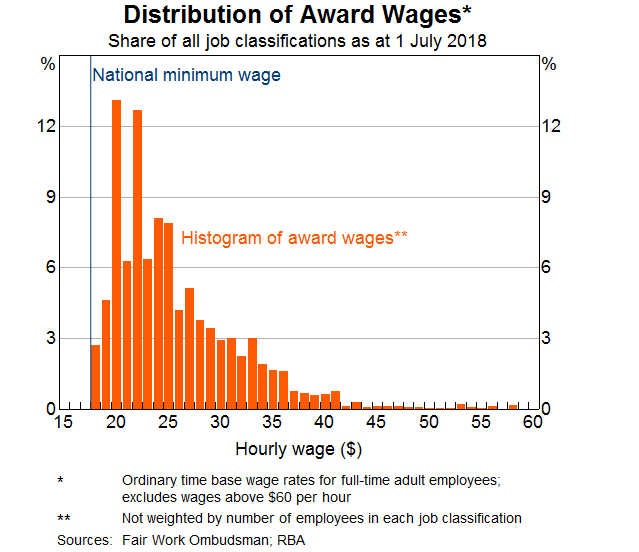
Everything I'm seeing indicates there's a "hump" starting at minimum wage and increasing to an amount around $20 an hour, where it begins dropping again, but I've only found state-wide graphs such as https://www.rba.gov.au/publications/bulletin/2018/sep/images... (Australian)

I guess a minimum of 15 and a hump at 20 would be "at or just above" but 25% is a decent amount.

Post reply on HN