Live data from Hacker News

Amazon’s Consumer Business Turned Off Final Oracle Database

aws.amazon.com

81–90 of 471 posts

Re: Amazon’s Consumer Business Turned Off Final Oracle Database

#81
post #75

Earlier quoted context omitted.

I’m interested in seeing how much they try to milk Java in the next 10 years. I can see them getting desperate enough to really bring the hammer down on licensing, killing off openjdk, and making life miserable for everyone in the process.

How? Its an Open source implementation of the java vm which they don't own.

Don’t they claim some sort of copyright on the APIs and also restrict what can be called “Java”?

Re: Amazon’s Consumer Business Turned Off Final Oracle Database

#82
Amazon's leadership famously pushed hard in the early 2000s for all its systems to share data only via service interfaces ( https://gist.github.com/chitchcock/1281611 ).

I wonder how much of the reason for that was actually a wish to avoid getting further locked in to Oracle (changing or removing a database that backs a single service is very much easier than changing a database that also acts as an integration point).

Re: Amazon’s Consumer Business Turned Off Final Oracle Database

#83
Obviously, enough Amazon bots are giving me bad karma, but my point stands: No, Amazon is not a special snowflake because it did this.

This was an expensive exercise in spite, took a long time and a lot of people - and everyone knows it.

They could have done this far efficiently already if they wanted to scale out, but that company has too many conflicting internal priorities that they took a heck of a long time to move away to anything that scales.

They never try to invent things and if not Oracle, they'd use some other vendor built software. That is the true reality of this company.

So no, if you're thinking you're better than this company for moving away from vendor built software, you are mistaken. In the worst possible way.

Re: Amazon’s Consumer Business Turned Off Final Oracle Database

#84
post #75

Earlier quoted context omitted.

I’m interested in seeing how much they try to milk Java in the next 10 years. I can see them getting desperate enough to really bring the hammer down on licensing, killing off openjdk, and making life miserable for everyone in the process.

How? Its an Open source implementation of the java vm which they don't own.

There are a couple ways they are trying to do this. They’re actively fighting the court battle vs Google for copyright of the Java api. They’re also adding more features to Java that are only supported in new versions, and they can/will attempt licensing lock in for those features. OpenJDK might survive as permanently stuck in version 8, or it might survive as a fork which will divide the community.

Re: Amazon’s Consumer Business Turned Off Final Oracle Database

#85

Is this not a case study that anyone can leave Oracle now, if an Amazon scale install can?

It is not. Amazon accomplished the task by building their own Oracle replacement. You have to be approximately as large as Amazon for that to be a realistic option. If you'd like to use the alternatives that Amazon built, you can, of course, migrate to Amazon Web Services. Though, if you dislike the vendor lock-in you're experiencing with Oracle, and are considering Amazon as a good place to flee to, you possibly hav…

That said, if you restrict yourself to the PostgreSQL subset of Aurora, you will be able to move to any Postgres implementation down the line.

Yes, they charge you a fee to move your data off. However, that is not the limiting factor for people moving off of Oracle. (And if it is, they're probably not looking at AWS in the first place.)

Re: Amazon’s Consumer Business Turned Off Final Oracle Database

#86
post #37

I wonder if anyone here has seen any net new adoption of Oracle DBs in the last few years? It was an absolute juggernaut 10-15 years ago and has rapidly tanked their reputation and spread their business across software, services and cloud with mixed results. Is it actually still growing or just milking their stodgy enterprise customers for more money?

I can imagine that there are more than a few Oracle customers whose spend increases year-over-year because:

1) they have significant investment in the human capital side of Oracle, which is to say, Oracle DBAs on staff who are highly capable at keeping the lights on for their Oracle databases, but have little or no familiarity with alternatives 2) enterprise architects are required to get approval from their DBAs for the design of new systems, who won't approve non-Oracle databases that they can't support, so new systems get built with new Oracle databases 3) the financial cost of the additional databases is organizationally far enough removed from the design phase that Finance has no real power to say no, and anyway such enterprises have other areas of the business that are far more bloated grabbing Finance's attention, where the cost of additional Oracle licenses is a rounding error by comparison 4) Anybody at a high enough level to see why this is a problem has far bigger problems to deal with and so the situation persists.

I doubt that apathetic enterprises are enough to make Oracle database a growth center overall when nobody in their right mind adopts it for new companies, but I doubt that all of their customers are looking for a migration exit.

Re: Amazon’s Consumer Business Turned Off Final Oracle Database

#87

Is this not a case study that anyone can leave Oracle now, if an Amazon scale install can?

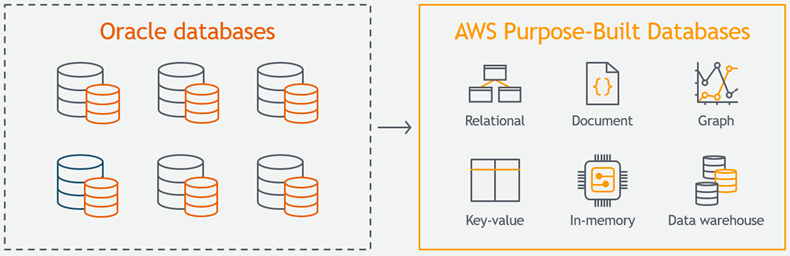
I think the approach can be applied to many companies. I have seen some companies turning every single data storing problem into an Oracle problem. Amazon turned many of the problems into ones that are easier to solve. Using 6 different technologies[1]. I am sure not all applies to all departments but it is a better approach to do this at the scale they got. For small companies this really does not matter. If your hot data fits a single node disk cache you obviously won't benefit from using a horizontally scalable database but Oracle's customers are often in the higher end of the scale spectrum. The question is how can Amazon compete with Oracle where the relationship is there for decades between a customer and Oracle. Good example of this is banks. They managed to get some of the financial companies to move some workloads to AWS but to move Oracle workloads to something else is a whole different game.

1. https://media.amazonwebservices.com/blog/2019/bye_bye_oracle...

Re: Amazon’s Consumer Business Turned Off Final Oracle Database

#88

As someone who has never used or worked with Oracle DBs, can someone explain why migrating to another technology is so difficult? With all the database engines available, is there really not another one that can match Oracle without massive customizations?

It probably starts with horrible things (not SQL compatible) like "" is equal to NULL...

Re: Amazon’s Consumer Business Turned Off Final Oracle Database

#89
We've been working on migrating from Oracle to Postgres for a few years now. We are about 2 weeks from being finished. It is not for the faint of heart, but it is totally worth it. The documentation is much much better, performance is equivalent or better, the sql dialect is saner, etc. Other than moving the data itself (ora2pg was invaluable for this), rewriting the queries is what has taken the most amount of time. Some of our tips on differences between oracle and postgres sql:

replace nvl with coalesce

replace rownum replace listagg with string_agg

replace recursive hierarchy (start with/connect by/prior) with recursive

replace minus with except

replace SYSDATE with CURRENT_TIMESTAMP

replace trunc(sysdate) with CURRENT_DATE

replace trunc(datelastupdated) with DATE(datelastupduted) or datelastupdated::date

replace artificial date sentinels/fenceposts like to_date(’01 Jan 1900’) with '-infinity'::date

remove dual table references (not needed in postgres)

replace decode with case statements

replace unique with distinct

replace to_number with ::integer

replace mod with % operator

replace merge into with INSERT ... ON CONFLICT… DO UPDATE/NOTHING

change the default of any table using sys_guid() as a default to gen_random_uuid()

oracle pivot and unpivot do not work in postgres - use unnest

ORDER BY NLSSORT(english, 'NLS_SORT=generic_m') becomes ORDER BY gin(insensitive_query(english) gin_trgm_ops)

Oracle: uses IS NULL to check for empty string; in postgres, empty string and null are different

If a varchar/text column has a unique index a check needs to be made to make sure empty strings are changed to nulls before adding or updating the column.

PostgreSQL requires a sub-SELECT surrounded by parentheses, and an alias must be provided for it. - SELECT * FROM ( ) A

any functions in the order by clause must be moved to the select statement (e.g. order by lower(column_name))

Any sort of numeric/integer/bigint/etc. inside of a IN statement must not be a string (including 'null' - don't bother trying to use null="" it won't work). Concatenating a NULL with a NOT NULL will result in a NULL.

Pay attention to any left joins. If a column from a left join is used in a where or select clause it might be null.

For sequences, instead of .nextval use nextval('')
Re: Amazon’s Consumer Business Turned Off Final Oracle Database

#90
post #3

Is this not a case study that anyone can leave Oracle now, if an Amazon scale install can?

It shows that a big company like Amazon, hiring thousands of SDEs still needed other vendors software than their own, because of all that time they spent in hiring and firing people and obsessing over their customers needs. sarcasm

No, it means that Amazon reached the point of considering other solutions than Oracle (I bet partially because of cost) at the time when this project started to move their database workloads that at the time were residing on Oracle to something else. Amazon uses many software vendors, they by no mean suffer from the NIH (not invented here) plague.
Post reply on HN