This is similar to the "Stirling radioisotope generator" [1] but it is an actual nuclear reactor (albeit a small one). Both systems are a response to the same fundamental problem, the dwindling supply of Plutonium-238 [2]. The Stirling radioisotope generator uses Pu-238 more efficiently than thermoelectric RTGs, and the nuclear reactor from the article dispenses with Pu-238 altogether. [1] https://en.wikipedia.org/wi…
For anyone else wondering why Pu-238 is dwindling, from the linked wikipedia: “The United States stopped producing bulk Pu-238 with the closure of the Savannah River Site reactors in 1988.[12][13][14] Since 1993, all of the Pu-238 used in American spacecraft has been purchased from Russia. In total, 16.5 kilograms (36 lb) has been purchased but Russia is no longer producing Pu-238 and their own supply is reportedly r…
NASA to test prototype Kilopower nuclear reactor
81–90 of 116 posts
Re: NASA to test prototype Kilopower nuclear reactor
#82Earlier quoted context omitted.
For anyone else wondering why Pu-238 is dwindling, from the linked wikipedia: “The United States stopped producing bulk Pu-238 with the closure of the Savannah River Site reactors in 1988.[12][13][14] Since 1993, all of the Pu-238 used in American spacecraft has been purchased from Russia. In total, 16.5 kilograms (36 lb) has been purchased but Russia is no longer producing Pu-238 and their own supply is reportedly r…
When I lived in Seattle I was sitting at a cafe one day and a government motorcade came down the street with an 18 wheel truck carrying a dumbell-shaped canister with a giant yellow nuclear symbol on the side. I've never been able to figure out what they were transporting. Does anybody here know what it might have been? It was post 9/11 so I was surprised they were still moving radioactive material on the surface str…
Re: NASA to test prototype Kilopower nuclear reactor
#83Earlier quoted context omitted.
They're very low power, make a lot of waste low-grade heat, and use an inefficient electricity generation approach.
> make a lot of waste low-grade heat That's probably the biggest issue for deep space it's extremely difficult to shed heat in hard vacuum (without ejecting mass and its heat with it) as you can only radiate it away.
Re: NASA to test prototype Kilopower nuclear reactor
#84Earlier quoted context omitted.
Totally. You're probably catching downvotes from people offended by "indoctrination", but a) indoctrination is what schools do, that's their purpose, and b) nuclear is actually pretty safe. I agree with the sentiment. Anti-science sentiments proliferate partly because science doesn't spend much on public outreach, especially compared to people who want to make a buck off scaring others about new technologies. NASA ha…
In your zeal to defend nuclear energy, you're come around full circle, defending something indefensible, with arguments far removed from actual science. Nuclear energy may be safe, if done under near-perfect condition, with extremely large budgets to understand risks, and plans to mitigate incidents. There is truth to the argument that nuclear power saves lives compared to coal power. But nuclear power isn't inherent…
Re: NASA to test prototype Kilopower nuclear reactor
#85Earlier quoted context omitted.
For anyone else wondering why Pu-238 is dwindling, from the linked wikipedia: “The United States stopped producing bulk Pu-238 with the closure of the Savannah River Site reactors in 1988.[12][13][14] Since 1993, all of the Pu-238 used in American spacecraft has been purchased from Russia. In total, 16.5 kilograms (36 lb) has been purchased but Russia is no longer producing Pu-238 and their own supply is reportedly r…
When I lived in Seattle I was sitting at a cafe one day and a government motorcade came down the street with an 18 wheel truck carrying a dumbell-shaped canister with a giant yellow nuclear symbol on the side. I've never been able to figure out what they were transporting. Does anybody here know what it might have been? It was post 9/11 so I was surprised they were still moving radioactive material on the surface str…
However, containment vessels like that are usually for refined ores, which end up in reactors, smoke detectors, medical devices, radiotherapy machines, you name it. Too expensive and possibly hazardous to airlift.
As far as I know, production of atomic weapons has stopped in this country and we're not even sure if they still work (half-lives--they rot). Could've been materiel for a stewardship program at the Hanford Site, or waste being evacuated from the Hanford Site.
Generally speaking, the remaining atoms transported and transmuted are for peace. That's why Russia brokers Uranium to the States, and why people in Kazakhstan and elsewhere continue to mine fissile ore.
If you were to shut down the remaining fission plants of Planet Earth, civilization as we know it, would end almost immediately, such is our need for these fuels. It would not be pretty--consider the amount of electric heat, the number of electric stoves with 50+ year duty lifetimes. That's why Japan recycles spent fuel at the French reactor.
Re: NASA to test prototype Kilopower nuclear reactor
#86My first thought was "deep space mission". But because of moving parts involved, this is probably not the use-case. So a bit OT, I was wondering if anyone has yet thought about the solution of still using solar panels for them, but to also use a mirror to focus more light in the direction of the probe or a laserbeam? I mean, theoretical I don't see why not, appart from being more expensive? Andd you could also offset…
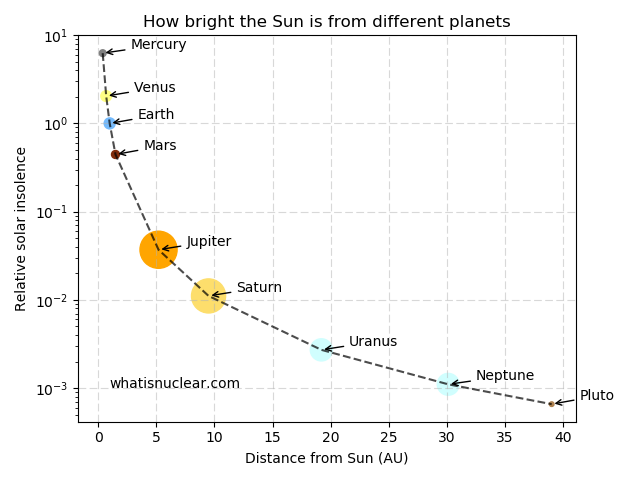
Inverse square law. Every n AU you go out from the earth you will need n 2 are of mirror to focus on a solar panel to get the same power. That assumes you can even build a structure that can keep that shape. Say you have a mission to Uranus, you will need a mirror with 400 times the area of the solar cells to get as much power as they would in earth orbit.
Re: NASA to test prototype Kilopower nuclear reactor
#87Earlier quoted context omitted.
For anyone else wondering why Pu-238 is dwindling, from the linked wikipedia: “The United States stopped producing bulk Pu-238 with the closure of the Savannah River Site reactors in 1988.[12][13][14] Since 1993, all of the Pu-238 used in American spacecraft has been purchased from Russia. In total, 16.5 kilograms (36 lb) has been purchased but Russia is no longer producing Pu-238 and their own supply is reportedly r…
US production has resumed, according to Wikipedia, as Cobalt 60 is coproduced and useful for medical sterilization. As an aside: There are some people who are very skeptical of both atoms and space exploration. I'm not sure what their motives are but given the amount of steel necessary to produce wind turbines, I'm unconvinced that "renewable" is actually "greener."
Beyond that, Steel is 100% recyclable^, and that accounts for over 65% of US steel production. Recycled steel can be done in arc furnaces, requiring no coal coke. [1]
Info like this is at the tip of your fingers.
[0] https://www.worldsteel.org/en/dam/jcr:f07b864c-908e-4229-9f9...
[1] https://seekingalpha.com/article/3785906-metallurgical-coal-...
^ This rate is never achieved. Global average is ~90%, as some countries aren't efficient: http://www.steel.org/sustainability/steel-recycling.aspx
Re: NASA to test prototype Kilopower nuclear reactor
#88Earlier quoted context omitted.
The 40+ years the Voyager probes have stuck around for is impressive... but the actual primary mission duration was about 12 years (for Voyager 2), and that was with two (planned but not guaranteed) extensions for Uranus and Neptune. The RTGs on both probes have decayed A fair amount at this point and are producing a lot less power. 10 years may seem short, but combined with an electrically powered thruster there is…
If you want to use the RTG to power thrusters, then I'd think that doing the "detour" via a stirling engine to create electrical current to turn into thrust might be unnecessary. There must be some way to directly turn radioactivity (or heat) into thrust with sufficiently high exhaust velocity!?
Re: NASA to test prototype Kilopower nuclear reactor
#89Earlier quoted context omitted.
> make a lot of waste low-grade heat That's probably the biggest issue for deep space it's extremely difficult to shed heat in hard vacuum (without ejecting mass and its heat with it) as you can only radiate it away.
And radiative heat transfer scaled with temperature to the fourth power so it would be easy to do if you had materials that could handle really high temperatures for long times.
Re: NASA to test prototype Kilopower nuclear reactor
#90Earlier quoted context omitted.
Has anyone studied these protesters? My off-the-cuff sense is they’re mostly older environmentalists.
It's because sometimes a rocket explodes on the launch pad or a few seconds later, and it could spread radiactive material over a very wide area.