Live data from Hacker News

Philae Found

esa.int

81–90 of 135 posts

Re: Philae Found

#81
post #67

I didn't get why this was important and the article didn't reveal it upon skimming. Since it seems to get people very enthusiastic I gave it a proper read. After 11 paragraphs, the actual news is revealed: > “This [...] means that we now have the missing ‘ground-truth’ information needed to put Philae’s three days of science into proper context, now that we know where that ground actually is!”

It is scientifically useful, but mostly people are just pleasantly surprised that the proverbial needle in the haystack was actually found before the mission of Rosetta itself ends, and happy to get closure for the story of the little probe that went MIA. It's an emotional response first and foremost, just being human.
Re: Philae Found

#82
From Wikipedia about the comet: "One of the most outstanding discoveries of the mission so far is the detection of large amounts of free molecular oxygen (O 2) gas surrounding the comet. Current solar system models suggest the molecular oxygen should have disappeared by the time 67P was created, about 4.6 billion years ago in a violent and hot process that would have caused the oxygen to react with hydrogen and form water. Molecular oxygen has never before been detected in cometary comas. In situ measurements indicate that the O 2/H 2O ratio is isotropic in the coma and does not change systematically with heliocentric distance, suggesting that primordial O 2 was incorporated into the nucleus during the comet's formation. Detection of molecular nitrogen (N 2) in the comet suggests that its cometary grains formed in low-temperature conditions below 30 K (−243.2 °C; −405.7 °F)." [1]

[1]: https://en.wikipedia.org/wiki/67P/Churyumov%E2%80%93Gerasime...

Re: Philae Found

#83
post #67

I didn't get why this was important and the article didn't reveal it upon skimming. Since it seems to get people very enthusiastic I gave it a proper read. After 11 paragraphs, the actual news is revealed: > “This [...] means that we now have the missing ‘ground-truth’ information needed to put Philae’s three days of science into proper context, now that we know where that ground actually is!”

Scientifically speaking, a successful mission is one where you've gathered all the data for analysis and can work with it long after the mission is over.

It's like, if SpaceX launches a rocket and it explodes - a real failure would be if they captured no telemetry and had no idea what happened vs knowing everything that happened and being able to replay the mission after the fact. Often times the data is far more important than the outcome.

Re: Philae Found

#84
post #74

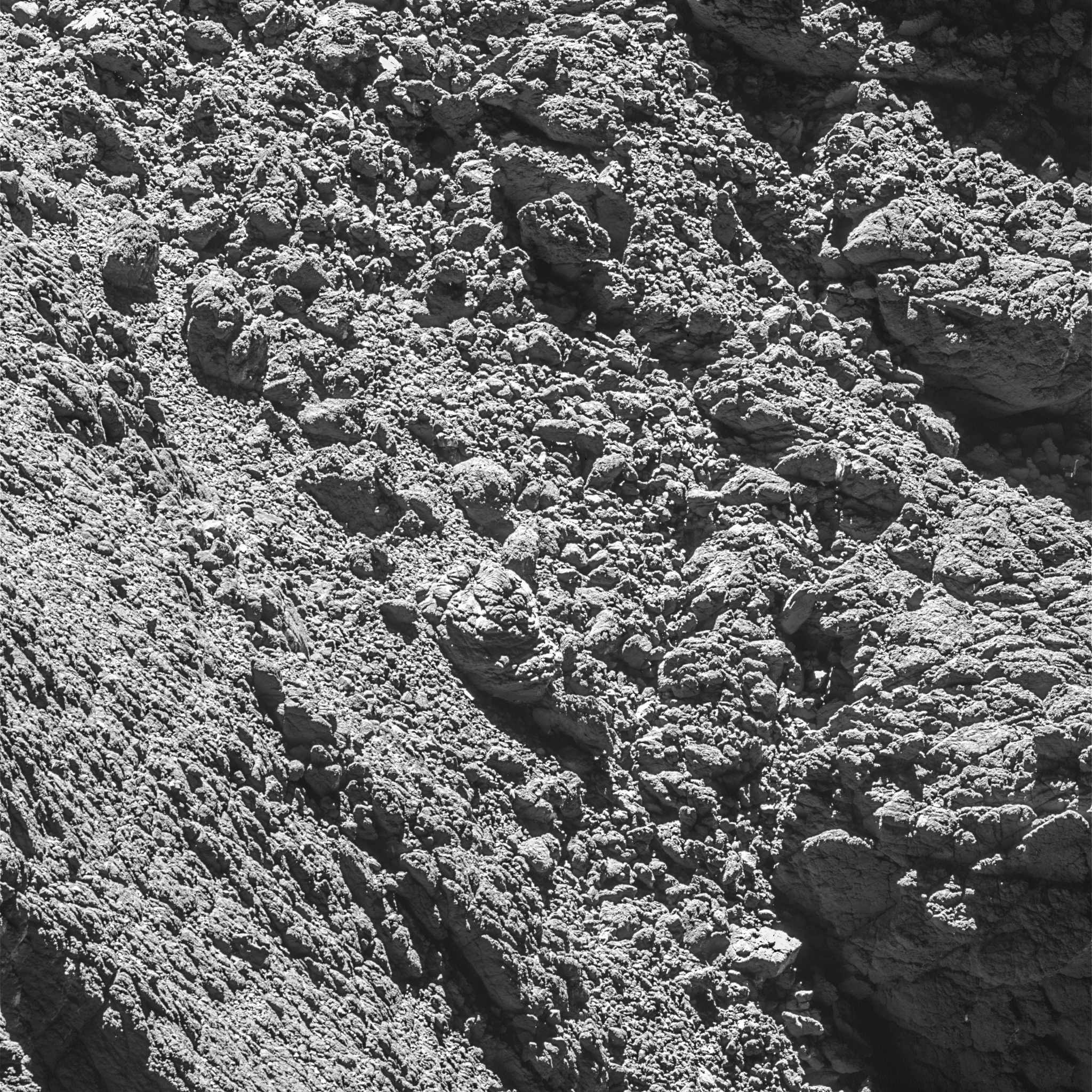
The hi-res image shows how just how unlucky a landing spot this was. http://www.esa.int/spaceinimages/Images/2016/09/OSIRIS_narro...

Direct link: http://www.esa.int/var/esa/storage/images/esa_multimedia/ima... [changed, thanks]

I think you might be looking for this: http://www.esa.int/var/esa/storage/images/esa_multimedia/ima...

Linked from http://www.esa.int/spaceinimages/Images/2016/09/OSIRIS_narro...

Re: Philae Found

#86
post #83
post #67

I didn't get why this was important and the article didn't reveal it upon skimming. Since it seems to get people very enthusiastic I gave it a proper read. After 11 paragraphs, the actual news is revealed: > “This [...] means that we now have the missing ‘ground-truth’ information needed to put Philae’s three days of science into proper context, now that we know where that ground actually is!”

Scientifically speaking, a successful mission is one where you've gathered all the data for analysis and can work with it long after the mission is over. It's like, if SpaceX launches a rocket and it explodes - a real failure would be if they captured no telemetry and had no idea what happened vs knowing everything that happened and being able to replay the mission after the fact. Often times the data is far more imp…

The SpaceX comparison is bad because they don't do science missions. SpaceX do commercial launches for paying customers. Mission success is defined by whether the payload gets to its intended orbit, unharmed. Even if SpaceX learn a lot from a mission, if the payload is lost then the mission failed. While one can learn from failures, when the mission is not a test, learning is not enough for the mission to be called a success.

Re: Philae Found

#87

Earlier quoted context omitted.

A dye bomb is used for aerial crash/rescue. That would contaminate a surface, but also provide a possible visual marker. Maybe several launched away from the lander, but which could be used to triangulate it, in the rare case that might actually be of interest. I suspect there's a lot of re-thinking of how to land on a comet going on as well.

Certainly I started thinking about better ways once this image made it clear what we (humans) are dealing with here. I can imagine a cage-like outer shell where the robot inside is able to rotate on two axes under power. Let it tumble any which way and then use sensors to determine the correct orientation and right itself. NASA has a concept for this: https://ti.arc.nasa.gov/tech/asr/intelligent-robotics/tenseg...

That's pretty much what Spirit and Opportunity's airbag landing system was, although a lot simpler --- it was set up so that no matter what way up it was after it came to a rest (after bouncing and rolling!), when the bags deflated it would automatically roll the right way up so that when the deployment mechanism finally opened, the rover could just drive out.

I've tried to find a video showing it happening, but while there's lots of animations of bouncing, rolling, and the final opening up, they all miss the critical moment. Also, car safety videos are really badly poisoning the search results...

Re: Philae Found

#88
post #83

Earlier quoted context omitted.

Scientifically speaking, a successful mission is one where you've gathered all the data for analysis and can work with it long after the mission is over. It's like, if SpaceX launches a rocket and it explodes - a real failure would be if they captured no telemetry and had no idea what happened vs knowing everything that happened and being able to replay the mission after the fact. Often times the data is far more imp…

The SpaceX comparison is bad because they don't do science missions. SpaceX do commercial launches for paying customers. Mission success is defined by whether the payload gets to its intended orbit, unharmed. Even if SpaceX learn a lot from a mission, if the payload is lost then the mission failed. While one can learn from failures, when the mission is not a test, learning is not enough for the mission to be called a…

SpaceX has done quite a few missions to develop their rockets before getting contracts from NASA, etc. Some of those also included payloads.

Re: Philae Found

#89
post #83
post #67

I didn't get why this was important and the article didn't reveal it upon skimming. Since it seems to get people very enthusiastic I gave it a proper read. After 11 paragraphs, the actual news is revealed: > “This [...] means that we now have the missing ‘ground-truth’ information needed to put Philae’s three days of science into proper context, now that we know where that ground actually is!”

Scientifically speaking, a successful mission is one where you've gathered all the data for analysis and can work with it long after the mission is over. It's like, if SpaceX launches a rocket and it explodes - a real failure would be if they captured no telemetry and had no idea what happened vs knowing everything that happened and being able to replay the mission after the fact. Often times the data is far more imp…

I cannot think of any situation where the rocket exploding on the pad would not cause the mission to be considered a failure.

Re: Philae Found

#90

I watched this documentary called "To catch a comet" about the Rosette/Philae mission to comet Churyumov–Gerasimenko. The achievement of getting to the comet and landing Philae, like many other achievements in space, is really phenomenal. So many things could've gone wrong, but the fact that the worst was Philae bouncing and getting stuck in a dark place (and not being able to perform fully) is a huge success beset b…

I tried to find the full version of the PBS "To catch a comet" about the Rosette/Philae mission but came up empty handed. Searching google, I was able to find a talk by Mark McCaughrean (ESA) called "Rosetta: to Catch a Comet". Been watching it for about 30 minutes and it's awesome. So, for anyone else looking for something to watch, this worked out great. Pretty amazing talk!

https://www.youtube.com/watch?v=KOiY-OCCRjs

Post reply on HN