I can talk about some of this, if only because of some of the ethical dilemmas facing me and genome testing as of recent.
Racial Groups as described by a geneticist vs say, a government doing polling on its citizens are different animals.
Goverments == mostly sociological. An example would be Hispanic in the US, where growing up data collection would ask if someone was Hispanic, and now it asks if you are white vs non-white Hispanic. Meanwhile in say, Meanwhile, if someone crossed the border to Mexico, there is no such thing as Hispanic - you can be White, Mestizo (Indigenous-European hybrid), Indigenous, and Other. It is totally possible to live on the border of the US-Mexico, have reasons to commute across the US-Mexican border, have citizenship to both countries, and have totally different answers on your census depending on what country asked you about your race/ethnicity, because as can be clearly seen, the way that question is asked is different in mexico and the US to begin with.
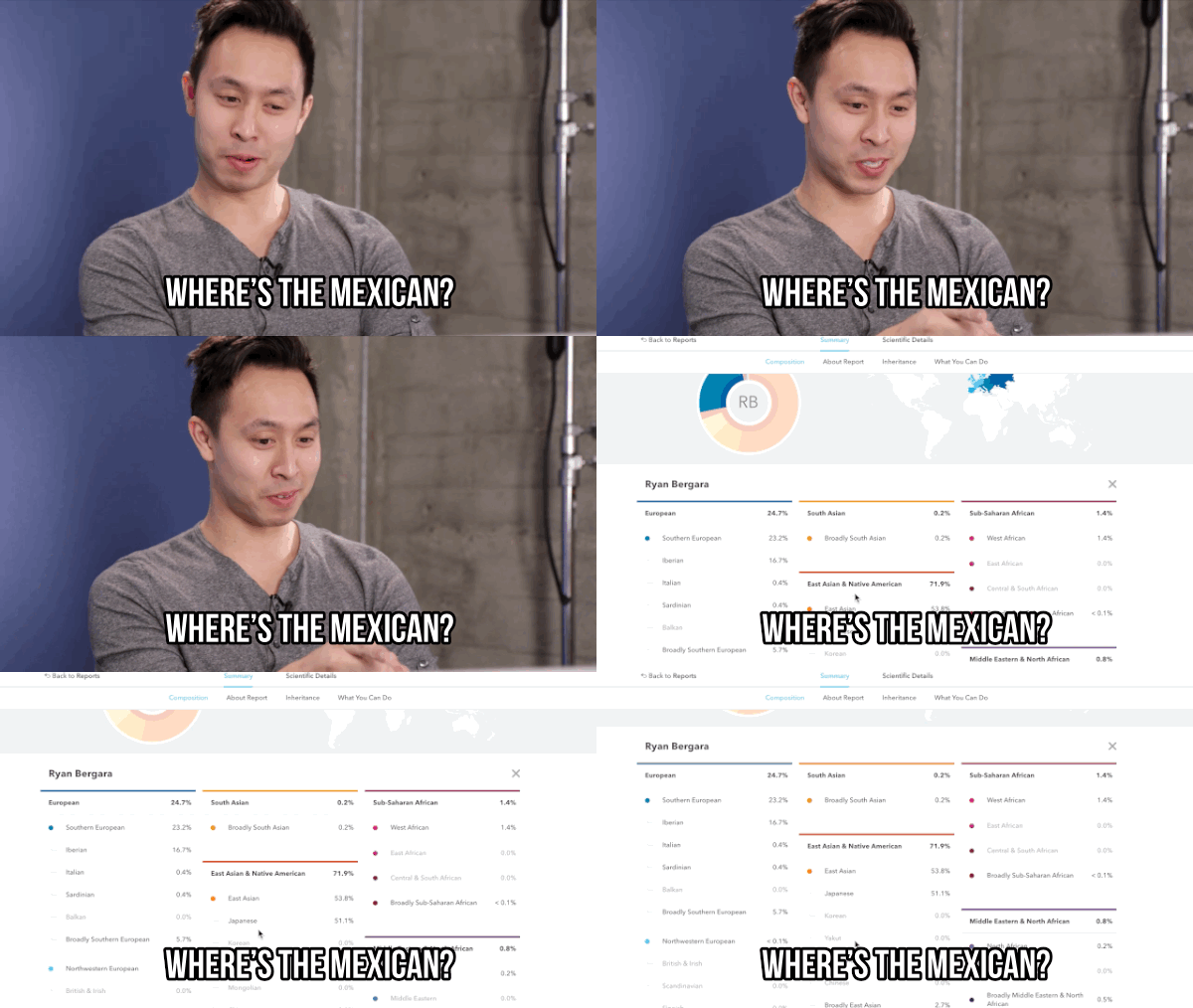
Let's talk about being Mezito as an idea. From a geneticist's point of view, it doesn't exist. (or at least, not yet, and it is unliekly to any time soon) Which is how 23 and me and buzzfeed manages to get this Gif off of one of Buzzfeed's employees, who very clearly feels he is half mexican (aka mezito) https://img.buzzfeed.com/buzzfeed-static/static/2016-01/21/1... In other words, there are no clusters that define "mexican"/mezito
In order to have such clusters, you need to have long histories in one area, histories of inbreeding, and other major causes to make mutations pop selectively. Even with those mutations popping selectively, you also need those mutations/genes to be very trait specific in most cases/ultra selective. Otherwise, you are looking at junk.
So, one of the reasons ashkenazim are testable as ashkenazim is because they have a very long history of inbreeding. So do the japanese compared to other asian groups, same with the Finnish, especially if you are Saami.
http://www.ncbi.nlm.nih.gov/pmc/articles/PMC2575505/
Still once these ibreeding/long history facts start to subside, you end up with whatever is the strongest trait set in a pure mendelian fashion. It is why there are plenty of ashkenazim who definitely decendants of the founder populations of ashkenazim who don't carry other sets of Ashkenazi marker genes, whereas there are ashkenazim where you can't tell who do carry these other genes. The other random sets come from other places (sex..mutations..) and are bred out with enough time. (Otherwise there would be many many more questions about how I exist, genetically speaking, since I should not be able to metabolize alcohol in about 1.5 hours...)
However, most traits are not one gene == one trait. It's how the music plays together, especially in concert with epigentic factors. For many things involving "intelligence" (or actually lots of things for humans), we're looking at a non-mendellian inheritance pattern, including Genomic imprinting issues ( https://en.wikipedia.org/wiki/Genomic_imprinting ). So while some gene related to "intelligence"/"thinness"/"insert something here" might be more observable among certain groups/populations, it doesn't mean it doesn't exist among other populations and some other factor, genetic, epigentic, or otherwise, is suppressing your view.
This is why if/when you get involved with genetic research on humans, the ideal is to get the entire family (as much as possible) involved in tests - even if the original candidate comes from a human genetic isolate polpulation. There are otherwise broader concerns about power and sample size in the study, because you might be looking at something which is actually something else.
http://www.nature.com/gim/journal/v4/n2/full/gim200210a.html
(but, hey, what do I know...I had to ask geneticists and people doing research in this area when I found out my genome is worth something accidentally...)