Live data from Hacker News

US Department of Energy: Fusion Ignition Achieved

energy.gov

781–790 of 1001 posts

Re: US Department of Energy: Fusion Ignition Achieved

#781

Earlier quoted context omitted.

Exactly the opposite: their task, assigned by Congress, is weapons work . Period. But pretending to work on "carbon-free energy" is good for funding, just now . Four years ago, being all about weapons opened the tap. Make no mistake, there is no story here. There will be no "unlimited free energy" from this, or any other fusion project. The fusion startups are spending down investors' money with zero possibility of p…

If they can get a continuous fusion reaction going converting the heat energy from that to electricity won't be a problem. Getting a contained fusion reaction that gives out more energy than input is the problem how to convert that into electricity is not going to be a problem.

It doesn't make heat. It makes fast neutrons. Turning them into usable heat is a project of its own.

Turning dumb heat into electric power is expensive. Nothing that depends on doing that can ever compete with wind and solar, anymore.

Tritium doesn't grow on trees. Making it by blasting those hot neutrons into a thousand tons of FLiBe is easy enough. Getting your few grams a day, at PPB concentration, out of that thousand tons of stuff is... nobody has any idea how. But you need to, to have fuel for tomorrow.

No, there won't be any of that. It would be fantastically more expensive than fission. Fission is not competitive, and gets less so by the day. Fusion is nothing but a money pit (with the just barely-possible exception of D-3He).
Re: US Department of Energy: Fusion Ignition Achieved

#782
After the Wright brother's first demonstration of powered flight, I like to imagine all the pessimists in this thread would have said that commercial air transport would never be viable because wood and fabric don't have the material properties to carry a ton of steel.

Re: US Department of Energy: Fusion Ignition Achieved

#783
post #577

Earlier quoted context omitted.

Their total power draw from the grid was 300 megajoules and they got back about 3 megajoules, so don't start celebrating yet. Source: New York Times.

A quick peruse through this wikipedia article will tell you what still needs done, and what this means: https://en.wikipedia.org/wiki/Laser_Inertial_Fusion_Energy Give it a read. Intertial confinement fusion with a Q > 1 may very well point the way towards a realistic powerplant. Fusion is at a point it deserves investment. The NIF cost about the same as a single b-2 bomber.

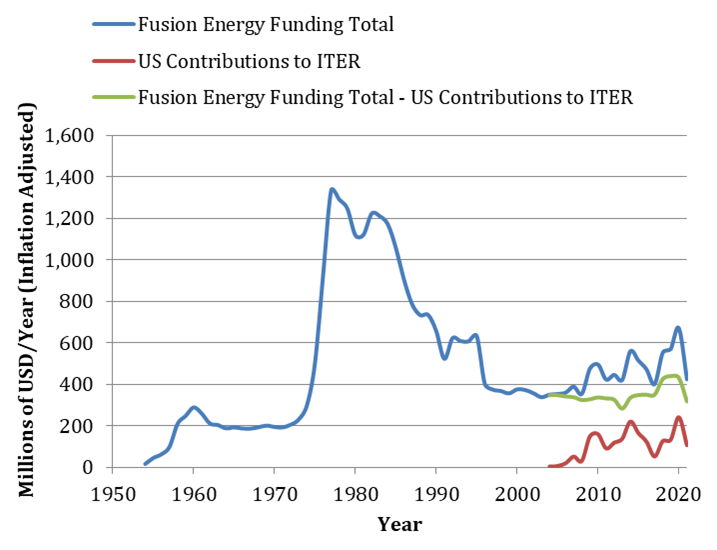
Total annual US public research into fusion that is not ITER or this project (which does not come from the fusion pot. As others have said this project was built for weapons research) is about $300 million per year[1]. We, as a country, do not give a rats ass about having fusion as a power source. VC funding recently (for the first time) supported many fusion startup ideas at or above the $300 million level. Too bad ZIRP is over and private funding is now likely to dry up. The recent private funding in fusion was really amazing. Many new ideas and methods are being tried. This is what fusion research needed. Not spending billions on magnets and cement in France that is ITER. Hopefully some of them have a long enough runway to get promising work done and get follow-up funding.

[1]http://large.stanford.edu/courses/2021/ph241/margraf1/images...

Re: US Department of Energy: Fusion Ignition Achieved

#784
post #757

Earlier quoted context omitted.

Exactly the opposite: their task, assigned by Congress, is weapons work . Period. But pretending to work on "carbon-free energy" is good for funding, just now . Four years ago, being all about weapons opened the tap. Make no mistake, there is no story here. There will be no "unlimited free energy" from this, or any other fusion project. The fusion startups are spending down investors' money with zero possibility of p…

At least ITER has a plausible, in a sci-fi story sense, way of creating a sustainable fusion reaction to which more fuel could be given. The fact the neutrons produced, if it did reach the high Q ratios, would irradiate and break down everything involved, is probably 2070's scientists and engineers problems to solve.

In that paradise of abundant cheap solar and wind power, only weapons people will be interested in fusion.

They will probably be trying to come up with zero-fallout things they can use tactically.

Re: US Department of Energy: Fusion Ignition Achieved

#785

Are there any thoughts on how this will become a power plant yet? It's awesome to see it filled up, reacted and then reset as a proof of concept, but can it ever be a continuous flow through the chamber without losing that ignition temp? Or will it be more like a 4 cylinder engine where each reactor is at a different stage of being filled, heated, reacting and emptying, with the net result being continuous? Edit: Tak…

NIF never was designed to be a power plant or have anything to do with power generation. This is something most commenters don't appear to appreciate. It's an experimental facility that, when distilled to its simplest explanation, lets us study things when you squish them really, really hard. It turns out, fusion is one of the things you can study when you squish stuff really hard - and one of the big challenges was…

Yeah obviously. I was asking about the next stage.

Re: US Department of Energy: Fusion Ignition Achieved

#786
post #429

Earlier quoted context omitted.

Do we know how much tritium is needed for a city's energy generation? What about a state etc? Reason I ask is the only uses I have seen for tritium is on old watch dials made in the pre-90's. Curious how much of this resource is out there.

Take spullara's numbers: 2.01410177811 u = 3.34449439340696e-24 g deuterium 3.01604928 u = 5.008267217094e-24 g tritium 17.6 MeV = 7.832863e-19 kWh energy Divide through, and you will see that you need 4.27 ug/kWh of deuterium, and 6.39 ug/kWh of tritium. A random source [1] says that New York will use 50.6 TWh per year by 2027. That would require ~216 kg/yr of deuterium and ~323/yr kg of tritium. This is all assumin…

Tritium has a half-life of 12 years so there is no deep pool of tritium upon which to draw. The primary source of tritium on earth is cosmic-ray interactions in the upper atmosphere that produces 7.5Kg of tritium a year worldwide.[1]

Isn't that going to cause a serious problem if it requires 323Kg/yr of tritium just to power New York City?

[1] https://www.sciencedirect.com/topics/earth-and-planetary-sci...

Re: US Department of Energy: Fusion Ignition Achieved

#787

Earlier quoted context omitted.

100% agree. We should be dumping as much as we can in getting fusion up and running ASAP. It could be a silver bullet to stop climate change alone, and by driving energy costs lower, enable huge innovations in AI/automation and increasing material wealth. $1T to move fusion forward just 5 years from eg 2040 to 2035 could alone have a huge ROI in terms of climate mitigation and decarbonization

How easy is to write $1T, but with that you can basically install enough solar cell to power all of USA energy need.

Solar can't do that without massive batteries that don't exist. Even then it's not viable in areas where there isn't sufficient sunlight.

Re: US Department of Energy: Fusion Ignition Achieved

#788
post #429

Earlier quoted context omitted.

Take spullara's numbers: 2.01410177811 u = 3.34449439340696e-24 g deuterium 3.01604928 u = 5.008267217094e-24 g tritium 17.6 MeV = 7.832863e-19 kWh energy Divide through, and you will see that you need 4.27 ug/kWh of deuterium, and 6.39 ug/kWh of tritium. A random source [1] says that New York will use 50.6 TWh per year by 2027. That would require ~216 kg/yr of deuterium and ~323/yr kg of tritium. This is all assumin…

Tritium has a half-life of 12 years so there is no deep pool of tritium upon which to draw. The primary source of tritium on earth is cosmic-ray interactions in the upper atmosphere that produces 7.5Kg of tritium a year worldwide.[1] Isn't that going to cause a serious problem if it requires 323Kg/yr of tritium just to power New York City? [1] https://www.sciencedirect.com/topics/earth-and-planetary-sci...

Apparently no, because it can be made by the fusion process itself, via contact with lithium, and there's enough proven reserves of the latter to supply us for 100s of years.

Re: US Department of Energy: Fusion Ignition Achieved

#789
post #643

Earlier quoted context omitted.

Could you elaborate on your point a bit more? If you're talking about utilizing the weak force vs. the residual strong force then I'm not sure this argument holds up. Also, when comparing to renewable+storage you have to consider how much land has to be dedicated to energy use in these scenarios. Wind and solar require orders of magnitude more than a potential fusion reactor (or an existing fission reactor).

Just referring to what particles the released energy is carried in. The easiest fusion reactions to make happen release most energy as neutrons. But neutrons are, from a practical standpoint, a huge pain in the ass to deal with. They just fly off until they hit another atomic nucleus. They irradiate the structure of reactor, making it radioactive and weakening it, neccesating periodic replacement. This means handling…

Neutrons aren't that hard to capture. They are certainly harder to capture than charged particles but there are plenty of materials that are dense enough to reliably capture neutrons. This is how heat is extracted from the reaction to use in a generator. The activation of the containment material is a problem but it's not even close to the level it is for fission reactors where you're forced to deal with spent fuel rods.

At the moment fusion is obviously not cheap but no one is planning on using the technology in its current form for actual power generation. The processes involved will all get more efficient and given the astronomical upper limits of energy output from fusion it doesn't take a big stretch of the imagination to think that it will eventually be preferable to solar and wind power. There's no guarantee that will happen but hopefully this breakthrough will trigger more investment and momentum to make it a reality. I also want to add that I'm very pro solar and wind, especially in the short term.

Re: US Department of Energy: Fusion Ignition Achieved

#790

Earlier quoted context omitted.

A quick peruse through this wikipedia article will tell you what still needs done, and what this means: https://en.wikipedia.org/wiki/Laser_Inertial_Fusion_Energy Give it a read. Intertial confinement fusion with a Q > 1 may very well point the way towards a realistic powerplant. Fusion is at a point it deserves investment. The NIF cost about the same as a single b-2 bomber.

Total annual US public research into fusion that is not ITER or this project (which does not come from the fusion pot. As others have said this project was built for weapons research) is about $300 million per year[1]. We, as a country, do not give a rats ass about having fusion as a power source. VC funding recently (for the first time) supported many fusion startup ideas at or above the $300 million level. Too bad…

We may be certain, anyway, that all the startups will spend all the money they get. There will be no power generated. The investors will not get any of their money back.

That would be fine, except some of the investors are pension funds.

Post reply on HN