Live data from Hacker News

Why are 38 percent of Stanford students saying they're disabled?

reason.com

741–750 of 1001 posts

Re: Why are 38 percent of Stanford students saying they're disabled?

#741
post #707

Earlier quoted context omitted.

That's true, but astigmatism: - is clearly defined - can be measured objectively (with autorefractors, keratometers, corneal topographers) - can be corrected cheaply ($20 glasses) to eliminate any disadvantage in performance or efficiency Neurodivergence: - is not clearly defined - cannot be measured objectively, and is diagnosed using behavioral observations and cognitive tests - may rely on 'accommodations' that, i…

You misunderstand how neurodivergence is be handled in education. It isn't a single diagnosis, and does not have a single accommodation. We use a catch-all word because it makes it easier to talk about as a collection of issues, but that's not how it's diagnosed or treated. If you would find wearing noise blocking ear muffs, or sitting on a bouncy chair, or using a typing instrument instead of writing, improves your…

"If you would find wearing noise blocking ear muffs, or sitting on a bouncy chair, or using a typing instrument instead of writing, improves your performance on a test, then yes that should be permitted."

The thing these examples have in common is that they don't give you any inherent advantage that invalidates the purpose of the test. (Assuming it's not a handwriting test, or an 'ignoring distractions' test.)

I would group all of these along with the examples I gave: corrective glasses, and wheelchairs. They should be available to all students, without diagnosis or discrimination.

If you think limited time on tests doesn't serve a useful purpose, then why give 'extra' time to only some students, and not to all students?
Re: Why are 38 percent of Stanford students saying they're disabled?

#742
> Most of these students are claiming mental health conditions and learning disabilities, like anxiety, depression, and ADHD. ... Obviously, something is off here. The idea that some of the most elite, selective universities in America—schools that require 99th percentile SATs and sterling essays—would be educating large numbers of genuinely learning disabled students is clearly bogus.

"Obviously"? "is clearly bogus?"

Not to me. I see too much rhetoric and assumptions. In an article in Reason magazine, I expect more -- to demonstrate careful thinking that cuts through lazy common-sense thinking.

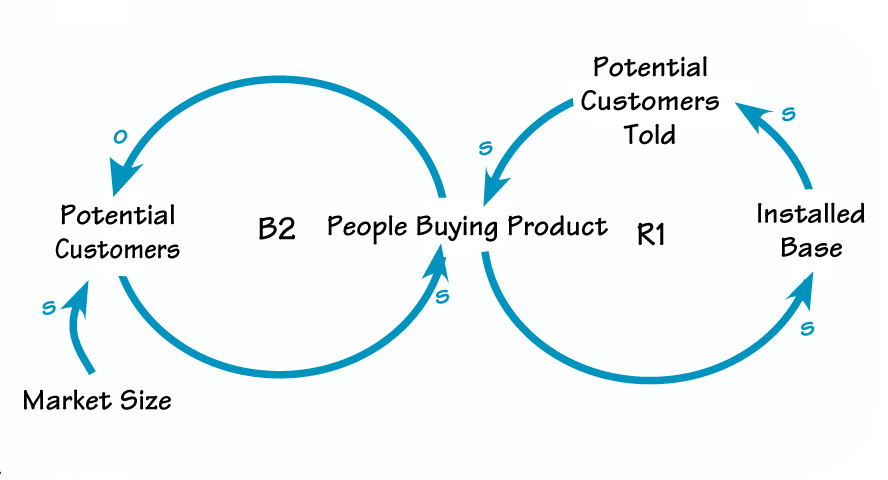
To make sense of a situation, one of my favorite tools is simple: a causal diagram(s). See [1]. This requires effort, and it should. Making a useful, communicable model that forms the foundation for your argument takes practice. Here's a disability-related example: [2]

I want to live in a world where causal models are demanded by readers.

[1]: https://thesystemsthinker.com/wp-content/uploads/images/volu...

[2]: https://ibb.co/5XcGyLK0

Re: Why are 38 percent of Stanford students saying they're disabled?

#743
post #682

Earlier quoted context omitted.

If I'm paying a professional by the hour, yes, it matters if he can do it in one hour rather than two. I once hired a civil engineer to do a job for me, and he started billing me for time spent learning how to do it. I refused to pay him. (There was nothing unusual about the job, it was a simple repair task.)

That's a tricky one that I find myself pondering a lot as a contractor. I've ultimately decided that if it's something I'm required to learn for this specific task then I'm billing for the time spent doing that. But if it's something that I figure I should know as a person being hired to do a task in this particular domain then I won't bill for it. To me it's the difference between hiring a mechanic to 'rebuild an en…

I agree with your assessment. In my case, I am a mechanical engineer and what he was billing me for smelled of being scammed - he thought I was ignorant. I confronted him on it and he backed down.

I've had similar experiences with auto repair shops. Recently I got a BS estimate for an alternator replacement, and a BS explanation. Fortunately, I had done my homework beforehand and knew everything about how to replace the alternator on my particular car, and the service rep knew he was outmaneuvered and gave me a fair price.

Women believe they are targeted by auto mechanics, but they target men as much as they can, too.

Re: Why are 38 percent of Stanford students saying they're disabled?

#744

Earlier quoted context omitted.

Caltech had timed exams (2-3 hours) and infinite time exams, at the discretion of the professor. The students hated the infinite time ones, because nobody knew how much time other students spent on the test so one felt obliged to spend inordinate amounts of time on it. Besides, if you couldn't solve the exam problems in 2 hours, you simply didn't know the material.

In the upper division of my undergrad physics degree that was really common. Open book, open everything except peers. I personally loved those exams and my grades went way up. I could walk away for a few minutes if I was stuck, maybe grab a beer to relax, and get back and solve the problems. But I think this is much harder to do and getting even more difficult. I was at a small university and you really couldn't goog…

That's how my parents taught. Design questions to make the students apply their knowledge rather than regurgitate it. Forget a fact it's being applied to, look it up. Don't understand the concepts, you're stuck. Know the material, piece of cake. One time I was in my father's classroom because he was showing a film he wanted me to see. There was a quiz afterwards, he knew it wouldn't be alien to me and had me try it. 5 minutes later I turn it in, the class thinks I gave up. Then he says I aced it. But I graded an awful lot of his tests, I know that when I didn't know the material I wouldn't stand a chance. The day I found a question that I could guess was notable enough to me that I asked my mother about it. (A case of not knowing the fact. Her supplying the information that the tribe in question was a stone age culture in the New Guinea jungles made the why apparent.)

Re: Why are 38 percent of Stanford students saying they're disabled?

#746

Earlier quoted context omitted.

Even in the top 1% there’s a limited amount of positions. Everyone wants every advantage possible over everyone else. That is how the market is. Even for Stanford students there is a hierarchy.

Yes, I agree with that, but that still doesn't explain why it would be a good idea to give some students more time on a test. It explains why students would be incentivized to game the system and get more time. But it doesn't explain why we have this strange system to begin with.

Probably started out as an exception for truly difficult situations but like everything else became routinely exploited once widely known about and eventually became a defacto norm and just part of the protocol.

A lot of things start like this. You need someone with an aggressive backbone to enforce things - which these institutions won't have.

Re: Why are 38 percent of Stanford students saying they're disabled?

#747
post #670

Earlier quoted context omitted.

Caltech had timed exams (2-3 hours) and infinite time exams, at the discretion of the professor. The students hated the infinite time ones, because nobody knew how much time other students spent on the test so one felt obliged to spend inordinate amounts of time on it. Besides, if you couldn't solve the exam problems in 2 hours, you simply didn't know the material.

That's basically a take-home at that point (assuming open book--or at least honesty) and, yes, you're now computing with classmates who will spend a weekend on it. It's the same problem as companies giving take-home interview problems that you should only spend an hour or two on.

At Caltech, exams were take-home, with a 2 hour time limit. It was on your honor to abide by the 2 hour rule. I used my alarm clock.

Ya know, the funny thing about students - if you presume they are honest, they tend to be honest. The students loved it, I loved it. If anyone cheated, the students would turn him in. Nobody ever bragged about cheating, 'cuz they would have been ostracized.

Besides, I actually wanted to learn the stuff.

Re: Why are 38 percent of Stanford students saying they're disabled?

#748
post #713

Earlier quoted context omitted.

> My logic is that I just assumed a bit of water in advance would prevent toothpaste from directly/easily adhering to the bristles, keeping more of it "in useful circulation" as it were. > kinda gross A few months back I needed some hydrogen peroxide, but the available bottle was more than I was likely to use before it degraded into H20... So, naturally, I started messing around looking for other applications. (It wo…

Hey, interesting idea using it against the shower gunk. Definitely going to try it. And, yes, definitely water first. It's sitting out there exposed, rinse it off!

Let us know if the peroxide gets rid of the shower gunk. I've tried all kinds of cleaners to no avail.

Re: Why are 38 percent of Stanford students saying they're disabled?

#749
post #565

Earlier quoted context omitted.

This is 100% the fault of a society that has continuously pushed to expand the meaning of “disability” (and many other words) until it no longer resembles anything that a reasonable person would associate with the term, while aggressively silencing anyone who dared to speak out against that concept creep.

Yes, but people who lie are also at fault

Hate the game (the system and the people who set it up and are maintaining it), not the player.

Re: Why are 38 percent of Stanford students saying they're disabled?

#750

Earlier quoted context omitted.

I think about this quite a lot. I’ve come to the conclusion that in the past acting with integrity was rewarded and lacking integrity was punished. In 2025 it seems integrity is meaningless, “winning” is all that matters. Particularly, you are not punished for acting without integrity but definitely “punished” for having it.

That's what you get in a world where damn near everything is measured against some objective criteria, analyzed by a 3rd party or tracked by the government or someone at the behest thereof None of these things measure "not an asshole". They measure results. The incentives from there are obvious. The business owners who treats employees, customers, vendor, everyone like shit in his quest to produce the most widgets, j…

Someone has never heard of a medieval peasant. Or take your pick of ancient slave...

Maybe your theory is that if you weren't alive in the past to see "an asshole" for yourself, then the prudent conclusion is a sort skepticism about their very existence.

I wonder how you envision the past then... a vacant landscape? Perhaps you actually believe human nature has radically changed just in the past few decades? The odd thing is I think an actual analysis might contradict your claim, that is if the measurement is simply who is "an asshole". Perhaps we would find more surveillance actually reduces "asshole" behavior generally. Like how confrontational people often change their behavior when confronted by a camera, .etc

Post reply on HN