Live data from Hacker News

Station Crew Docks Dragon Capsule to ISS

nasa.gov

71–80 of 82 posts

Re: Station Crew Docks Dragon Capsule to ISS

#71

Earlier quoted context omitted.

The cynical part of me thinks because manned spaceflight, at least in the context of being stuck in a LEO tin can, is of questionable utility and we try to find things for people to do? We can automate quite a bit of this, in fact, the ESA's Automated Transfer Vehicle just docks itself. Wikipedia: At a distance of 249 m, the ATV computers use videometer and telegoniometer data for final approach and docking manoeuvre…

In the Shuttle, the landing gear control was intentionally left outside computer control so that the vehicle could not be flown unmanned. Flight control software could autoland the shuttle from orbit, but it took a human being to let the wheels down. So I don't think your cynicism is excessive.

Towards the end of the program, a "jumper cable" was carried to get around that:

  The cable would connect an avionics bay in Discovery's middeck with the
  controls one level up on its flight deck, effectively allowing flight
  controllers in Houston to perform landing activities currently done by
  shuttle  astronauts.

  Those manual activities include starting the shuttle's auxiliary power units,
  deploying an air data probe, unstowing the orbiter's landing gear and
  releasing its drag chute after landing, Herring said.
[1] http://www.space.com/2560-shuttle-carry-tools-repair-remote-...

Re: Station Crew Docks Dragon Capsule to ISS

#72
post #52

Earlier quoted context omitted.

"The voting system exists so that the community can raise productive comments, and lower unproductive comments" sounds like "a voting system so people can democratically decide what content is good or bad". What's the distinction you're trying to make?

The community does not decide what is good or bad. Paul Graham has already decided that. There is no democracy.

I am new to HN, but you say Paul Graham has already decided.

Check out this article: http://techcrunch.com/2014/03/29/after-stepping-aside-from-y...

Also, your comment was still allowed to post.

Re: Station Crew Docks Dragon Capsule to ISS

#73
post #52

Earlier quoted context omitted.

"The voting system exists so that the community can raise productive comments, and lower unproductive comments" sounds like "a voting system so people can democratically decide what content is good or bad". What's the distinction you're trying to make?

The community does not decide what is good or bad. Paul Graham has already decided that. There is no democracy.

I am new to HN, but you say Paul Graham has already decided.

Check out this article: http://techcrunch.com/2014/03/29/after-stepping-aside-from-y...

Also, your comment was still allowed to post.

Re: Station Crew Docks Dragon Capsule to ISS

#74
post #37

Earlier quoted context omitted.

No, the important lesson is to always label your units, and another one might be to always be careful passing dimensionful numbers between codes and teams. You can run into the same problem by accidentally even forgetting to convert between, e.g., newtons and millinewtons.

SI units don't include millinewtons, so the problem wouldn't arise. That's part of the point. You measure mass in kg, not g, not tonnes. You measure distance in metres. Not kilometers. Not nautical miles. You measure time in seconds. A Newton is a derived SI unit — 1 kg m / s^2 Incidentally, this is why engineering notation works the way it does. You pick your units and you get the significant figures from the mantis…

The SI units absolutely include newtons and millinewtons. The derived units (http://physics.nist.gov/cuu/Units/units.html) and prefixes (http://physics.nist.gov/cuu/Units/prefixes.html) are both part of the SI.

Also, remember, people are representing these numbers on computers. Derived units are very useful—in fact they are often critical to achieving necessary accuracies using compact representations. Further, representing quantities in terms of other unique, problem-specific units is often extremely helpful for ensuring good numerical behavior.

Re: Station Crew Docks Dragon Capsule to ISS

#75
post #37

Earlier quoted context omitted.

No, the important lesson is to always label your units, and another one might be to always be careful passing dimensionful numbers between codes and teams. You can run into the same problem by accidentally even forgetting to convert between, e.g., newtons and millinewtons.

That is precisely the policy adopted by NASA, and it lead to the Mars disaster, so you are suggesting as a solution the exactly policy that caused the problem. Furthermore, you are suggesting that the same entities--highly trained engineers and scientists and project managers--that proved inadequate to follow the policy you are suggesting last time can somehow be expected to follow the policy correctly at all times i…

Are you seriously claiming that a policy of labeling and testing units caused MCO to be lost?

Have you actually studied the mishap? If labeling and verifying the units was done carefully it would have prevented the accident.

A millinewton/newton mix-up could easily occur in a case like this one, too. The particular numbers which were misinterpreted in MCO's case were often small, and I can easily believe no one noticing similar ones being a few orders of magnitude off. (I do have a hard time imagining it with MCO's particular numbers, though.) Similarly, you can be bitten by a meters/centimeters switch or accidentally using different representations of the same quantity, such as specific impulse and its corresponding characteristic exhaust velocity, which only differ by a factor of about 10 when both are expressed in SI units.

I maintain that the key lesson is to always label your units, and to test them carefully and routinely, including at interfaces. I believe that claiming that using English units (as gross as they often are) caused the failure misses the more fundamental root problem.

(Also, I'm not claiming that labeling and verifying units is easy. I emphasize it partly because it's hard. Little of our current software ecosystem includes any concept of dimensionful numbers.)

Re: Station Crew Docks Dragon Capsule to ISS

#76
post #16

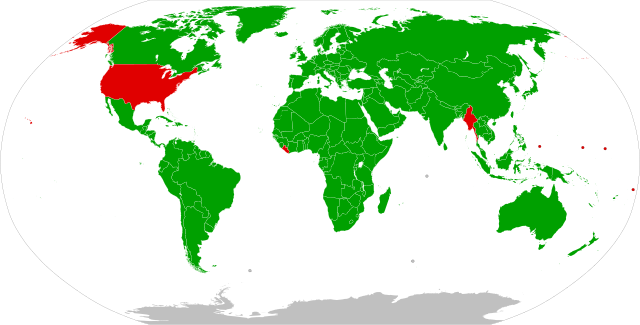
Is it common to use metric system when launching rockets to space or is it a peculiarity of SpaceX? I heard the speaker on SpaceX channel always referring to kilometers and kilometers per second when talking about height and speed.

I've heard it's common in some of em' overseas countries.

http://upload.wikimedia.org/wikipedia/commons/thumb/a/ab/Met...

Re: Station Crew Docks Dragon Capsule to ISS

#77
post #52

Earlier quoted context omitted.

The community does not decide what is good or bad. Paul Graham has already decided that. There is no democracy.

I am new to HN, but you say Paul Graham has already decided. Check out this article: http://techcrunch.com/2014/03/29/after-stepping-aside-from-y... Also, your comment was still allowed to post.

I accidentally downvoted you when attempting to pinch-zoom on my phone. I'm sorry! I didn't mean to make that mistake. I wish we had the feature to undo things like that.

Re: Station Crew Docks Dragon Capsule to ISS

#78

Earlier quoted context omitted.

Tloewald's point was that microseconds and nanoseconds are not SI base units, so standardizing on base units eliminates the ambiguity (the second alone is the SI base unit of time). Of course additional mechanisms of double and triple checking are probably still warranted to account for human fallibility.

That's fine until you start using floating point values in order to satisfy this SI fetish. (I guess you like farads and henries too.) It's much better to use fixed point and keep track of your multiplier. A sufficiently advanced type system could do this, but at some point it will require careful thinking about precision.

Using fixed point and tracking your multiplier is exactly like using floating point.

Re: Station Crew Docks Dragon Capsule to ISS

#79

Earlier quoted context omitted.

Tloewald's point was that microseconds and nanoseconds are not SI base units, so standardizing on base units eliminates the ambiguity (the second alone is the SI base unit of time). Of course additional mechanisms of double and triple checking are probably still warranted to account for human fallibility.

Regardless of what you standardize, you still need to include the unit for any figure.

Yes but you eliminate errors when working within a type of unit. NASA's problem came from converting one kind of length to another. You are clutching at straws here.

Re: Station Crew Docks Dragon Capsule to ISS

#80

Earlier quoted context omitted.

That's fine until you start using floating point values in order to satisfy this SI fetish. (I guess you like farads and henries too.) It's much better to use fixed point and keep track of your multiplier. A sufficiently advanced type system could do this, but at some point it will require careful thinking about precision.

Using fixed point and tracking your multiplier is exactly like using floating point.

Floating point is treated differently by compilers, involves different components of the processor, generates different types of errors, and has different performance. Perhaps there is some perspective from which that proposition is true?
Post reply on HN