I have some older SATA SSD's in my PC currently. I'd not buy a new one, too slow compared to NVME.
Samsung may end SATA SSD production soon
71–80 of 116 posts
Re: Samsung may end SATA SSD production soon
#72Earlier quoted context omitted.
If I were to bet on my hunches: At least half, leaning more, of that 20% buying SATA SSDs is probably momentum of people who didn't know they could get a better performing m.2 NVMe drive for the same price. Few people are upgrading PCs with SSDs for the first time in 2025 and those that are probably didn't really need SATA, they just searched for SATA/saw SATA. I don't really know how one would get numbers for any of…
I prefer SSDs because the connector is so much more accessible. Ripping out the video card and futzing with the pain of that tiny NVME screw is no fun. I am almost never IO blocked where the performance difference between the two matters. I guess when I do the initial full backup image of my drive, but after that, everything is incremental.
> I prefer SSDs because the connector is so much more accessible. Ripping out the video card and futzing with the pain of that tiny NVME screw is no fun.
This doesn't make sense as written. I suspect you meant to say "SATA SSDs" (or just "SATA") in the first sentence instead of "SSDs", and M.2 instead of NVMe in the second sentence. This kind of discussion is much easier to have when it isn't polluted by sloppy misnaming.
Re: Samsung may end SATA SSD production soon
#73What I want to know is if this is the beginning of the end of the SATA era. Once one major player leaves, others are sure to follow, and soon quality no longer matters, and finally the tech atrophies. I don't want to be forced to have my spinning platters connected via NVMe and a series of connector adapters.
> I don't want to be forced to have my spinning platters connected via NVMe and a series of connector adapters.
I want to build a mini PC-based 3D printed NAS box with a SATA backplate with that exact NVME connector adapter setup!
https://makerworld.com/en/models/1644686-n5-mini-a-3d-printe...
The reality is, as long as you have PCIe you can do pretty much whatever you want, and it's not a big deal.
Re: Samsung may end SATA SSD production soon
#74SATA SSD's are in a weird space. HDD are cheaper and more reliable for large storage pools. NVME is everywhere and provides those quick speeds and are even faster if you need that. There just aren't many use cases where SATA SSD's are the best option.
SATA SSDs have one advantage though - their size. You don't see m.2 form factor SSDs going well over 8TBs, but for a larger SATA drive you can find >8TBs easily. Samsung had the best offering for this recently - Samsung SSD 870 QVO The enterprise world has U2, but us plebs don't really have a comparable alternative.
No advantage over SAS here - it's the same form factor.
Re: Samsung may end SATA SSD production soon
#75I can't say I'm surprised, but I am disappointed. The SATA SSD market has basically turned into a dumping ground for low quality flash and controllers, with the 870s being the only consistently good drives still in production after Crucial discontinued the MX500. It's the end of an era.
The thing is, what's the market for them? If you care even remotely about speed, you'll get an NVMe drive. If you're a data hoarder who wants to connect 50 drives, you'll go for spinning rust. Enterprise will go for U.3. So what's left? An upgrade for grandma's 15-year-old desktop? A borderline-scammy pre-built machine where the listed spec is "1TB SSD" and they used the absolute cheapest drive they can find? Maybe a…
> Maybe a boot drive for some VM host?
Actually that's a really common use - I've bought a half dozen or so Dell rack mount servers in the last 5 years or so, and work with folks who buy orders of magnitude more, and we all spec RAID0 SATA boot drives. If SATA goes away, I think you'll find low-capacity SAS drives filling that niche.
I highly doubt you'll find M.2 drives filling that niche, either. 2.5" drives can be replaced without opening the machine, too, which is a major win - every time you pull the machine out on its rails and pop the top is another opportunity for cables to come out or other things to go wrong.
Re: Samsung may end SATA SSD production soon
#76I've noticed there aren't a lot of reasonable home/sb m.2 NVME NAS options for main boards and enclosures. SATA SSD still seems like the way you have to go for a 5 to 8 drive system (boot disk + 4+ raid6).
If you want to go big in capacity, which is something you usually want for NAS, m.2 becomes super expensive.
Re: Samsung may end SATA SSD production soon
#77Earlier quoted context omitted.
We used to have motherboards with six or twelve SATA ports. And SATA HDDs have way more capacity than the paltry (yet insanely expensive) options available with NVMe.
We used to want to connect SSDs, hard drives and optical drives, all to SATA ports. Now, mainstream PCs only need one type of internal drive. Hard drives and optical drives are solidly out of the mainstream and have been for quite a while, so it's natural that motherboards don't need as many ports.
> Now, mainstream PCs only need one type of internal drive
More so it would only need one drive. ODD is dead for at least 10 years and most people never need another internal drive at all.
Re: Samsung may end SATA SSD production soon
#78What I want to know is if this is the beginning of the end of the SATA era. Once one major player leaves, others are sure to follow, and soon quality no longer matters, and finally the tech atrophies. I don't want to be forced to have my spinning platters connected via NVMe and a series of connector adapters.
> I don't want to be forced to have my spinning platters connected via NVM
It's called a PCIe disk controller and you just accustomized to have one built-in in the south bridge.
Re: Samsung may end SATA SSD production soon
#79Earlier quoted context omitted.
Problem is that you only get pitiful amount of m2 slots in mainstream motherboards.
Three is not pitiful. Three is plenty for mainstream use cases, which is what mainstream motherboards are designed for.
its not enough if you have four ssds each with 4tb for instance
Re: Samsung may end SATA SSD production soon
#80Samsung makes fast expensive storage but even cheap storage can max out SATA, hence there's no point Samsung trying to compete in the dwindling SATA space.
Does this mean that we'll start to see SATA replaced with faster interfaces in the future? Something like U.2/U.3 that's currently available to the enterprise?
SATA just needs to be retired. It's already been replaced, we don't need Yet Another Storage Interface. Considering consumer IO-Chipsets are already implemented in such a way that they take 4 (or generally, a few) upstream lanes of $CurrentGenPCIe to the CPU, and bifurcating/multiplexing it out (providing USB, SATA, NVMe, etc I/O), we should just remove the SATA cost/manufacturing overhead entirely, and focusing on keeping the cost of keeping that PCIe switching/chipset down for consumers (and stop double-stacking chipsets AMD, motherboards are pricey enough). Or even just integrating better bifurcation support on the CPU's themselves as some already support it (typically via converting x16 on the "top"/"first" PCIe slot to x4/x4/x4/x4).
Going forward, SAS should just replace SATA where NVMe PCIe is for some reason a problem (eg price), even on the consumer side, as it would still support existing legacy SATA devices.
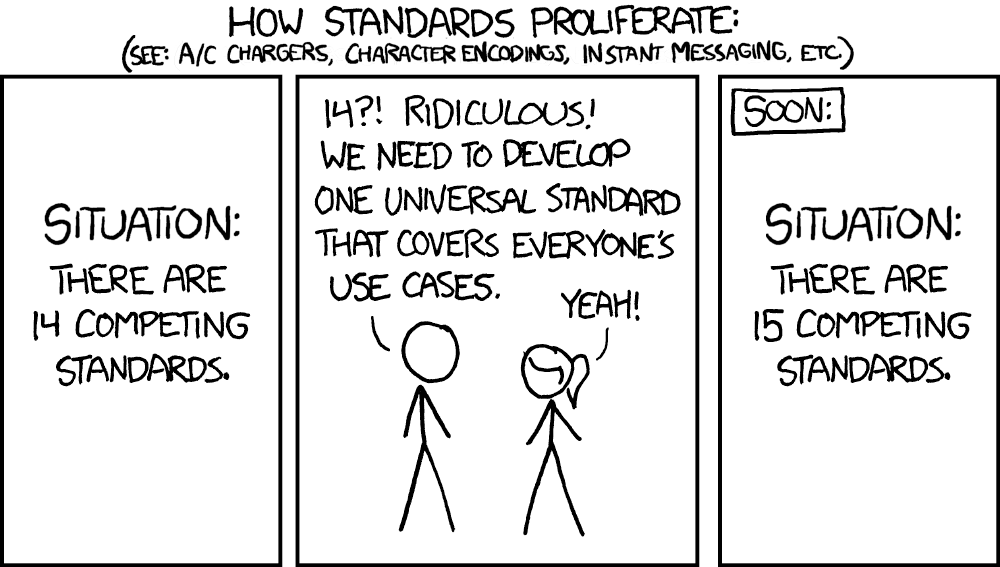
Storage related interfaces (I'm aware there's some overlap here, but point is, there's already plenty of options, and lots of nuances to deal with already, let's not add to it without good reason):
- NVMe PCIe
- M.2 and all of it's keys/lengths/clearances
- U.2 (SFF-8639) and U.3 (SFF-TA-1001)
- EDSFF (which is a very large family of things)
- FibreChannel
- SAS and all of it's permutations
- Oculink
- MCIO
- Let's not forget USB4/Thunderbolt supporting Tunnelling of PCIe
Obligatory: https://imgs.xkcd.com/comics/standards_2x.png