Love it. At the end of the article they mention digging in to the Amiga scene. If you want to feel old, Deluxe Paint turns 40 this year. My mates had Amigas (I had an Amstrad) and the computing world just felt full of wonder and promise. It was a magical time of creation. https://en.m.wikipedia.org/wiki/Deluxe_Paint
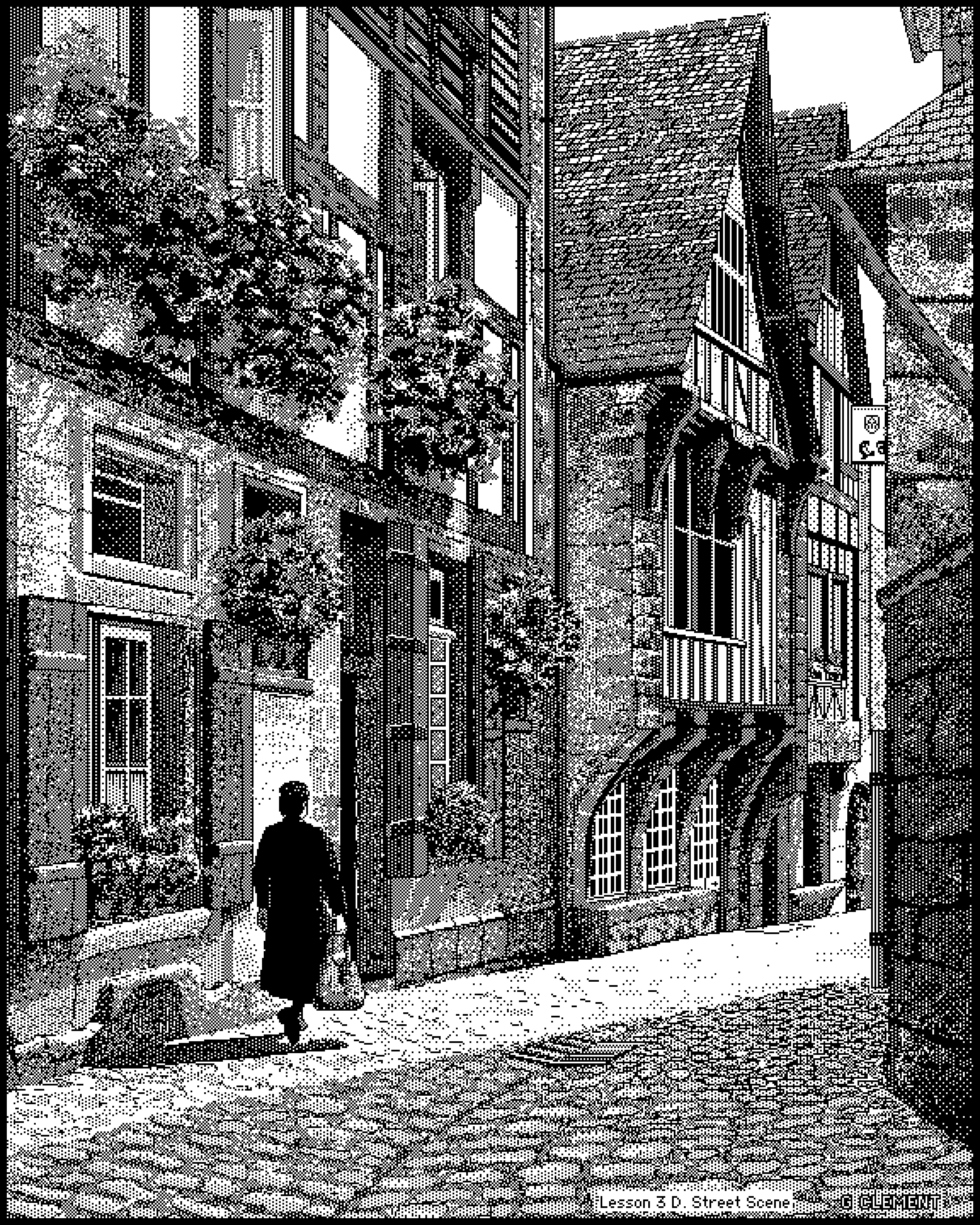
MacPaint Art from the Mid-80s Still Looks Great Today
71–80 of 210 posts
Re: MacPaint Art from the Mid-80s Still Looks Great Today
#72There's a term I read about a long time ago, I think it was "aesthetic completeness" or something like that. It was used in the context of video games whose art direction was fully realized in the game, i.e. increases in graphics hardware or capabilities wouldn't add anything to the game in an artistic sense. The original Homeworld games were held up as examples. Anyway, this reminded me of that. Making these picture…
The same holds true for everything from cave paintings to Roman frescos. It's part of human expression. The tools of that expression shape it. For example, Bach's music was shaped by the fact that the harpsichord had no sustain. The piano changed that, but "upscaling" Bach's work to take advantage of this new technology would destroy them. You use the new technology to play them as they were written for the old. The…
Re: MacPaint Art from the Mid-80s Still Looks Great Today
#73Earlier quoted context omitted.
Hm, are you sure that there is not some nostalgia at play here? To me they look horribly pixelated and at least some would improve aesthetically a lot for me with a higher resolution.
You have no idea on how charming these games look.
But that was my not well received point about nostalgia ..
Re: MacPaint Art from the Mid-80s Still Looks Great Today
#74Re: MacPaint Art from the Mid-80s Still Looks Great Today
#75Re: MacPaint Art from the Mid-80s Still Looks Great Today
#76Re: MacPaint Art from the Mid-80s Still Looks Great Today
#77Earlier quoted context omitted.
I was viewing them via a small mobile screen, not high DPI, not fullscreen. And to me, they simply don't look good the way they are. But if you folks enjoy them, go for it. Otherwise taste is subjective I think.
It's amazing what people achieved with the resources of the '80s, creating fairly enjoyable visuals using extremely limited technology. Another example from the early '90s is MARS.COM (1) by Tim Clarke (1993). Just 6 kilobytes and 30+ fps on a 12MHZ 286 (2). 1. https://www.youtube.com/watch?v=_zSjpIyMt0k 2. https://github.com/matrix-toolbox/MARS.COM/blob/main/MARS.AS...
But that doesn't mean I would enjoy a pixelated image now more than a high resolution image of the same motive.
Re: MacPaint Art from the Mid-80s Still Looks Great Today
#78Re: MacPaint Art from the Mid-80s Still Looks Great Today
#79Earlier quoted context omitted.
Pixel art is very much still around today, even though it's far from "pushing" the limits of current hardware. It's pursuing a rather consistent "vision" of maximizing quality while staying within the bounds of a predefined level of detail (i.e. resolution) and color depth.
Right. This is kind of what I’m talking about. Someone choosing pixel art today is making a choice; they have a vision. 40 years ago, they were limited by the system. The choice was largely made for them. Old video games come to mind. The box art would be drastically different than the look of the game. The box art was the vision, the game was what they ended up with after compromises due to the hardware of the day.…
A point of comparison would be to the game Quake, which came out the same year, and whose graphics felt light years ahead . But Quake mostly became a multiplayer hit, as the single-player story and overall atmosphere weren't very compelling.
Re: MacPaint Art from the Mid-80s Still Looks Great Today
#80These really need to be viewed with a CRT renderer IMO, as well as the Amiga art mentioned in this thread. The hard square pixels on the website aren’t quite representative of what these looked like on a contemporary monitor.
Up to a point, but the early Macintosh displays were quite crisp and clinical—certainly compared to something like a consumer NTSC or PAL CRT TV—as befitted a platform which was very focussed on WYSIWYG paper-document editing.