Live data from Hacker News

Vera C. Rubin Observatory first images

rubinobservatory.org

71–80 of 172 posts

Re: Vera C. Rubin Observatory first images

#71
post #8

I really like the Rubin because I think a lot of people focus too much on "deep" seeing (IE, looking at individual or several objects with very high magnification only once). The Rubin does much more "wide" seeing and this actually produces a ton of useful data- basically, enough data to collect reliable statistics about things. This helps refine cosmological models in ways that smaller individual observations cannot…

It does wide through image stacking/repeated visits. The speed and FOV is the key here.
Re: Vera C. Rubin Observatory first images

#75

Why are there lens-flare-like artifacts around some of the bright objects?

Those are diffraction spikes, caused by how the light interacts with the support structure holding the secondary mirror. Each telescope has different patterns, hubble, jwst, etc. I think they only happen for stars, and not for galaxies (an easy way to know which is which), but I might be wrong on that (there's a possibility for faint stars not to have them IIRC).

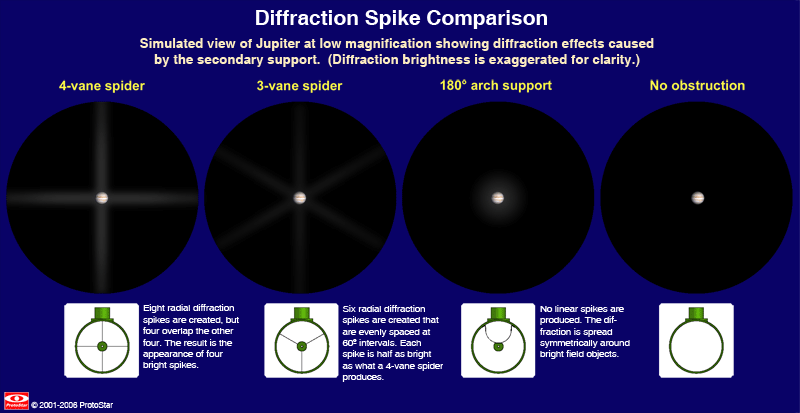
Diffraction spikes [1] are a natural result of the wave-like nature of light, so they occur for all objects viewed through a telescope, and the exact pattern depends on the number and thickness of the vanes.

My favourite fact about these in relation to astronomy is that you can actually get rid of the diffraction spikes if your support vanes are curved, which ends up smearing out the diffraction pattern over a larger area [2]. However this is often not what you want in professional astronomy, because the smeared light can obscure faint objects you might want to see, like moons orbiting planets, planets orbiting stars, or lensed objects behind galaxies in deep space. So you often want sharp, crisp diffraction spikes so you can resolve these faint objects next to or behind the bright object that's up front.

[1] https://www.celestron.com/blogs/knowledgebase/what-is-a-diff...

[2] https://www.fpi-protostar.com/img/spikes.gif

Re: Vera C. Rubin Observatory first images

#76
post #45

The wikipedia article is quite good - https://en.wikipedia.org/wiki/Vera_C._Rubin_Observatory (Edit: Treasure trove of details in the references if any of your interests are adjacent to this) The image of the woman holding the model of the sensor is nice because it includes a moon for scale. Question I was curious about is whether or not the focal plane was flat (it is). This is an interesting tidbit: > Once images a…

>The prompt products are alerts, issued within 60 seconds of observation, about objects that have changed brightness or position relative to archived images of that sky position. Transferring, processing, and differencing such large images within 60 seconds (previous methods took hours, on smaller images) is a significant software engineering problem by itself.[64] >This stage of processing will be performed at a cla…

I thought all satellites already have known orbits?

Both because they can't be made invisible, and because you need to avoid collisions.

Re: Vera C. Rubin Observatory first images

#77
post #9

The asteroid detection capability is amazing: https://rubinobservatory.org/news/rubin-first-look/swarm-ast...

That is likely the most unexcitedly unsettling video I have ever seen. Amazing storytelling really.

It’s like swimming in a lake or river and thinking the water is just water but then you take a closer look and it’s just incredibly alive to the point of absurdity.

Re: Vera C. Rubin Observatory first images

#78
post #68
post #65

Earlier quoted context omitted.

…they do the science

I've worked on quite a few large-scale scientific collaborations like this (and also worked on/talked to the lead scientists of LSST) and typically, the end groups that do science aren't the ones handling the massive infrastructure. That typically goes to well-funded sites with great infrastructure who then provide straightforward ways for the smaller science groups to operate on the bits of data they care about. Her…

The difference with this project is the data from Rubin itself isn’t where most of the scientific value comes from. It’s from follow up observations. Coordinating multiple observatories all with varying degrees of programmatic access in order to get timely observations is a challenge. But hey if you insist on being an “everything is easy” Andy I won’t bother anymore.

Re: Vera C. Rubin Observatory first images

#79
post #58

Back in January 2010 I went on a blind date with a lady who’s now my wife — an astrophysicist. We talked about this instrument and how Google would shuffle petabytes of raw observations, then distilling them into datasets researchers could actually use (don't know if Google is still involved?). We’ll celebrate 15 years of marriage this January, and I have been following the progress of this telescope since 2007 or so…

> We’ll celebrate 15 years of marriage this January,

Congrats!

Re: Vera C. Rubin Observatory first images

#80
post #37

something green: https://skyviewer.app/embed?target=186.82033+8.25479&fov=0.0...

Could be a satellite that moved into the frame during green.

There was a livestream presentation and press conference up on YouTube

https://www.youtube.com/live/Zv22_Amsreo?si=zQLeGfJokZoCPkji

At time 1:38:19 - one hour 38 minutes 19 seconds - into the livestream presentation, there's a slide that shows RGB streaks of fast-moving objects that were removed for the final image.

Those streaks are apparently asteroids.

Perhaps it is indeed a glitch or cosmic ray event.

(Is there a better URL for the slide deck?)

Post reply on HN