Live data from Hacker News

Computers Reduce Efficiency: Case Studies of the Solow Paradox (2023)

scottlocklin.wordpress.com

71–80 of 92 posts

Re: Computers Reduce Efficiency: Case Studies of the Solow Paradox (2023)

#71
post #17

I think this article is drastically downplaying how dramatically more complicated designs and things are now than they were before. I don't believe it's computers that are to blame; I believe it's complexity nightmare problem. We have much tighter tolerances for everything now; everything "does more" and relies on my components. Back when we used pen and paper to create military vehicles it was mostly JUST about perf…

Agreed. Complexity could ultimately be our downfall. Everything is drastically more complicated than before and the margins for safety are getting more and more reduced.

Take my own industry of electricity markets for example. It used to be you had large vertically integrated utilities that handled generation of power as well as the transmission of it to the residential grid (distribution). They would run the grid and factor all costs (fixed and variable) into residential and industrial rates. This is easy to explain to someone in a minute or so. In the 1970s and 80s though deregulation took off and you could finally build fairly efficient and smaller gas plants, so there was a push to have these much larger grid operators optimize over a much larger region and introduce competition amongst those in the market, so the public wouldn't suffer from unwise investments from the utilities. This system is more efficient, but is supposed to operate off of a "free market" system. The only problem is that it has never worked very well overall. It does schedule power more efficiently, but you have all these power plants needed for just a handful of events that are no longer solvent as they can't earn enough money in the markets. So the grid operators are dealing with mass scale retirements (some of these would've occured anyway due to EPA rulings) and spending tons of time and money trying to fix a problem that didn't use to exist. These organizations have thousands of pages of legal documents and run enormously complex power auctions and have to employ hundreds of employees to administer all of it. Very few people understand how the cake is made anymore so to speak. Does it save more money? Yes, but the cost is a massive increase in complexity that grows each year as new rules are made. So we took something conceptually simple and made it 10x more complex in order to squeak out more savings. I'm not saying it was the wrong path, but doing this sort of thing all over society/economy has its own costs.
Re: Computers Reduce Efficiency: Case Studies of the Solow Paradox (2023)

#72

It definitely is true that a design which could easily be created by hand is harder to create on a computer. The things where computers shine are actually managimg the complexity of a large and complicated systems. What I think the article leaves unspoken (but implied) is the "curse of tools", if you give a person tools he is likely to use them, even if they might not be applicable. Meaning that someone might decide…

Complexity is the outcome of misunderstanding. The misunderstanding can come from lots of areas.

It could be from a requirements perspective: “I understand what I can build easily, but not what you want.”

It could be from an engineering perspective: “I understand what you want, but I don’t understand how to build that cohesively.”

It could be from a scientific perspective: “No one knows what tools we need to investigate this.”

I saw mentioned in other comments that CAD software doesn’t allow for sketching. As someone who was originally trained in drafting the old way, and who has used modern CAD systems to produce models for fantastically large physical simulations, I largely agree that sketching is lost. But the sketching that I can do on paper is just not at the same level of complexity as I can kinda do on my computer.

But the complexity of using the new tool obscures the fact that my model is much more complicated than I could otherwise manage using old tools. And that’s because I’m still learning. In fact, I have to “deploy” while I’m still in learning mode about a problem, unlike before, where I had to understand the problem in order to use the tools to draft the thing.

Being able to do something with a half-formed idea sounds like sketching, but when non-experts rely upon it, it’s pretty fragile. Because it wasn’t done.

Building a memex (something the author disparages multiple times) is super hard because we still don’t understand how to represent ideas separately from language, our original mental sketching tool. But people built Altavista and Google and LLMs anyway. And yeah, they’re super complex.

How does TCP/IP work over wireless connections? Poorly and with a lot of complexity. Why? Because the concept of a connection is ill-defined when communication relies on ephemeral signaling.

But despite the complexity, it is useful and fun to use only half-baked ideas. Just like it’s fun to use language to describe stuff I don’t understand, but merely experience. Graduation. Being a parent to a sick child. Losing a loved one.

Re: Computers Reduce Efficiency: Case Studies of the Solow Paradox (2023)

#73

There are at least two dimensions to this that I believe that the author has overlooked: 1. Economies of scale. It may be that drafting something up in CAD takes more cycles to get right up front, but once you have an established design it is much easier to reproduce it by orders of magnitude 2. Changes in software. Software companies are ever changing their interfaces, decreasing productivity every time their users…

And CAD models benefit from better technology "for free", better visualization, better heuristics (for rule/code/safety/conformance checking), and so on.

Did it make sense for military nuclear submarines back then? Well, maybe not, who knows. (Submarines are definitely not mass produced.)

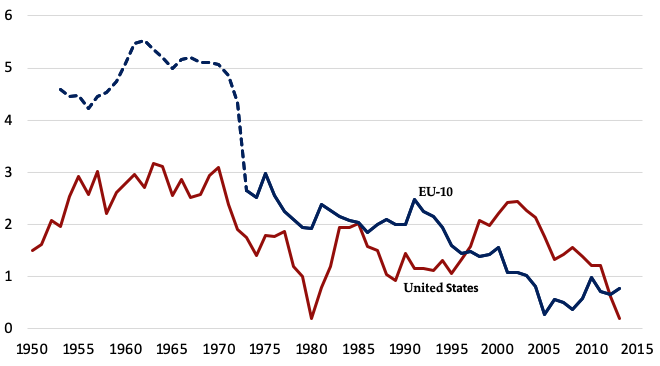
But what this 'insightful essay' ignores is that productivity decreased overall in the 'West' (as the post-WWII boom ended) but then picked up right around the dot-fucking-com boom. Oh, wait computers. But maybe this glorified shitpost should have used recent datasets instead of spending its eruditeness budget on extra spicy and fancy words. (propitiate!)

https://www.mckinsey.com/~/media/mckinsey/mckinsey%20global%...

https://cepr.org/sites/default/files/styles/flexible_wysiwyg...

https://www.caixabankresearch.com/sites/default/files/styles...

Re: Computers Reduce Efficiency: Case Studies of the Solow Paradox (2023)

#74
Under appreciated: Automation creates, or dramatically enhances, the need to fully understand problems and solutions at the most detailed and practical levels. Because automation removes the valuable manual ad hoc flexibility to adapt to most wonkiness.

1. When a job requires a mix of human and computer work, productivity changes are very dependent on interface details. Even one slightly confusing GUI, slowness of feedback, a tool that isn't quite as flexible as a job needs, or an inability to see/edit/use related information at the same time, can greatly harm productivity.

2. When a job is completely automated, productivity can go way up. But this productivity doesn't get attributed to human workers, it is corporate productivity. And then only if this highly optimized task really provides value. There is a lot of performative information processing, with conjectured long term payoffs, serving the needs of management and tech workers to look busy, and believe they are valuable.

For both human and corporate productivity, automation makes it extremely easy to decrease productivity due to the most subtle mismatches between problems and solutions.

When work is done by hand, these mismatches tend to be glaringly obvious, less tolerated, and more easily mitigated or eliminated.

Re: Computers Reduce Efficiency: Case Studies of the Solow Paradox (2023)

#75

It definitely is true that a design which could easily be created by hand is harder to create on a computer. The things where computers shine are actually managimg the complexity of a large and complicated systems. What I think the article leaves unspoken (but implied) is the "curse of tools", if you give a person tools he is likely to use them, even if they might not be applicable. Meaning that someone might decide…

Never underestimate the personal satisfaction of spending a day, or a week, installing, playing or configuring one's tools!

In the past, we customized our workflow while in the flow. Now, to approximate that freedom, we have to futz around up front, with the limited control levers they give us. In a slow feedback loop with any actual work, to get our tools to help us in the way we want.

Which for complex tools and work, can rapidly become its own end.

Re: Computers Reduce Efficiency: Case Studies of the Solow Paradox (2023)

#76

For similar reasons to those mentioned in the article it's possible the past century will be seen as a dark age by future humans. Computers are incredibly fragile and depend on complex systems (eg the electricity grid) to even operate. They also can't persist data even across several decades reliably. Yet we've created a society where nothing can be done without a computer and all our data is stored in computers inst…

The problem is that complex systems have not made us more knowledgeable and capable, but instead they have become a crutch. https://www.palladiummag.com/2023/06/01/complex-systems-wont...

>By the 1960s, the systematic selection for competence came into direct conflict with the political imperatives of the civil rights movement. During the period from 1961 to 1972, a series of Supreme Court rulings, executive orders, and laws—most critically, the Civil Rights Act of 1964—put meritocracy and the new political imperative of protected-group diversity on a collision course.

Lot of this kind of stuff. Thesis summarized is that America is going to hell in a handbasket because the Feds are demanding that black people get hired once in a blue moon, a practice which dilutes meritocracy, according to the author.

Heh.

>When this was not enough, MIT increased its gender diversity by simply offering jobs to previously rejected female candidates. While no university will admit to letting standards slip for the sake of diversity, no one has offered a serious argument why the new processes produce higher or even equivalent quality faculty as opposed to simply more diverse faculty.

Ah, MIT now pumping out dumb blondes, are they? Having encountered such people as the author of this piece several times before,I have to wonder about the "meritocracy" process in place prior. So "merit" correlates positively with sunscreen purchases, and inversely to tampon expenditure, does it?

>This effect was likely seen in a recent paper by McDonald, Keeves, and Westphal. The paper points out that white male senior leaders reduce their engagement following the appointment of a minority CEO. While it is possible that author Ijeoma Oluo is correct, and that white men have so much unconscious bias raging inside of them that the appointment of a diverse CEO sends them into a tailspin of resentment, there is another more plausible explanation. When boards choose diverse CEOs to make a political statement, high performers who see an organization shifting away from valuing honest performance respond by disengaging.

I mean... is there an actual difference here? First, I'm not convinced it's unconscious bias. Second, this "disengagement" certainly seems like the kind of "meritocracy" we have sadly grown quite familiar with.

>The problem is that complex systems have not made us more knowledgeable and capable, but instead they have become a crutch.

This article kind of sounds like some people want the old crutch back. There is a non trivial question of your fitness for this, however. In the 50's the rise of psychotherapy made it quite clear that people were cracking under the strain of delivering "merit."

I'm quite delighted that this is such a concern to you people. Excellent.

Re: Computers Reduce Efficiency: Case Studies of the Solow Paradox (2023)

#77
post #25

Earlier quoted context omitted.

> Back when we used pen and paper to create military vehicles it was mostly JUST about performance and completing the objective. There wasn't thousands upon thousands of other requirements and features (whether or not this is a good thing is debatable). It makes me wonder if this piling-on of requirements is also enabled or encouraged by computers. I agree that things are becoming more complex, but I’m thinking compu…

The U.S. tax code is certainly far more complex than it would otherwise be if not for computers.

No, the complexity comes from people, both the taxed, and those who impose them, and those who manipulate the legal process for relief. Computers actually give the sums a chance to be somewhat correct.

Re: Computers Reduce Efficiency: Case Studies of the Solow Paradox (2023)

#78
post #53

It definitely is true that a design which could easily be created by hand is harder to create on a computer. The things where computers shine are actually managimg the complexity of a large and complicated systems. What I think the article leaves unspoken (but implied) is the "curse of tools", if you give a person tools he is likely to use them, even if they might not be applicable. Meaning that someone might decide…

The curse of tools applies in computing too. A virtue of languages like Go is that they reduce incidental and gratuitous complexity through the simplicity of the language. A complex language with a powerful type system like Rust or C++ will tempt programmers to use every facet of the language and create baroque overly complex code.

Sounds like an argument for C, honestly. After all, that complexity is either in the language, or solved on a case by case basis. Every patch adds complexity, because it reflects changes in the business environment that presents the problem the code is solving.

Re: Computers Reduce Efficiency: Case Studies of the Solow Paradox (2023)

#79
post #25
post #17

I think this article is drastically downplaying how dramatically more complicated designs and things are now than they were before. I don't believe it's computers that are to blame; I believe it's complexity nightmare problem. We have much tighter tolerances for everything now; everything "does more" and relies on my components. Back when we used pen and paper to create military vehicles it was mostly JUST about perf…

> Back when we used pen and paper to create military vehicles it was mostly JUST about performance and completing the objective. There wasn't thousands upon thousands of other requirements and features (whether or not this is a good thing is debatable). It makes me wonder if this piling-on of requirements is also enabled or encouraged by computers. I agree that things are becoming more complex, but I’m thinking compu…

> It makes me wonder if this piling-on of requirements is also enabled or encouraged by computers.

You can build a radar with pen and paper but you can't build an effective stealth bomber with the same. You can't build guided weapons without computers. You can't effectively build hyper-accurate guidance and navigation without computers.

Without computers you're at late-40s early 50s weapon systems. If everyone is stuck at that level you've got some amount of balance in capabilities. The first side/power to apply computers to increase capabilities has a significant advantage over all competitors.

Even if the availability of computers makes things more complex the increased capability is often worth the complexity in aggregate.

The first Gulf Ware is a good object lesson. Iraq had a large and capable military that was several technological generations behind their opponents. The Coalition forces could operate at night with impunity, had unbroken communications behind enemy lines, and could operate in enemy airspace largely uncontested. If the Coalition forces had the same level of technology and dispersion of high technology through the ranks, the Gulf War could have easily been fought to a stalemate or worse.

Re: Computers Reduce Efficiency: Case Studies of the Solow Paradox (2023)

#80

I build architectures for major systems and in every case I start with a blank paper in a Strathmore 400series Sketchbook About 4 years ago I made a wall of my office into a chalkboard and that’s been where I work out massively complex interdependencies and data workflows Nothing on a computer remotely compares to the speed and specificity of pen or chalk in hand

Except a tablet with pen support

Not even close.

That can break and isn’t perfectly 100% available like my analog method and has much less transportability

Post reply on HN