Earlier quoted context omitted.
It is certainly more expensive to install electric chargers into an existing inert concrete structure than it is to design them in from the beginning. The building I am in is working this out right now, as are many others. Planning for Uber and autonomous cars includes architecting porticos and pickup/dropoff points in favor of garages. Many buildings are hostile to use of Uber in my daily experience.
> Many buildings are hostile to use of Uber in my daily experience. if there's already a taxi rank, then uber should be using that space to pick-up/drop-off. If there isn't, then the current building is _already_ unfriendly to taxis.
Heaven or High Water – Selling Miami's Last 50 Years
71–80 of 154 posts
Re: Heaven or High Water – Selling Miami's Last 50 Years
#72Earlier quoted context omitted.
I’m similarly perplexed at RE. For one, I make a good living and yet I can’t find decent, affordable homes near me. They’re all dated and much too expensive/soft. Dated in that they almost never have AC despite climate change making it necessary in the area - and rampant lead paint/asbestos. Apartment buildings are similarly dated. Last I looked, in a big city apartment complexes were rare if they had one or two char…
>they almost never have AC despite climate change making it necessary in the area I'm really sorry but this isn't how climate change works. Climate change is a slow increase in average temperature over 100+ years that has dramatic impact on lots of things, but probably not the "need" for AC.
1. A slow and steady increase in the average temperature.
2. A rapid increase in the frequency of extreme weather events.
Point 1 doesn't force people to buy ACs, but Point 2 will. For example, you generally don't need AC in San Francisco, but a heat wave in 2017 killed 14 people[0]. As the frequency of heatwaves increases, people will need to equip themselves against the temperature _extremes_, even though the _average_ temperature hasn't changed much.
[0] https://www.kqed.org/science/1932692/climate-change-dishes-u...
>As the world has warmed, that warming has triggered many other changes to the Earth’s climate. Changes in extreme weather and climate events, such as heat waves and droughts, are the primary way that most people experience climate change. Human-induced climate change has already increased the number and strength of some of these extreme events. Over the last 50 years, much of the U.S. has seen increases in prolonged periods of excessively high temperatures, heavy downpours, and in some regions, severe floods and droughts.
[1] https://nca2014.globalchange.gov/highlights/report-findings/...
>One of the most visible consequences of a warming world is an increase in the intensity and frequency of extreme weather events. The National Climate Assessment finds that the number of heat waves, heavy downpours, and major hurricanes has increased in the United States, and the strength of these events has increased, too.
[2] https://www.c2es.org/content/extreme-weather-and-climate-cha...
Re: Heaven or High Water – Selling Miami's Last 50 Years
#73Earlier quoted context omitted.
I know this is getting a little off topic, but I'm as surprised as you that electric charging isn't taking on at parking lots and structures much as I expected. I mean even Disney only has like 2-6 charging spots in each of their parking lots designed to hold over 12,000 cars per lot! And then you look at other parking structures and see that they have a token charger or 2 and the few I've reached out to never have a…
People don't like to spend money until they're in real pain. If you don't go to Disney because you have purchased a car that can't go there unless there are electric charge stations, I don't think that's painful for them yet.
Re: Heaven or High Water – Selling Miami's Last 50 Years
#74I live in Orlando. I have lived in Florida for all of my life (47 years) and I also wonder how we are going to adapt. I don't see any long term planning. A few years ago I was looking for a new office building. Considering the parking situations, I asked each developer what they were planning for electric cars, Ubers, and autonomous cars. None of them had a plan. They all said such changes were 20 years or more away.…
Most buildings last more than 20 years. I get you can make rennovations...however if you plan for the future during construction those rennovations can be much cheaper. For example making their be excess circuit breaker capacity during construction doesn't cost much and enables ev charging to be added at a later date for less money than if that spare electrical capacity wasn't installed
Re: Heaven or High Water – Selling Miami's Last 50 Years
#75Earlier quoted context omitted.
> Many buildings are hostile to use of Uber in my daily experience. if there's already a taxi rank, then uber should be using that space to pick-up/drop-off. If there isn't, then the current building is _already_ unfriendly to taxis.
Except taxi ranks are a queue of fungible vehicles; uber/lyft's are "bespoke" so the exact same structure won't work quite as well. But it wouldn't be hard to make a pickup/dropoff area. I suspect there already is one at most places, it's just a pissy, petty policy that doesn't allow ridesharing (etc) to use it.
Re: Heaven or High Water – Selling Miami's Last 50 Years
#76Earlier quoted context omitted.
That may be politically more difficult when a substantial portion of the population insists that lower taxes and less government/regulation are an absolute good, to be pursued in all circumstances.
The vast majority making that argument only do so over issues where they think it is in their own interest. Where spending or legislation is in their interest, it's just common sense.
Re: Heaven or High Water – Selling Miami's Last 50 Years
#77Earlier quoted context omitted.
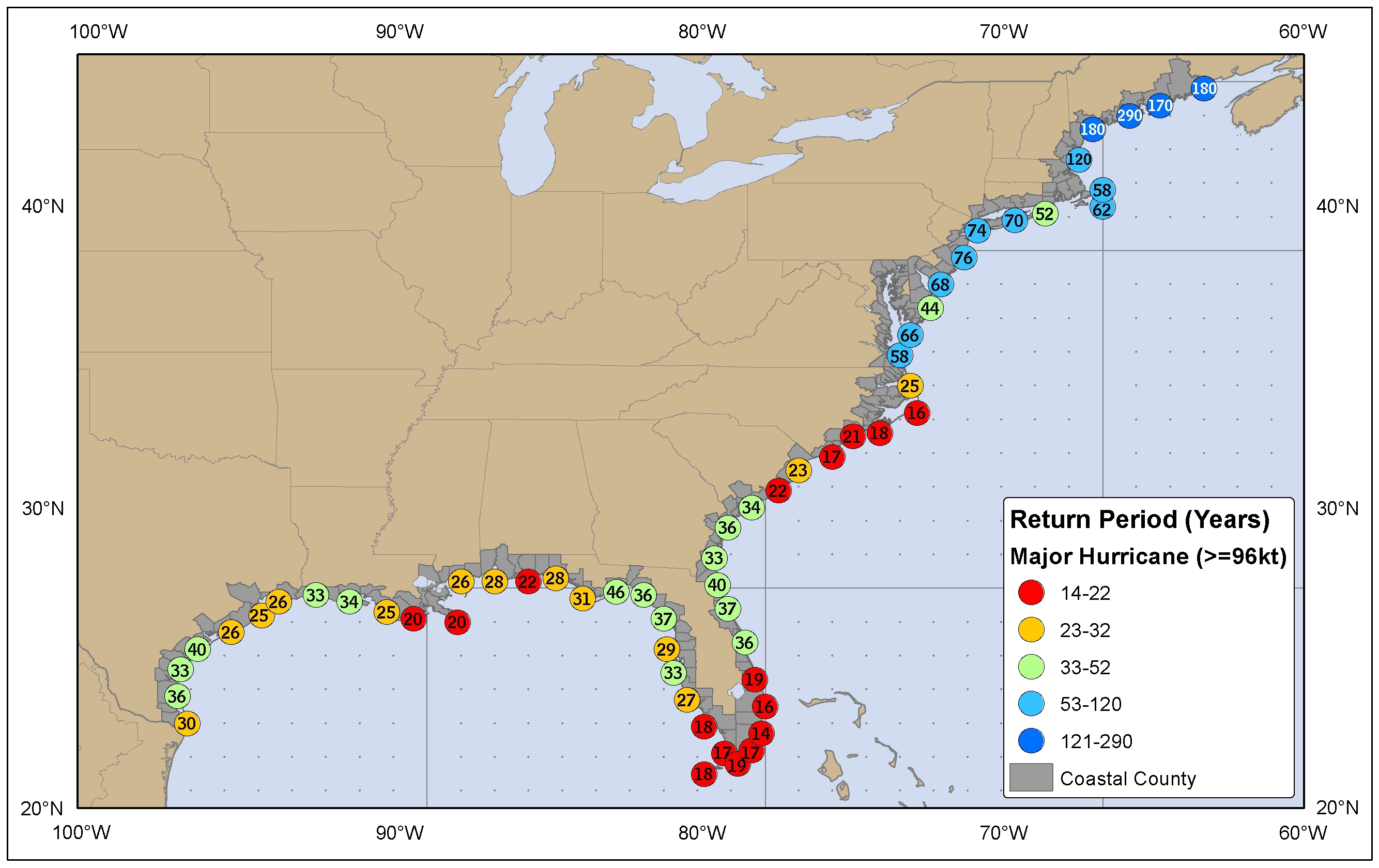
Florida's status as a swing state in Presidential elections means that both political parties will bail it out no matter what. The whole nation already bails out Florida via the National Flood Insurance Program, since no entity other than the federal government could possibly insure such a high frequency high risk event. Another taxpayer casualty of the electoral college system.
To imply that Florida is the sole reason that the National Flood Insurance Program will stay is really out there. Other states along the Gulf are big recipients, and there's always the chance that a hurricane will swing up the eastern seaboard, in which case everything from Georgia to at least North Carolina will be using that program. There's also the chance of inland flooding if there's enough snowmelt or rain so t…
The CBO [2, "The National Flood Insurance Program: Financial Soundness and Affordability"] calls that out as clearly as possible without naming names.
"In particular, the overall shortfall of $1.4 billion is attributable largely to premiums’ falling short of expected costs in coastal counties, which constitute roughly 10 percent of all counties with NFIP policies but account for three-quarters of all NFIP policies nationwide."
You know who pays the highest NFIP rates? Connecticut. The lowest? Florida.
[1] https://www.nhc.noaa.gov/climo/images/return_mjrhurr.jpg
Re: Heaven or High Water – Selling Miami's Last 50 Years
#78Re: Heaven or High Water – Selling Miami's Last 50 Years
#79I live in Orlando. I have lived in Florida for all of my life (47 years) and I also wonder how we are going to adapt. I don't see any long term planning. A few years ago I was looking for a new office building. Considering the parking situations, I asked each developer what they were planning for electric cars, Ubers, and autonomous cars. None of them had a plan. They all said such changes were 20 years or more away.…
Re: Heaven or High Water – Selling Miami's Last 50 Years
#80Earlier quoted context omitted.
If your city is built on a sponge and in the flattest state to boot your solutions look like seasteading, not dams and pumps. From an engineering point of view Miami should be looking to Venice, not Amsterdam. You can’t save Florida land by pumping so the only way to go is to make your own taller land or to build what amount to boats or oil rigs.
Adding some fun science: pumps are particularly unsuited to FL because of the "sponge" that makes up its land. As freshwater is taken up from the soil for human use, saltwater slowly follows it in (contaminating Fl's freshwater source). If there's a mismatch in the rate of percolation, you can get sinkholes -- the land collapses because there isn't water in the cracks holding it up. https://www.smithsonianmag.com/sci…