Earlier quoted context omitted.
I've been slowly working on my own simple home "Alexa" using mostly CMUSphinx for the voice detection. Honestly my most successful methods involved the least amount of complex NLP. Just simply treating the sentence as a bag of words and looking for "on" or "off" or "change" (and their synonyms) and the presence of known smart objects works extremely well. I could say "Hey Marvin, turn on the lights and TV", or "Hey M…
This was recently mentioned on HN, but I haven't really looked into it (apparently requires training your own models, but provides prepared scripts to do that for some common datasets): https://github.com/mozilla/DeepSpeech
An Upgrade to SyntaxNet, New Models and a Parsing Competition
71–80 of 93 posts
Re: An Upgrade to SyntaxNet, New Models and a Parsing Competition
#72Earlier quoted context omitted.
Two times in my life, I've gotten deeply excited about Mathematica. The first time I wanted to use it for economics homework as an undergraduate. (Don't worry, I did it on paper first.) The second time, I wanted to use it for machine learning, especially NLP. Mainly the knowledge base Mathematica hooks into is what drew me. The problem in the end is that the customizability of Mathematica ends right where things get…
> If you want to show people cool little examples, Mathematica is clean and fast, but you can't build anything serious with it. Mathematica, which is a serious project, is largely written in Mathematica. Wolfram|Alpha, another large project, is built in Mathematica. Outside the company, https://emeraldcloudlab.com/ for example has built their platform on Mathematica. > And by "serious", I guess I mean something with…
Re: An Upgrade to SyntaxNet, New Models and a Parsing Competition
#73We changed the title from "Google open-sources Tensorflow-based framework for NLP", which appears misleading, given that it happened last May: https://news.ycombinator.com/item?id=11686029 . On HN the idea is to rewrite titles only to make them less misleading (or less baity). Please see https://news.ycombinator.com/newsguidelines.html .
dang, sorry if this seemed misleading. In my humble opinion, the blog title does not do full justice to the new release, primarily since it carries a new framework within SyntaxNet: https://github.com/tensorflow/models/blob/master/syntaxnet/g... This new DRAGNN framework is what I thought the folks here would want to know. Perhaps I should have linked to the github page, rather than the blog announcement.
For the same reason, it probably doesn't make sense to change the current thread to point to that Github page now, since that would orphan the existing discussion.
Re: An Upgrade to SyntaxNet, New Models and a Parsing Competition
#74Earlier quoted context omitted.
It is not a good idea to compile TensorFlow by your own unless you really need it (for example for TensorFlow serving). Python packages are the way to go.
This is a bit unfortunate, in a real sense. I mean, I already build enough software, so I'm not sad on missing out. But here's the thing: TensorFlow actually installed great on Windows and it took less than 10 minutes to get running, once I had Python3 installed, even with GPU support. Even worked awesome in VS Code, out of the box, with autocomplete in the python mode. Even a baby like me got started easily. But it'…
Could you please share in more details the problems you encountered with Bazel?
If you have specific questions, I encourage you to post on StackOverflow with the bazel and tensorflow tags, both the Bazel and Tensorflow teams are monitoring and answering questions there.
Re: An Upgrade to SyntaxNet, New Models and a Parsing Competition
#75Earlier quoted context omitted.
Two times in my life, I've gotten deeply excited about Mathematica. The first time I wanted to use it for economics homework as an undergraduate. (Don't worry, I did it on paper first.) The second time, I wanted to use it for machine learning, especially NLP. Mainly the knowledge base Mathematica hooks into is what drew me. The problem in the end is that the customizability of Mathematica ends right where things get…
> If you want to show people cool little examples, Mathematica is clean and fast, but you can't build anything serious with it. Mathematica, which is a serious project, is largely written in Mathematica. Wolfram|Alpha, another large project, is built in Mathematica. Outside the company, https://emeraldcloudlab.com/ for example has built their platform on Mathematica. > And by "serious", I guess I mean something with…
For research, closed source should be a dealbreaker.
Re: An Upgrade to SyntaxNet, New Models and a Parsing Competition
#76Earlier quoted context omitted.
> If you want to show people cool little examples, Mathematica is clean and fast, but you can't build anything serious with it. Mathematica, which is a serious project, is largely written in Mathematica. Wolfram|Alpha, another large project, is built in Mathematica. Outside the company, https://emeraldcloudlab.com/ for example has built their platform on Mathematica. > And by "serious", I guess I mean something with…
> For research, a "thing you can do with Mathematica" is often what you want. But other than that you can put things you build in the cloud via APIFunctions (similar to AWS Lambda functions), or call out to them via wolframscript, or talk to kernels directly via MathLink or LibraryLink, or over sockets via ChannelListen. For research, closed source should be a dealbreaker.
Re: An Upgrade to SyntaxNet, New Models and a Parsing Competition
#77Re: An Upgrade to SyntaxNet, New Models and a Parsing Competition
#78Hoping this will quickly make into someone's home grown self-hosted version of Alexa. Alexa, turn the lights on in the kitchen. Alexa, turn on the kitchen light. Alexa, light up the kitchen. Should all accomplish the same task using this framework.
I've been slowly working on my own simple home "Alexa" using mostly CMUSphinx for the voice detection. Honestly my most successful methods involved the least amount of complex NLP. Just simply treating the sentence as a bag of words and looking for "on" or "off" or "change" (and their synonyms) and the presence of known smart objects works extremely well. I could say "Hey Marvin, turn on the lights and TV", or "Hey M…
Re: An Upgrade to SyntaxNet, New Models and a Parsing Competition
#79For those of us who aren't developers but maybe more aptly called "hackers" (cause we hack stuff together even though we're operating out of our league, sometimes we get stuff to work). I am wondering, is there a even higher level guide to using Tensor Flow. I am currently growing Sweet Peas in my office in enclosed containers that automanage environment, nutrition and water. I have the capaability to log a lot of da…
The short answer is to skip TensorFlow entirely and use/learn Keras for a high-level overview; then you can learn top-down if you need to use/look at TF code directly. Another HN thread has good tutorials for simple uses of Tensorflow: https://news.ycombinator.com/item?id=13464496 However, NNs are optimal for text/image data as they can learn the features. If your data features are already known, you don't necessaril…
Re: An Upgrade to SyntaxNet, New Models and a Parsing Competition
#80Earlier quoted context omitted.
The short answer is to skip TensorFlow entirely and use/learn Keras for a high-level overview; then you can learn top-down if you need to use/look at TF code directly. Another HN thread has good tutorials for simple uses of Tensorflow: https://news.ycombinator.com/item?id=13464496 However, NNs are optimal for text/image data as they can learn the features. If your data features are already known, you don't necessaril…
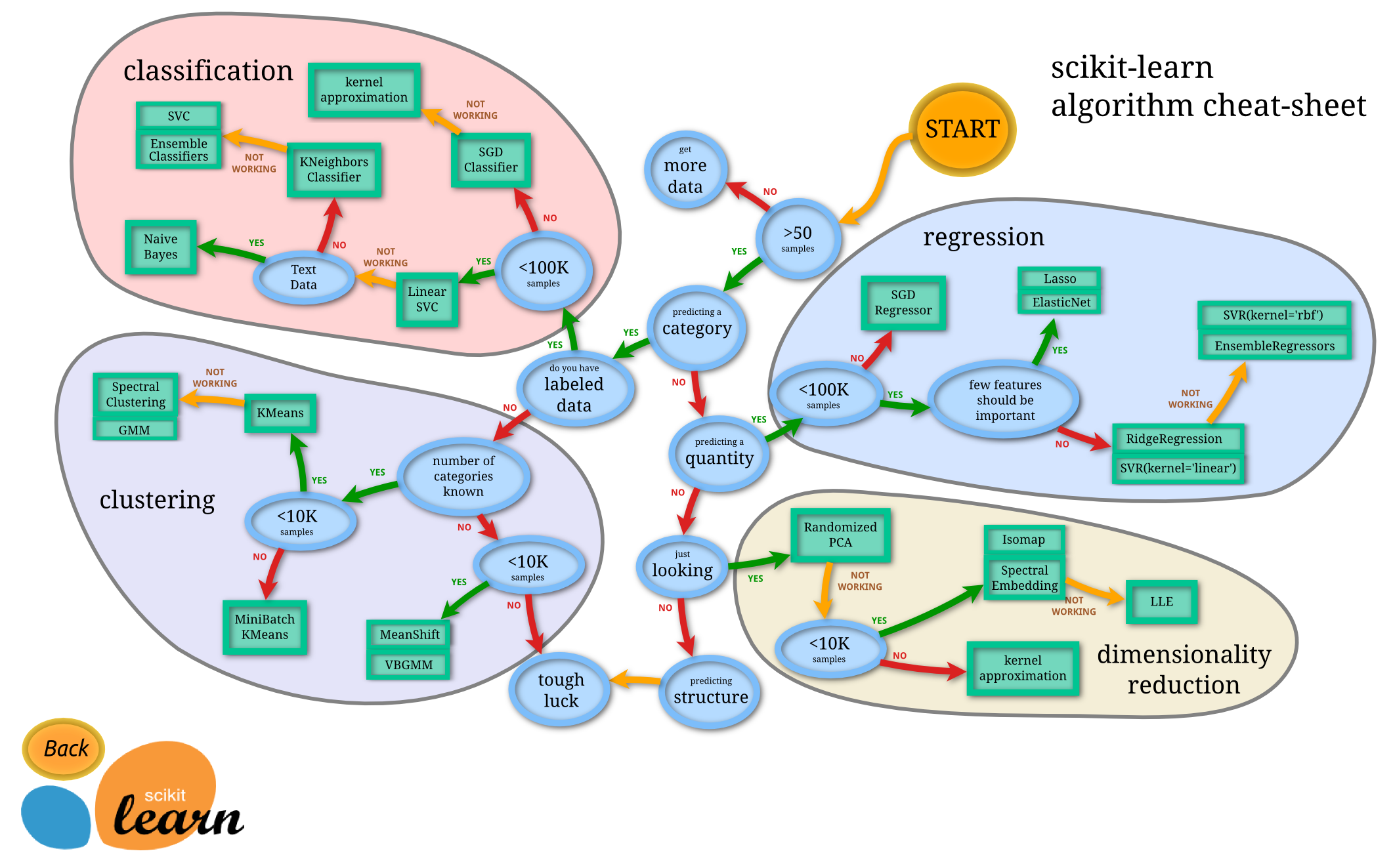
sklearn has this flowchart for what machine learning method to use: http://scikit-learn.org/stable/_static/ml_map.png