Live data from Hacker News

Philae Found

esa.int

71–80 of 135 posts

Re: Philae Found

#71
post #67

I didn't get why this was important and the article didn't reveal it upon skimming. Since it seems to get people very enthusiastic I gave it a proper read. After 11 paragraphs, the actual news is revealed: > “This [...] means that we now have the missing ‘ground-truth’ information needed to put Philae’s three days of science into proper context, now that we know where that ground actually is!”

Also, the third paragraph shows why it was relevant:

> The images also provide proof of Philae’s orientation, making it clear why establishing communications was so difficult following its landing on 12 November 2014.

Mostly the curiosity of the public and more importantly the scientists who worked so hard on the project only to have their lander not land properly.

Otherwise the fact that Philae was lost almost immediately upon landing has been a huge story line this past year. I believe the blog assumed the readers would know this. A CNN article would typically provide back story but this is original source from ESA.
Re: Philae Found

#72
post #31

Earlier quoted context omitted.

RTFA. It was already known it had landed, just not exactly where.

Yes, they knew it landed, they got data back and then other than the last burst, never heard from it again. That's from the article and other news sources. Nice to know that it was still there after the last burst, that it hadn't been swept into space. And from the pictures it's going to be on there for awhile.

Then RYFC: "it's good to know that Philae hadn't bounced off into space." does not correlate with someone who had bother to read the article before commenting. You can't "bounce" from a stationary position, but glad to see you've now caught up.

Re: Philae Found

#75
post #64

"At 2.7 km, the resolution of the OSIRIS narrow-angle camera is about 5 cm/pixel, sufficient to reveal characteristic features of Philae’s 1 m-sized body and its legs, as seen in these definitive pictures." I looked at the pictures and the human eye can barely see the lander. Considering that the chances of losing these landers is not that low, I don't understand why they don't make them visually more distinctive. An…

If they were to commit resources to this situation, a simple, tiny, low power radio beacon would be an option. Rather than search for it, let it tell Rosetta where it is. The problem with this is that even though the beacon could be only a few grams and use micro-watts (1 milliwatt transmission 1/1000th of the time?) of energy, Rosetta would need a receiver capable of picking it up. I assume Rosetta has something lik…

It seems that the beacon is not necessary. They already have radio localization. The problem is confirmation from imagery.

> Radio ranging data tied its location down to an area spanning a few tens of metres, but a number of potential candidate objects identified in relatively low-resolution images taken from larger distances could not be analysed in detail until recently.

Re: Philae Found

#76
post #67

I didn't get why this was important and the article didn't reveal it upon skimming. Since it seems to get people very enthusiastic I gave it a proper read. After 11 paragraphs, the actual news is revealed: > “This [...] means that we now have the missing ‘ground-truth’ information needed to put Philae’s three days of science into proper context, now that we know where that ground actually is!”

There were a couple of mechanisms intended to hook it upright to the surface upon landing. Instead it bounced 2 or 3 times and landed tilted in some rocks. The battery was only sufficient for a few hours of pictures and other experiments. If it had landed upright and charged by solar panels it could have operated a long time, perhaps until now. The hope was that some of the solar panels were exposed it might revive after a couple of weeks. There was a hint it called the orbitor at least once, but no more data.

Re: Philae Found

#77

NASA and ESA's recent push to land things on comets and asteroids makes me pause and wonder if they have in the last decade or so calculated the orbit of an object that concerns them.

[deleted]

Re: Philae Found

#78
post #74

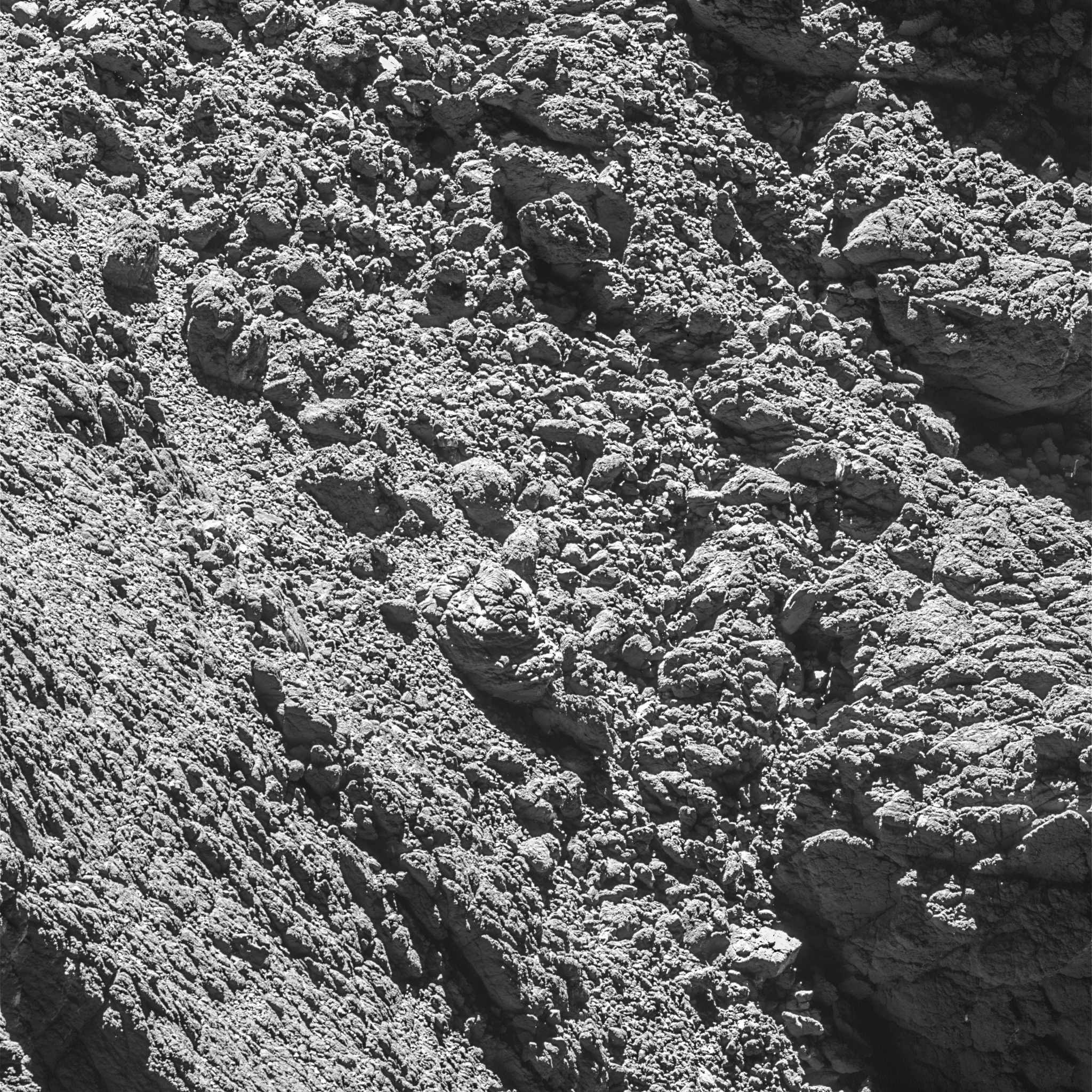
The hi-res image shows how just how unlucky a landing spot this was. http://www.esa.int/spaceinimages/Images/2016/09/OSIRIS_narro...

Direct link: http://www.esa.int/var/esa/storage/images/esa_multimedia/ima... [changed, thanks]

That's not the full resolution image.

Re: Philae Found

#79
post #64

Earlier quoted context omitted.

If they were to commit resources to this situation, a simple, tiny, low power radio beacon would be an option. Rather than search for it, let it tell Rosetta where it is. The problem with this is that even though the beacon could be only a few grams and use micro-watts (1 milliwatt transmission 1/1000th of the time?) of energy, Rosetta would need a receiver capable of picking it up. I assume Rosetta has something lik…

It seems that the beacon is not necessary. They already have radio localization. The problem is confirmation from imagery. > Radio ranging data tied its location down to an area spanning a few tens of metres, but a number of potential candidate objects identified in relatively low-resolution images taken from larger distances could not be analysed in detail until recently.

Ah hah... good spotting. Using radio to locate down to 10's of meters is a heck of an achievement. Makes me wonder how many other amazing things are hidden under the surface of this effort that are similarly amazing but don't see the light of day.

Re: Philae Found

#80

Earlier quoted context omitted.

My entirely uneducated guess is that a layer of paint would impede the cooling of electronics that depend on the housing to dissipate heat.Paint would also absorb more solar heat than plain metal.

A dye bomb is used for aerial crash/rescue. That would contaminate a surface, but also provide a possible visual marker. Maybe several launched away from the lander, but which could be used to triangulate it, in the rare case that might actually be of interest. I suspect there's a lot of re-thinking of how to land on a comet going on as well.

Certainly I started thinking about better ways once this image made it clear what we (humans) are dealing with here.

I can imagine a cage-like outer shell where the robot inside is able to rotate on two axes under power. Let it tumble any which way and then use sensors to determine the correct orientation and right itself.

NASA has a concept for this: https://ti.arc.nasa.gov/tech/asr/intelligent-robotics/tenseg...

Post reply on HN