So it proves that the concept of irrational number is rather useless in practice ...
How Many Decimals of Pi Do We Really Need?
71–80 of 134 posts
Re: How Many Decimals of Pi Do We Really Need?
#72Earlier quoted context omitted.
Did the astronauts use slide rules? I know the E6B is pretty common for pilots still.
> I know the E6B is pretty common for pilots still. I've used that before. It is not a standard logarithm stick but a vector addition tool. Does one thing very quickly.
The other side from the vector adder ("front" side at https://upload.wikimedia.org/wikipedia/commons/c/c4/StudentE... ) includes a circular slide rule with perfectly normal log scales for fuel, time, distance calculations, an extra scale to help with hours/minutes conversions, and some marks for various conversion factors, including lb/gal fuel and lb/gal oil for use in weight/balance.
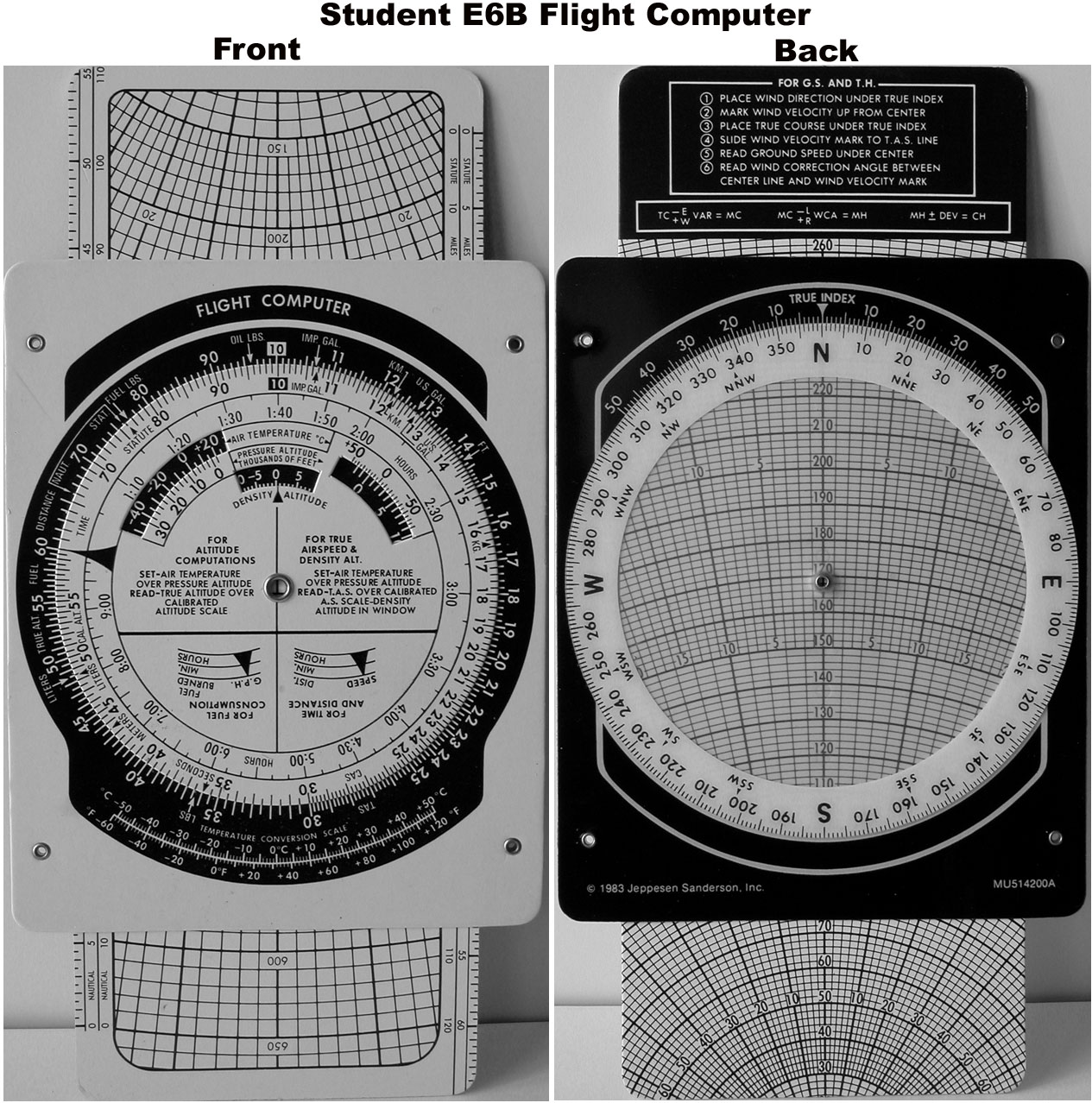
The main difference between a straight and circular rule is that it has only one appearance of the index, so you don't have to move the slide around as much, and it's round so the equivalent of a 10" rule has around 3" diameter.
It also has other scales for converting altimeter/airspeed (really pressure gauge) readings into other numbers more useful for certain purposes like true altitude (good for missing obstructions) and "density altitude" (for estimating takeoff performance, also helpful for missing obstructions).
Re: How Many Decimals of Pi Do We Really Need?
#73Earlier quoted context omitted.
The smallest possible distance is the Plank lenght, 1,6 10^-35 (1 10^-15 is the diameter of a proton). And for that you only need around 60 digits of pi to calculate the circumference of the universe. Of course, that is just for the simple operation of calculate the circumference given the diameter, more complex operations with pi may require more precision.
Never heard it stated that way. Can you elaborate on "the smallest possible distance is Plank's length"? Is that the smallest observable distance?
Re: How Many Decimals of Pi Do We Really Need?
#74Non-metric units... sigh...
Re: How Many Decimals of Pi Do We Really Need?
#75We need all of them. Keep going until you reach the end.
Re: How Many Decimals of Pi Do We Really Need?
#76If you know the diameter of the observable Universe and you want to calculate its circumference with the accuracy of the diameter of a proton, the number of digits of pi that you need is 43.
The smallest possible distance is the Plank lenght, 1,6 10^-35 (1 10^-15 is the diameter of a proton). And for that you only need around 60 digits of pi to calculate the circumference of the universe. Of course, that is just for the simple operation of calculate the circumference given the diameter, more complex operations with pi may require more precision.
Does that mean the rest of the digits of pi are not "real," at least according to a realist rather than a Platonic philosophical position on the meaning and nature of mathematics? Seems like you could argue that digits beyond what are needed to render measurement to within one Planck length are meaningless and therefore a kind of fiction... at least if you take that philosophical position.
Re: How Many Decimals of Pi Do We Really Need?
#77Not quite Pi, but something very closely related to Pi is retained to extremely high precision in computers. libm frequently contains 2/pi to very high precision. For example, Newlib's math library contains 476 decimal digits of 2/pi as part of its routines for calculating sine and cosine of numbers outside the range [-pi/4..pi/4]. See e_rem_pio2.c for more. Many of the open source math libraries are ultimately desce…
Here is an article how precision of Pi could affect trigonometry
https://randomascii.wordpress.com/2014/10/09/intel-underesti...
Re: How Many Decimals of Pi Do We Really Need?
#78This overlooks the issue that for repeated calculations, such as numerical integration, the trouble comes from accumulated roundoff errors. Even 16 digits of precision can become 0 digits pretty quickly if you're not very careful.
A branch of physics used to be taught a long time ago called "numerical analysis" to deal with this issue. We even used to be careful about the difference between 'precise and exact'. Pi = acos(0) is absolutely exact. But computer don't know about symbolic calculus. So to put the value in a register we used tricks. Pi as a the converging value at the infinite of the Taylor development is awesome. But computer don't k…
When you watch Walter Lewin's physics lectures, he repeatedly says "measurement means nothing without stating the uncertainty".
see - Lec 01: Units, Dimensions, and Scaling Arguments | 8.01 Classical Mechanics (Walter Lewin) [1]
[1] https://www.youtube.com/watch?v=X9c0MRooBzQ#t=4m30s
Physics Works !
Re: How Many Decimals of Pi Do We Really Need?
#79This story is frustrating to me because it makes it sound like 15 digits of precision isn't a lot. Fifteen isn't a big number, but fifteen degrees of precision is almost incomprehensible.
If you measured your height with fifteen degrees of precision, you would have a measurement in femtometres. A femtometre is roughly the diameter of a proton.
That's really precise!
Re: How Many Decimals of Pi Do We Really Need?
#80In the 'Frontiers in Astrophysics' course on Open Yale, professor Bailyn says that, for the purpose of the course, pi = 3, and pi^2 = 10. Pi = 3, coincidentally, is the Hebrew Bible's approximation too.
[deleted]