Live data from Hacker News

The United States’ Unamendable Constitution

newyorker.com

631–640 of 747 posts

Re: The United States’ Unamendable Constitution

#631
post #33

It's an interesting article and if you bounced off it because you had a visceral reaction to the premise, like I did at first, I'd recommend taking another whack at it. Jill Lepore, if you're not familiar with her work, is a historian with a reputation as a more rigorous version of people like Howard Zinn. I don't think it's a good article though. In particular, I don't think it coheres. It's about how the modern Con…

> There's a sort of obvious framing to the piece that the Constitution should be more fluid and easy to amend. I think 2022 is a very weird time to prioritize that. I'm not a doomer about US politics, but they're not in a very good state right now. Lepore talks about national abortion, immigration, and firearms policy and how they'd be impacted by a more readily-amended Constitution, but I think she should take a wider view and look at things like how speech and free association would be impacted.

The article is just a whine-fest about how "we could ban things I don't like and make law things I do!" Just from the perspective of a historian which doesnt mean they're immune to someones extreme biases.

> It's about how the modern Constitution has become "un-amendable", but it spends a big chunk of the middle of the piece demonstrating the Constitution was never really all that amendable: successful amendments are extraordinarily rare, especially when they're about big-ticket issues. Our biggest structural changes occurred after an enormous civil war.

Indeed, the greatest success of America is the unamenability of the constitution. Yes, in edge cases like slavery you would wish something could be done. However, nothing in said constitution explicitly permit slavery. Interpreted in the most charitable way slavery should've been unconstitutional from the get-go. At any rate, the constitution is about as close as we can come to a "ground truth". Other countries have constitutions that are more amenable. As a result, there's political chaos all the time as every politician does their own thing and undoes other things. Since these are ground truths all other laws can be forged from them. It appears this historian needs to go back to US Government 101. Nothing in the constitution explicitly forbids abortion, immigration, etc. In fact, the constitution should take no position on these issues. They are not "ground truth" rights that we are given for simply existing. If you head down that path, then suddenly we are codifying what will end up looking like the 10 commandments instead of a book of rights. The constitution is not a moral guide. It's a series of meta-laws from which all others can (should) be derived.
Re: The United States’ Unamendable Constitution

#632

Earlier quoted context omitted.

The idea that the Constitution is somehow directed by the security of individual rights doesn’t pass the most basic reading or history lesson. It’s a delineation of governmental responsibilities between the various federal branches and the states. It wasn’t until the Bill of Rights was later ratified that it has anything to say about individual rights other than to deny them.

This is either absurd or sorely uninformed. That the Bill of Rights was added later is essentially a procedural technicality. The (lack of a) Bill of Rights was a major concern when the Constitution was drafted. It was passed with the promise that amending it with a Bill of Rights would be the first priority. The Constitution was only passed without it so the convention wouldn't keep dragging on.

And because a large portion of the delegates thought that the numeration of the rights was unnecessary as it wasn't the point of a constitution.

Re: The United States’ Unamendable Constitution

#633
post #570
post #33

It's an interesting article and if you bounced off it because you had a visceral reaction to the premise, like I did at first, I'd recommend taking another whack at it. Jill Lepore, if you're not familiar with her work, is a historian with a reputation as a more rigorous version of people like Howard Zinn. I don't think it's a good article though. In particular, I don't think it coheres. It's about how the modern Con…

Meanwhile, Ireland manages to amend its constitution regularly [1] without exploding. I _very much disagree_ with the assertion that the US constitution's rigidity is its greatest strength. Similar to taking on too much technical debt, this rigidity makes it impossible to update in response to changing circumstances! I'm not convinced that's ever a good thing; what good reason is there to believe that a constitution…

> what good reason is there to believe that a constitution conceived over 200 years ago (when the US had roughly 1% the people, ~1/3 the land, legal slavery, an early-industrial / agrarian economy, etc., etc., etc.) is useful today?

What good reason is there to believe a politician today could do better? Or are you simply trying to use slavery as a cudgel to get people to not argue with you? Politicians today are a ruling class that are worth hundreds times more than the average citizen, receive better benefits like healthcare, can use privileged information for financial gain, are often large land owners, etc. Nothing has changed - at all. If anything, it's probably gotten worse at scale.

> Even if we agree that "free speech" and "free association" are reasonable universal rights (and I think we do), what these concepts mean in practice must necessarily evolve as technology gives us new ways of speaking and associating - and we will _always_ have to deal with the difficult question of what to do when someone, through exercising these rights, deprives others (intentionally or unintentionally) of the ability to exercise theirs. This balance necessarily changes as our methods of exercising free speech and association change.

Political interpretation by the lunatics in a post-mcarthy world are the reason that people think the bill of rights should be flexible. "But the founding fathers never talked about the internet!" is a very pathetic excuse from a very pathetic ruling class that currently controls this country. Any violation of the freedom of speech no matter the medium is a deprivation of rights. We have chosen to interpret it differently. Once you start opening this can of worms up you get all sorts of problems with what is intentionality, what is association, does "free speech" include things I don't like, etc. Right now there are plenty of politicians on every side of the spectrum who'd love to ban everything they don't like.

What I guess I am saying is people are the problem. Greedy, slimy, humans. The world is no more complex at it's core than it was 200 odd years ago. We have made it complicated by spending time finding gotchas instead of treating the constitution as a series of unquestionable meta-laws. Fix the politicians. The document is fine. To use your analogy, allowing simple amendments would be like changing the entire PR review process because a handful of malicious engineers refuse to ever follow the rules. Just fire the engineers!

Re: The United States’ Unamendable Constitution

#634

Earlier quoted context omitted.

US citizens do indeed have a constitution that confers lots of rights. My contention is simply that these rights are legal fictions and political footballs, and should not be in-scope for a constitution. They shouldn't be baked-in; they should be simple legislation. I mainly don't believe in these "rights". I think people should be treated fairly and equitably; and I think that should be a matter of law. But constitu…

Fortunately, you still have those rights - whether you recognize them or not, and whether or not the government recognizes them. They're inherent to being a human being - those "inalienable" rights mentioned in the Declaration of Independence. The US Constitution did not create those rights, it recognized them.

> those "inalienable" rights mentioned in the Declaration of Independence

/me not subject to USA law.

I've already said that I think "rights" are a fiction; so to me, inalienable rights are an inalienable fiction. Just because they've been written down doesn't make them real.

What are these rights? (I'm not asking for their enumeration; I want to know where they come from, what they're made of, if you like). I did philosophy at University (a long time ago), including a module on political philosophy. I don't know of any basis for the notion of a "right", other than privileges freely granted by others.

So, for example, I have a right to a state pension; I've paid for it all my working life, and I'm over 65. But the government can infringe that supposed right simply by passing a budget that abolishes it. It's a privilege, not a right.

The US constitution claims to protect these "rights" from infringement by legislators, enforced by the Supreme Court. But I have to say, the Supreme Court nowadays looks more like just another legislative body than a superior appeals court.

Re: The United States’ Unamendable Constitution

#635

Earlier quoted context omitted.

I fully agree with lettergram and disagree with naming capitalism as an 'enemy'. How do you think you're going to reduce poverty and create wealth without capitalism?

the ussr and china both developed from feudalism without capitalism and lifted a huge number of people out of poverty. not advocating their system, (not not-advocating either), but they are counter examples.

And e.g. eastern Germany build the Berlin wall to hold back the masses of western Germans that also wanted to be lifted out of poverty? /sarcasm off

Or was it the other way around?

Re: The United States’ Unamendable Constitution

#636

Earlier quoted context omitted.

We should not idolize a past that did not exist. The politicians during the 1780s were not more virtuous, cooperative, or intelligent than the politicians of today. I tend to agree more with Thomas Jefferson: "On similar ground it may be proved that no society can make a perpetual constitution, or even a perpetual law. The earth belongs always to the living generation. They may manage it then, and what proceeds from…

But then you site one of those politicians who wrote actual thoughtful discourse. Is there a single politician in office or who has recently left office in America who has written anything approaching the thoughtfulness of even this short piece? I have to believe that even if it were true that many or most politicians in 1780 were similar to politicians today on levels that you mention that they still had a serious c…

Ron Paul. That is literally it.

Re: The United States’ Unamendable Constitution

#637

Earlier quoted context omitted.

> Ruth Badger Ginsburg Ruth Badger Ginsburg should be a Supreme Court Justice on a kids show filled with animals who makes landmark decisions the real Ruth Bader Ginsburg would have proud of. Your own link contains my very point: the Charter of Rights and Freedoms is a modern piece of human rights legislation. RBG specifically calls out the Charter, not the Canadian constitution as a whole. The Charter is like the US…

"The Canadian Charter of Rights and Freedoms guarantees the rights and freedoms set out in it subject only to such reasonable limits prescribed by law as can be demonstrably justified in a free and democratic society." So the law can override it as they please? I prefer the US version that says "Congress shall make no law ..."

For a long time now I have tried to sum up the differences between the US and Canada in our founding principals. Canada's is "Peace, Order, and Good Government". Contrast that against the "Life, Liberty, and the Pursuit of Happiness" and the fundamental differences in our approaches to government make a lot more sense.

We're much more like the UK than the US in the function of government and the construction of laws, though Parliamentary Sovereignty is expressly subject to judicial review in Canada, something the UK is going to have to grapple with over the next decade now that they are no longer subject to the European Court of Human Rights.

The government can't just override the charter as they please using the language in the Guarantee. The charter allows for things like hate speech laws, but they have to fall under "reasonable limits", something the Supreme Court of Canada rules on all the time, nearly always in favour of citizens compared to the government. A recent example being medically assist death, where the Supreme Court ruled bans on assisted death violated the Charter.

The US is a free speech extremist country, but since even the US Supreme Court has ruled there are limits on speech (like threats) this isn't a night and day difference between our countries in my view. The US allows far more speech than Canada does, yet we rank higher on the press freedom index.

The thing that really lets the Charter down is section 33, the 'notwithstanding clause'. It allows the federal and provincial governments to pass laws overriding certain rights for a period of 5 years. The charter itself would likely never have come into being without it, but it does take some of the teeth away.

Re: The United States’ Unamendable Constitution

#638

Earlier quoted context omitted.

> individual rights over everything else I used to admire the US constitution. I've grown up now. Who could possibly be opposed to human rights - i.e. human beings having rights? And indeed, the US constitution does appear to be largely about rights. Over the years I've increasingly leaned to the view that these rights are mostly a legal fiction, and that the things that are supposedly rights are highly subjective po…

> s I've increasingly leaned to the view that these rights are mostly a legal fiction Ultimately all constitutions are just ink on paper (or parchment depending on age) and are only as good as the people who govern. > things that are supposedly rights are highly subjective political footballs. The fabric of society is a pitch where political football is played. The US Constitution is a product of the times when it wa…

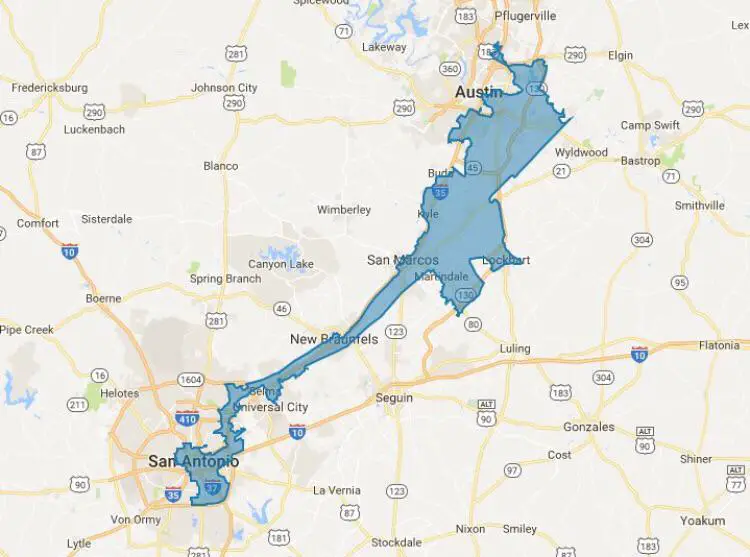
This is the kind of nonsense that is produced by the US Constitution:

https://vividmaps.com/wp-content/uploads/2020/06/Texas.jpg

Re: The United States’ Unamendable Constitution

#639

Earlier quoted context omitted.

As somebody not from the US, the mainstream "left" seems very right wing. When compared to the rest of the world, there is no left wing political party in the United States.

Every time... WE KNOW AND NOBODY CARES. We're talking about the US.

Well, this is an international forum, so I think it's a good idea to remember that many people reading are not from the same country and may have different interpretations of some terms. Also, maybe looking outside and gathering new data once in a while may put the problems you percieve your country to have in broader context, and help you find new solutions that actually work.

Re: The United States’ Unamendable Constitution

#640

Earlier quoted context omitted.

But then you site one of those politicians who wrote actual thoughtful discourse. Is there a single politician in office or who has recently left office in America who has written anything approaching the thoughtfulness of even this short piece? I have to believe that even if it were true that many or most politicians in 1780 were similar to politicians today on levels that you mention that they still had a serious c…

Ron Paul. That is literally it.

the guy whose platform is going back on the gold standard and abolishing embassies to other countries?

i'll give him credit for having a consistant platform and world view, but if he had his way we'd hand control of everything over to corporations -- and that's what his son is doing everything in his power to make happen.

Post reply on HN