Live data from Hacker News

The end of neighbours

macleans.ca

61–70 of 150 posts

Re: The end of neighbours

#61
post #51
post #47

Earlier quoted context omitted.

Why do you hate chatting? I can understand if one of your neighbors is annoying, but my point is that if you weren't driving, you'd certainly know more than just the annoying one next door, and you almost certainly get a kick out of dogging him with the person on the other side of his house. If not, hey, there's always one or two annoying neighbors, and if you can't find them, it's probably you.

I really don't know! I just get this deeply uncomfortable feeling when I see that I'm going to have to have some kind of unplanned interaction with them. I'm not a terribly shy person, there's just something about the neighbor encounter.

I feel the same way about neighbors in my apartment building and deploy similar strategies. I think its a mild form of social anxiety.

Re: The end of neighbours

#62
post #38

Earlier quoted context omitted.

> why is it considered so inherently important to spend time with your neighbors? It's propaganda disseminated by unhappy single women. :) I said it that way because not all single women are unhappy -- some prefer being alone, just as some men do. Recent statistics tell us that almost 1/2 of Americans are single, and they're about to become an absolute majority.

What does this have with the GPs point?

You mean, apart from answering his question?

Re: The end of neighbours

#63
post #41

Good to see they finally point the finger at what is fairly certainly the culprit: the automobile. When i lived in NYC, i knew most of my neighbors. Why? because we literally bumped into each other coming in and out of the building. When you have a common destination (subway, bus, market, etc), it's nice to have someone to chat with, but when your commute is in an automobile, you never get a chance to ask. Living roo…

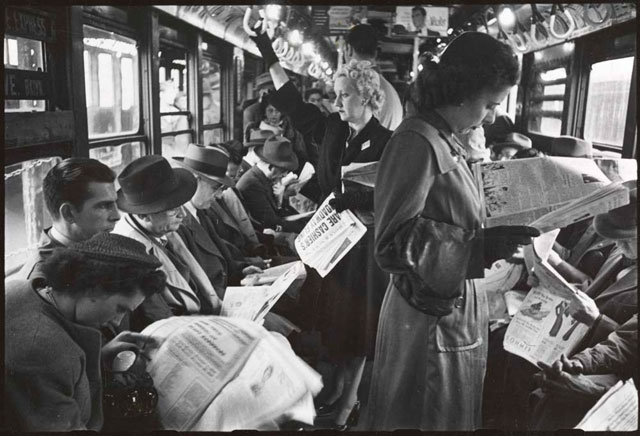
Unfortunately, you cannot now fix it by removing the automobile. Now, even when you bump into people, you don't have a conversation, because they're on their headphones or texting on their phone or whatever. Nobody's available to talk to, even if you would be willing to do so.

http://also.kottke.org/misc/images/kubrick-subway-newspapers...

Re: The end of neighbours

#66

The article seems to dog on the suburbs as a big part of the problem. Is there any breakdown of the polling that shows that people in denser areas know their neighbors any better? Controlling for occupation / income level would highlight differences in neighborliness against population density.

I would hazard a guess that its more common in apartments to be socially distant. Because you are far more likely to get annoyed by the neighbour being noisy, you don't have any windows to interact through with them (eg. waving) and most important (imo) of all: you can't just talk in the hallway/stairway the same way you do in a garden or across a fence. And actually entering someones quarters is probably a lot more…

I don't really know what to expect, that's why I'd like to see details in the polling.

On the one hand, living in a denser part of the city, you might walk around more and see people on your way. But many people just plug in headphones and look at their phone while walking.

On the other hand, your points stand out as to why living in multi-family homes might be taxing on community-building.

Re: The end of neighbours

#67
When I lived in NC I never knew ANY of my neighbors. When I moved to Chicago I met all of my neighbors except for one. [That one lives above me and I'm pretty sure everyone in the building hates them.]

Re: The end of neighbours

#68

My entire adult life, I haven't known any of my neighbors, until recently. One day about 8 months ago, we got a note on the door from new neighbors. They were having a "floor party" and invited everyone on the floor to their place. Almost everyone on the floor, reluctantly went to the party expecting it to be awkward. We all ended up drunk and hanging out until 2 am. Turns out, pretty much everyone on the floor was a…

This is pretty much the premise behind Nextdoor.com, you guys should check it out for your neighborhood!

Re: The end of neighbours

#69

A UK perspective: over the past decade there has been an enormous growth in the buy-to-let market and the UK is now overun by the worst type of property owner: the buy-to-let (buy-to-rent) landlord or "property investor". They treat housing as a pure profit-making exercise. When more and more homes in your area get bought by property investors and buy-to-let landlords it can have a detrimental effect (I've seen it ha…

In Australia, investment residential property is seen as almost an inalienable right and a cultural norm.

I've lived in the UK and opinions there vary a lot. In London, it doesn't really have a negative connotation that I can recall. In rural parts, it tends to be viewed very negatively. I seem to remember reading a story about anger against "Londoners" driving up local property prices (with weekend homes) resulting in someone burning one down.

Weekend homes are a different beast of course but the anger comes from basically the same place: the perception that "outsiders" are making housing unaffordable for "locals".

This seems to be a very Luddite view. If it weren't for people letting out property rental homes wouldn't exist outside of, say, council-run rental buildings. I don't see that as a good thing.

Some places have tackled this problem with regulation eg making it difficult for foreigners to buy real estate or punitive capital gains taxes on short-term property sales like in Switzerland.

In NYC we have a different problem: rich people parking money in real estate leading to what are known as "ghost buildings". This is mainly a Manhattan issue.

Historically NYC had rent control that ended in the early 70s (meaning no new rent control leases were issued, existing ones remained while the tenants remained). Reforms were enacted to allow tenants to buy their apartments leading to the "coop", which accounts for the vast majority of Manhattan apartments.

A coop is an interesting beast. Technically you own shares in the coop. The coop owns the building. Your shares entitle you to reside in a given apartment. You must comply with the coop's rules. Coops are typically for primary residences and, to a lesser extent, pied-a-terres.

You can sublet coops you own in some cases but it tends to be pretty restrictive (eg only for 2 years out of every 5 and you have to own it for at least 2 years).

The effect of this is that coops tend to have very high occupancy rates (in real terms) and relatively low turnover.

Most new builds are condos, where you own your property outright and are a member of an HOA (Home Owners Association). Buying a coop will involve getting approval by the board, which can place wildly varying limits on mortgage amounts, income to debt ratios, requiring personal and professional references and so on. Condos however require only finance approval (the building has a right of first refusal).

So a lot of condos are owned by wealthy people who might visit for a few days a year if at all. I don't think this ghost building phenomenon is healthy for a community and is certainly a problem if all construction falls into that category.

Buy-to-let isn't the problem here. Unchecked buy-to-let might well be. Banning it is throwing the baby out with the bathwater. A more nuanced scheme might give tax abatements for owner-occupied properties in the coop model. Or put quotes on investment property in a given area. You can even create markets for such things eg NYC has a market for "air rights" above buildings to allow really tall buildings.

As far as "crappy" rental property goes, that's pretty much rental property all over.
Re: The end of neighbours

#70

A UK perspective: over the past decade there has been an enormous growth in the buy-to-let market and the UK is now overun by the worst type of property owner: the buy-to-let (buy-to-rent) landlord or "property investor". They treat housing as a pure profit-making exercise. When more and more homes in your area get bought by property investors and buy-to-let landlords it can have a detrimental effect (I've seen it ha…

Are you suggesting that people shouldn't have the flexibility to move easily if they get a new job/partner or have a change in circumstances? That's what happens if every home must be owner-occupied and there isn't a liquid rental market. I moved to China a few years ago. I am glad that I was able to let my flat (to responsible tenants who have paid the rent on time for >3 years) and that I was able to rent an apartm…

Your parent post is not talking about some schmuck moving abroad for a few years. He is talking about the type of person who buys up property with the sole intention of making money by renting it off to others.
Post reply on HN