Live data from Hacker News

Why cul-de-sacs are bad for your health

slate.com

61–70 of 143 posts

Re: Why cul-de-sacs are bad for your health

#61
post #8

I'll never understand why we continue to design our suburbs for cars and driving with no attempt to encourage walking. Instead, we seem to discourage walking through a lack of sidewalks, concentration of destinations surrounded by parking lots a mile wide themselves, and burying houses in subdivisions that require almost a mile walk just to get out of.

Supposedly the financial value of a house is driven solely by its neighborhood (class, race) and its square footage, so as long as "every agrees sidewalks are worthless" then everyone is stuck in a "sidewalks are worthless" world. You need to get a majority of people to see a sidewalk as adding $$$ to the house rather than subtracting.

I've talked to many coworkers over the years who live in newer subdivisions without sidewalks. When mcmansions are so close together that you can stretch arms and touch two house at once, and no one has a backyard bigger than my garage, not having people walk in front of your house is seen as a privacy thing. Like, if you grew up in a "normal" house and then got stuck in a mcmansion subdivision and now your lawn is only roughly the size and dimensions of a driveway, you get kind of sensitive about what little you have. They see it as uncomfortable or creepy that I have sidewalks and are even more weirded out about the fact I actually use the sidewalks for after dinner walks like many of my neighbors, so I'm creepy for walking past houses and waving "hi" and stuff. Its kind of like non-nudists don't much understand nudists and vice versa. Which is getting a bit off topic but being a privacy and personal space type of thing is sorta on topic anyway. I think they're also weirded out by the bowl of spaghetti road designs, such that people seem to appear out of thin air 20 feet away and then disappear, unlike a more civilized street grid like where I live (about 60 years old, the house, not me (yet)) So hopefully that data provides some insight.

(edited to add it might be a territorial thing, like a dog. People raised to think 30 feet from their house is "theirs" are going to have weird attitudes about personal space when placed in a house with a front yard thats less than 5 feet deep, compared to a dude who lives on a one acre plot of land)

Re: Why cul-de-sacs are bad for your health

#62
post #10

The article mentions that Atlantic Station sits on a large parking deck, but doesn't explore how its 7,200 parking spaces can make an otherwise small outdoor mall very busy at popular times. Cars remove you from your immediate surroundings, but they also enable you to temporarily be part of a community physically distant from where you live. The answer to why Atlantans drive so much is not that they are lazy, but tha…

I like Atlanta. I lived there for 7-8 years. People in Atlanta drive because the urban planning is a disaster. It's a place where you can live in the city proper right next to retail and still have to trek across a giant parking lot in order to go to the store. The giant parking lots everywhere in the city utterly destroy the street life. As the article notes, Atlantic Station is actually much better in that regard. Because the parking lot is underground, you can actually walk around window shopping and pretend it's not there.

The article absolutely hits the nail on the head with the point about parking lots. When my wife and I go to Philadelphia, we'll walk several miles from the federal plaza to U Penn campus, window shopping, having lunch, etc. When we go to the mall in Newark, DE, we'll drive from the Costco to the Panera because we literally can't figure out how to cross the road on foot.

The cities built in the 1960's need to be razed and redeveloped with Westchester, NY as a model. There's nothing wrong with having suburbs where you can have a back yard, etc, but structure those suburbs like small towns with retail of their own and rail service into the core city. Actually let people live right next to the rail and retail, instead of surrounding it all with enormous, pedestrian unfriendly parking lots.

Re: Why cul-de-sacs are bad for your health

#63
post #23

Earlier quoted context omitted.

Worth noting since this is on HN: pretty much nothing in Atlanta is an "incredibly high price" by the standards of America's coastal cities. Things may be relatively higher in Midwtown than places much further away, but none of it will be "expensive" for folks reading this.

You presume too much. I live in a suburb just east of Kansas City and my money goes a long way here.

I need to get out my atlas, I coulda swore Kansas City was not on the coast.

Re: Why cul-de-sacs are bad for your health

#64

I did some research on cul-de-sacs using my own neighborhood using Google satellite images: It's gotten so out of control that you have to drive upwards of 4 miles just to see your neighbors when they're only a few yards away on a neighboring street: http://www.chrisnorstrom.com/2011/10/the-great-cul-de-sac-pr... I can understand the allure of cul-de-sacs but perhaps a regular "street grid" system with "pipe sprouts"…

In my experience, even the most rural farmland of Germany is more walkable than most American suburbs. Houses are quite far apart, but there's still decent bus service, and you can walk into town in maybe 20 minutes without crossing a highway.

Most suburbs are just bad design through and through. They're not really optimal at achieving their goals, and they have countless terrible side effects.

Re: Why cul-de-sacs are bad for your health

#65
I can see why the story about Atlanta was contrived to run in the winter. I spent some time in the South in my youth and you'd have to be ... overly acclimatized to intentionally set foot outside air conditioning from June to September or so. Its not just sauna-like, it fits the temp and humidity of a sauna exactly. So you're going to need to own a car with AC, and you're going to pay the extensive monthly bills if you use it or not, so may as well use it. I never really did anything outside in the south intentionally all summer long. I went out a couple times at night when it got down to the upper 70s as a low, sometimes, but the mosquitos were the size of hummingbirds. Aside from the summer weather its beautiful land and nice people.

Re: Why cul-de-sacs are bad for your health

#66
post #10

The article mentions that Atlantic Station sits on a large parking deck, but doesn't explore how its 7,200 parking spaces can make an otherwise small outdoor mall very busy at popular times. Cars remove you from your immediate surroundings, but they also enable you to temporarily be part of a community physically distant from where you live. The answer to why Atlantans drive so much is not that they are lazy, but tha…

”Atlanta, like all cities, used to be walkable and people actually lived IN the city instead of commuting 50 miles every day.“

This article highlights the parts of the city which are 100% dedicated to parking: https://news.ycombinator.com/item?id=6883589

tl;dr: Cars take up too much space, inflating a city artificially.

Re: Why cul-de-sacs are bad for your health

#67
post #31
post #25

Earlier quoted context omitted.

The article wasn't complaining about density but about structure; a fences-and-backyards suburb arranged on a grid or some other well-connected layout is much more walkable than the same density suburb where all traffic must pass through a distant trunk to a major street. This makes it possible to actually connect useful mass transit to the suburb, which as the article explained, people will use if it's there.

That's the catchy title, but the article is really about density and transportation by car. There's a nice diagram describing how living in the suburbs reduces the number of places in walking distance, but in that diagram the house isn't even on a cul-de-sac. The thesis is actually that cul-de-sacs increase driving distance, because the places where they are used tend not to have any walkable destinations. This makes…

In Midtown, I walk to Publix (I don't Marta to the grocery and avoid it at after the 7pm switch.

The most likely people to use Marta for groceries are the poor (and assumably carless) particularly from the South of the city (West End). And, I feel like my Publix is the only one located on the line.

I'd add that I ride Marta to get to Lenox, Buckhead, and Braves/Falcons games most often. Friends that live near stations and ride Marta also ride to GT.

Re: Why cul-de-sacs are bad for your health

#68
post #59
post #40

Some people like dead-end streets and large yards. Some people want to prevent people from having such an option.

Some people like high-rise apartments right next to the train station. Some people want to prevent people from having such an option.

I'm fine with both, as long as both parties are bearing the costs of their chosen option.

Re: Why cul-de-sacs are bad for your health

#69
I don't buy it. Cul-de-sacs experience less crime, fewer traffic accidents and are very conducive to taking safe leisurely walks. The problem is that some neighborhoods don't provide efficient pathways for practical pedestrian traffic between major destinations, which isn't caused by cul-de-sacs, but poor planning. Communities that provide pathways between cul-de-sacs away from traffic that connect such points have the best of both worlds. I envy them, because I live in a cul-de-sac that is about a mile from our schools as the crow flies, but the only available route adds 2 miles, driving or walking.

Re: Why cul-de-sacs are bad for your health

#70

Earlier quoted context omitted.

A large part of it is crime and/or race. The modern subdivision - full of meandering streets and poor connectivity to nearby arterials - is deliberate. It creates the gated neighborhood effect without the need to put up any unsightly walls or gates, and in effect keeps its residents separated from the world outside. The world outside presumably filled with undesirables. The lack of connectivity discourages through tr…

Anything other than a perfect grid in neighborhood design is due to classism? Sounds like bullshit to me. Mildly meandering side-streets: - Block some of the noise from nearby major streets - Obscure the view of traffic - Give the neighborhood a less "uniform" feel (think of how you feel in a neighborhood with 20 identical houses in a row. Arrow-straight roads contribute to that feeling) - Reduce through-traffic- not…

There a dramatic amount of understatement here.

"A little less walkable" is untrue. Meandering suburban layouts are dramatically less walkable - we're not talking about even the same order of magnitude.

Here's a commonly cited diagram of the difference in walkability between a grid layout and a sprawl-suburb. Both of these are real places, not hypothetical illustrations:

http://hbr.org/hb/article_assets/hbr/1005/F1005B_A_lg.gif

"A little less" is an understatement bordering on the edge of untruth. There used to be a better high-res version of this map that I can't find anymore - the right side is Ballard, Seattle, I've forgotten where the left side is (IIRC Dallas). The blue is the area reachable by walk from the central starting point in a given time (IIRC 10 minutes at average pace).

Note that Ballard is far from a "perfect grid" layout - there is still ample delineation between arterials and side streets. The grid is also lightly broken up every few blocks to prevent people from speeding right on through, while not making pedestrians go out of the way in the wrong direction.

The notion that sprawl-type neighborhoods are somehow safer for pedestrians (and conversely, grid-style layouts are more dangerous) also doesn't bear out in reality. Dallas, TX (a particularly famously suburban city) has a pedestrian fatality rate of 1.7 per 100K pop. NYC, the mother of all grid layouts (a perfect grid, even), clocks in at 1.8 per 100K. There's nothing to suggest grid layouts (perfect or otherwise) are intrinsically more dangerous to pedestrians.

The whole traffic business also doesn't jive:

> "Reduce through-traffic- not because "outsiders are undesirable" but because through-traffic is noisy"

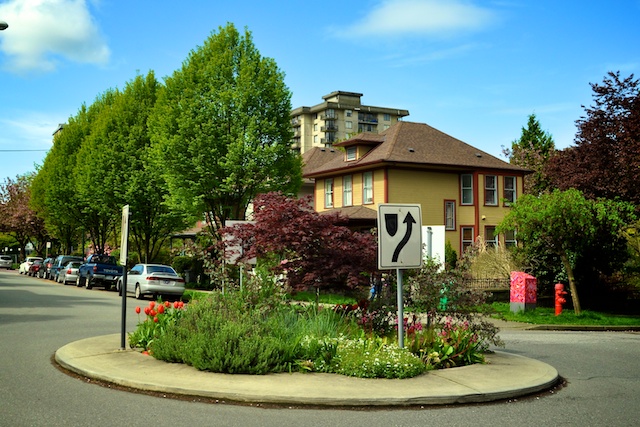
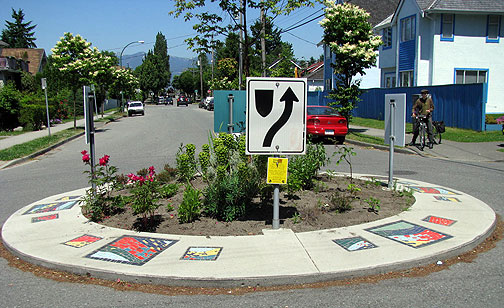
Except non-sprawl suburbs with grid layouts have been restricting through-traffic for decades. Throw down a few of these: http://www.nowtopians.com/wp-content/uploads/2008/07/mosaic-...

They're wonderful and keep side streets from becoming arterial relief valves, while allowing you all the walkability and accessibility of grid-based layouts. No chokepoints, no gates, no driver blasting his way through trying to find a shortcut to work. They also do a great job of curbing drunk drivers, who are more likely to get beached up on one of these than in the side of a house.

They look pretty good too: http://farm9.staticflickr.com/8002/7132823357_600fba9ee3_z.j...

Some people even make them into little parklets, though I'm not sure if I'd want to hang out there: http://www.vancourier.com/polopoly_fs/1.577052.1376349174!/f...

People who live in these neighborhoods aren't idiots. This isn't a win-lose scenario - this isn't pedestrians vs. safety vs. noise. We can have our cake and eat it too, in fact many neighborhoods around the country do. Besides the "uniformity" thing, there's really nothing that the sprawl-type suburb solves that hasn't already been solved in non-sprawl suburban developments. You can live in a house with a yard with a BBQ with a deck with a garage. You can have space for all your stuff. You can still walk to the grocery store. You can still save money and take the bus to work without it being a giant pain in the ass. You can still have nice parks nearby and your kids won't go to school in a skyscraper.

The opposite of the sprawling suburb isn't towers full of people stacked on top of one another, it's another type of suburb altogether.

Post reply on HN