Live data from Hacker News

All 9,300 Japanese train station, animated by the year it opened (1872–2026)

jivx.com

61–70 of 90 posts

Re: All 9,300 Japanese train station, animated by the year it opened (1872–2026)

#61

Now we need a part two that shows how the rural parts of the same network are slowly being closed due to depopulation. As of 2025, Japan has lost 1366 km of track (about 5% of the total) since the 1990s. https://en.wikipedia.org/wiki/List_of_closed_railway_lines_i...

To be fair, most countries have due to privatisation and people getting wealthier and buying cars. In my country a ton of lines have closed down too and ourv population only grows.

Closing lines in the 90s would be unusual; the big spurt of line closures was generally _far_ earlier in most places, generally 50s or 60s.
Re: All 9,300 Japanese train station, animated by the year it opened (1872–2026)

#62

Fun bit of trivia: Japanese train stations each have their own custom stamp, and if you have a piece of paper or a notebook they'll stamp it for you at the ticket booth (this is a fairly common thing to do there). If you get an A5 notebook, it's a neat way to document a trip -- one stamp for your departure station, one for your arrival.

Sadly not all of them, much to my ill discovery! They are fun souvenirs and I encourage everyone to collect them if they want a free momento (ideally bring your own stamp pad).

Re: All 9,300 Japanese train station, animated by the year it opened (1872–2026)

#63

Earlier quoted context omitted.

To be fair, most countries have due to privatisation and people getting wealthier and buying cars. In my country a ton of lines have closed down too and ourv population only grows.

> To be fair, most countries have due to privatisation Japan's system is almost entirely private and is best in the world by nearly every metric. We (the people) do not owe support to depopulated areas. If you choose to live in the boonies the government is not required to build or maintain roads, tracks, sewers, power to your place. Funds are not infinite. Japan's private system works because the government mostly g…

Or, more commonly, they have:

1. The public pay for and build the lines and prove market demand.

2. Decades later some 'fiscal conservatives' get elected.

3. Who then privatize them for a sweetheart deal to their friends.

4. Who then proceed to squeeze every penny they have out of the public, while foregoing expansion and service quality.

With an end result of everyone getting to pay through the nose for shit service, while profits accrue up. And nobody's building any competing lines, because rail is a textbook example of a natural monopoly, and it's hard to compete on capex with someone who got a full rail network by buying it, fully built out[1].

Nobody with a lick of sense will ever lend you the 100 billion dollars you need to open a from-scratch competitor, if you ever want to eat into the incumbent's margins. The incumbent knows this.

---

The rail company is the poster child for either a crown corporation, or at most, a 'customer-facing services outsourced on a fixed-term-contract'.

---

[1] Bonus points for rules around eminent domain changing at some point in the past century and a half, making it actually impossible to build a competing line today.

Re: All 9,300 Japanese train station, animated by the year it opened (1872–2026)

#64
post #42

Now we need a part two that shows how the rural parts of the same network are slowly being closed due to depopulation. As of 2025, Japan has lost 1366 km of track (about 5% of the total) since the 1990s. https://en.wikipedia.org/wiki/List_of_closed_railway_lines_i...

>closed due to depopulation Meanwhile, there's more people in the city of Tokyo than nearly the whole continent of Australia :) Japan's population is concentrating into a handful of big cities. I mean, who wants to live in a small town when there are endless options for shopping, restaurants, etc in the big city? It's not like in the US where big cities are dangerous. There's not much of a positive tradeoff for choos…

Having just traveled through a range of cities and towns in Japan, I don't think the lack of options for shopping and restaurants are the reason that small (150,000+ population) towns are depopulating.

There's plenty of ways to spend money in them. That's not the problem. Neither is there a huge lack of conveniences. Any one of them is way more livable than almost anywhere in North America.

Poor economic prospects for the area is likely a part of the problem. The big cities pay significantly more for ~the same work.

Re: All 9,300 Japanese train station, animated by the year it opened (1872–2026)

#65

Now we need a part two that shows how the rural parts of the same network are slowly being closed due to depopulation. As of 2025, Japan has lost 1366 km of track (about 5% of the total) since the 1990s. https://en.wikipedia.org/wiki/List_of_closed_railway_lines_i...

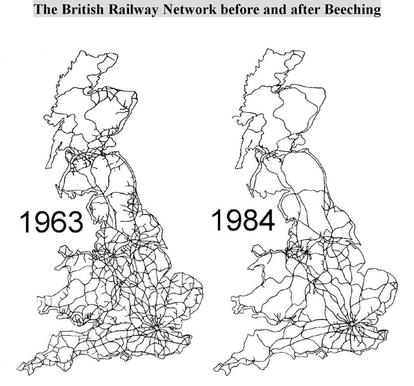
A UK one would be more dramatic, losing over 8000 miles over the twentieth century, most in the 1960s https://www.transportxtra.com/files/13108-l.jpg

Re: All 9,300 Japanese train station, animated by the year it opened (1872–2026)

#66

Earlier quoted context omitted.

This is a station which exists solely for transfer between two lines. It has no entrance. Idea always made me a bit nervous: https://en.wikipedia.org/wiki/Manulla_Junction_railway_stati...

I'd like to see something like that but on a subway. Just a platform and two tunnels with no stairs. If the service stops you're SOL and have to hoof it down the tracks.

Friedrichstraße was famously like that during the Cold War (West Berliners riding the lines were not permitted to exit into East Berlin), although of course the stairs physically existed. I think it's unusual for an underground station to be built without digging from the surface, so there's normally at least a fire escape.

Re: All 9,300 Japanese train station, animated by the year it opened (1872–2026)

#67

Earlier quoted context omitted.

To be fair, most countries have due to privatisation and people getting wealthier and buying cars. In my country a ton of lines have closed down too and ourv population only grows.

Closing lines in the 90s would be unusual; the big spurt of line closures was generally _far_ earlier in most places, generally 50s or 60s.

It was because until the 90s in Holland public transport was seen as a community service, not a business so even lines with limited traffic were served. During the 90s the neoliberal craze began where everything had to be a market.

Re: All 9,300 Japanese train station, animated by the year it opened (1872–2026)

#68
post #31
post #29

Earlier quoted context omitted.

Yep, seems to refer to "SecurityError: Attempt to use history.replaceState() more than 100 times per 10 seconds"

I hate the History API especially pushState. Even with this limit of 100 times per 10 seconds it still pollutes my browsing history too much. I need to vibe code an extension that makes pushState/replaceState noops on all webpages.

StopTheMadnessPro > Protect History.

https://underpassapp.com/StopTheMadness/

Re: All 9,300 Japanese train station, animated by the year it opened (1872–2026)

#69

Earlier quoted context omitted.

To be fair, most countries have due to privatisation and people getting wealthier and buying cars. In my country a ton of lines have closed down too and ourv population only grows.

> To be fair, most countries have due to privatisation Japan's system is almost entirely private and is best in the world by nearly every metric. We (the people) do not owe support to depopulated areas. If you choose to live in the boonies the government is not required to build or maintain roads, tracks, sewers, power to your place. Funds are not infinite. Japan's private system works because the government mostly g…

This take is hilariously misinformed. Japan's long-distance network was almost entirely public until JNR was privatized in 1987, and its successors the JRs continue to be for all intents and purposes controlled by the government.

Some not-very-light reading about the rise and fall of JNR:

https://www.substack-bahn.net/p/aura-of-success-the-first-ye...

https://www.substack-bahn.net/p/the-death-and-privatization-...

https://www.substack-bahn.net/p/the-death-and-privatization-...

Re: All 9,300 Japanese train station, animated by the year it opened (1872–2026)

#70
I’m not sure what I am looking at. I see a number going up but the methodology is missing and analysis is lacking.

Has Japan ever closed a railway station?

Are the 1872 stations the first ever in Japan?

Is this a plot of all stations ever constructed or just the ones that still exist?

Has the number of stations ever gone down?

What events are corollated with building booms and what direction does the arrow of causality point?

Post reply on HN