Live data from Hacker News

The Latest On Intelligence

danielwillingham.com

61–70 of 172 posts

Re: The Latest On Intelligence

#61
post #14

I didn't read the entire paper, but to someone who did, how much of a link is there between genetics and IQ? I know this isn't a popular subject, but if I remember correctly I believe that Ashkenazi Jews constitute 3% of the population yet have won 27% of the Nobel prizes in science. I would think that much like how different types of people from different regions have differing athletic capabilities, there would als…

Both scientific and athletic achievements have an alternative explanation: culture. If there was a good sample of adopted children from a group with such achievements, one could examine these hypotheses in more detail.
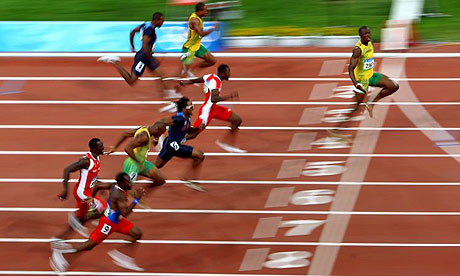
Certainly culture plays a role, but it's hard to argue that the reason a non-representative proportion of olympic runners are black is due to culture. http://static.guim.co.uk/sys-images/Sport/Pix/pictures/2008/... really demonstrates this fact.

What that picture doesn't show, though, is that there are a lot of almost-world-class sprinters who are european, asian or of other ethnicities. The edge that being of a certain ethnic background gives you in sprinting is only really important at the very top of the competition. I'd imagine that for the majority of people, training and dedication make up a far larger component of their success or failure at sprinting.

Interestingly, in the article it indicated that genetics appeared to play a bigger role in the intelligence of wealthy people. I'd imagine this is a similar situation. Genetics may give you a slight edge at the very top of academia, but otherwise education is the key.

Education is the low hanging fruit in increasing overall intelligence.

Re: The Latest On Intelligence

#63

Earlier quoted context omitted.

Or at least we should be pushing micro-nutrient supplements. And encouraging school lunch programs.

Not that that isn't a great thing to do, but how does that help anyone overcome the limits on opportunity that poverty places on them?

Malnutrition can be one such limit of opportunity, if it harms development in childhood. It's also one of the easiest things to fix; giving children nutritional supplements and subsidized school lunches is pretty cheap and straightforward, compared to just about any other method of ameliorating poverty.

Re: The Latest On Intelligence

#64
post #32

This article is very hard to digest because of the writers switching of "intelligence" and "IQ". Intelligence =/= IQ. IQ is a score on a test, and intelligence is a vague set of mental skills and processes to solve problems of varying degrees and subjects. To say that they are equal is like saying that athleticism is equal to the number of pounds you can bench. If the writer is talking about IQ, then these investigat…

This is how it works in practice (at least for psychologists and sociologists):

1. You have some definition based on some theory or hypothesis or something. You have to argue why your definition is meaningful and relevant.

2. You try to operationalize (i.e. turn it from a fuzzy concept into something measurable) that definition as best you can while always keeping an eye out for and discussing – at length – any and all limitations you can think of (of which there will always be many).

3. You use your operationalization to create measures.

4. You collect data with your measures, analyze and interpret it.

So there really isn’t much of a need to explicitly differentiate between intelligence and IQ in scientific writing. You might want to for the sake of clarity, but that difference is always implicit.

It’s always clear (at least to other psychologists or sociologists) that when the author is writing about empirical results with regards to intelligence, she means intelligence as previously defined by her, with her operationalization and determined by her measures and analytical techniques.

When I write about my little presence (= the sense of being somewhere, even if you are not actually there, e.g. when you are in a virtual environment) questionnaire I do not write “Presence Index Score” when I write about my results (at least not every time) – I will mostly just write “presence”. That I’m actually talking about the “Presence Index Score” is implicit.

But you are right – that difference is not obvious to anyone else and can, at times, even be confusing for experts.

Re: The Latest On Intelligence

#65

Earlier quoted context omitted.

Right. The implication, in my mind at least, is that fighting poverty should be one of the key goals of society. Being in poverty effectively hides gifts as poverty will dominate "natural" ability.

Or at least we should be pushing micro-nutrient supplements. And encouraging school lunch programs.

That's a pretty huge assumption, that micro-nutrients are a significant part of any difference.

You've assumed, first, that it's poverty that causes the lowered IQ, rather than that both poverty and lower-IQ are both effects of a common cause.

Second, even if there really is a causal chain, why in the world would you assume that the difference is related to nutrition? Why not, for example, cultural differences in the way that poor parents interact with children compared with the way that non-poor parents do?

Re: The Latest On Intelligence

#66
post #52

Earlier quoted context omitted.

Correlations mean almost nothing. Just going off your list: -IQ:Test Performance - Of course. IQ is a grade off of a test. It correlates with itself. If you mean tests such as the SAT or tests in a school, then yes, IQ does help somewhat with that, as it was designed to (the first IQ test, created by Alfred Binet, was designed to find students who would not do well in a regular school environment). However, do high t…

The examples you gave exactly match my intentions. I'm not sure where we are disagreeing, unless you are interpreting the phrases "intelligence" and "intelligence quotient" as more exclusive than most people. If that is the case, give me your definition of "intelligence", and we'll see where we go from there.

I'm saying that interpreting IQ as intelligence is extremely narrow-minded and misleading to the general public. There is absolutely no evidence that IQ is a decent measure of intelligence. My point is that intelligence is a much broader subject than simple IQ, and using IQ as a measure of intelligence will produce both false positives (by training for the exam) and false negatives (by not targeting other areas of intelligence than the specific area used in some types of academia).

I am not saying that there is a specific definition of intelligence that is good. I am saying that IQ as intelligence is not good. I wouldn't have a problem if people did use the terms "intelligence" and "IQ" so interchangeably. If the linked article talked only about IQ, then I would have no problem, but the article specifically talks about intelligence, and then uses studies on IQ to try to makes points about intelligence.

By the way, if you are looking for a better theory of intelligence (which is beside my point), then you should look at Cattell-Horn-Carroll Theory (http://en.wikipedia.org/wiki/Cattell-Horn-Carroll_theory) as an example.

Re: The Latest On Intelligence

#67
I thought it would be interesting to note that my karma score seems to be going up and down a lot on this topic in short periods of time. On other topics, it seems to increase slowly. I'm trying to think of what deeper conclusions could be drawn from this that people have what appear to be strong and varying opinions on something that should be rather scientific and objective.

Re: The Latest On Intelligence

#68
post #42
post #14

Earlier quoted context omitted.

Both scientific and athletic achievements have an alternative explanation: culture. If there was a good sample of adopted children from a group with such achievements, one could examine these hypotheses in more detail.

That's an incredible statistic. If the cause is cultural then it's a wonder there isn't a plethora of books advising on how to raise children the Ashkenazi way. Are there any such books?

While not completely the same or as limited in scope, I have come across this a number of times. http://en.wikipedia.org/wiki/Minnesota_Transracial_Adoption_...

Re: The Latest On Intelligence

#69
"A great deal of time has been wasted in the effort of measuring the heritability of traits in the false expectation that somehow the genetic nature of psychological phenomena would be revealed."

There is a strong cultural bias among much of the research community to go out of their way to deny any genetic factors in intelligence. Perhaps this is well intentioned, but it is absurd.

I have come across very few squirrels that have mastered fire, or could be taught calculus, or even addition. I doubt that this is cultural or due to the squirrels upbringing, diet, social status, or how many books the squirrel has available to it, or the quality of it's teachers, or pathogens. Clearly then, it is possible for genetics to completely dominate other factors in determining intelligence. In the animal kingdom at large heredity/genetics account for basically all of the variation in intelligence.

The unanswered question is whether there is enough genetic diversity across the human species to cause intelligence to be significantly hereditable. The fear among scientists that try to keep the lid on this question is that the answer might be yes, and worse that such variations will correlate with geographic or national groupings. This would put a very nasty perceived scientific stamp of approval on racism (even though this would be unjustified), and could over time lead to discrimination and 'scientific racism'.

Anyway, in the end science will uncover the truth here, and in the meantime it is probably very prudent to not make any potentially inflammatory statements and to be very cautious about any studies that could fuel hate. I just find it absurd that whenever this kind of question comes up people start denying that there is any hereditary component of intelligence, and that IQ is completely meaningless, etc.

Re: The Latest On Intelligence

#70

I didn't read the entire paper, but to someone who did, how much of a link is there between genetics and IQ? I know this isn't a popular subject, but if I remember correctly I believe that Ashkenazi Jews constitute 3% of the population yet have won 27% of the Nobel prizes in science. I would think that much like how different types of people from different regions have differing athletic capabilities, there would als…

It says a lot about it. For instance:

"She examined the IQs of Black and mixed- race children averaging 8.5 years of age who were adopted by middle-class families who were either Black or White. The children who were of half-European origin had virtually the same average IQ as the children who were of exclusively Black origin. Hence European genes were of no advantage to this group of 'Blacks.' Children (both Black and mixed-race) adopted by White families had IQs 13 points higher on average than those adopted by Black families, indicating that there were marked differences in the environments of Black and White families relevant to socialization for IQ; indeed, the differences were large enough to account for virtually the entire Black–White gap in IQ at the time of the study."

It says less about Jews in particular, which I'd guess is because of a lack of data. There's not a heck of a lot of Jews up for adoption, relative to blacks. But it does note:

"It is important to note that even at the highest estimates we have of Jewish IQ, Jewish accomplishment exceeds what would be predicted on the basis of IQ alone. Nisbett (2009) has argued that the numbers of Jewish Ivy Leaguers, professors at elite colleges, Supreme Court clerks, and Nobel Prize winners are greater than one would expect even if average Jewish IQ were 115. He has also noted that remarkable as the superior achievement of Jews is, the achievement difference between Jews and non-Jews is far less extreme than differences between groups in many other comparisons that cannot be explained on purely genetic grounds, such as the achievements of the Italians versus the English in the 15th century, of the English versus the Italians after the 18th century, of Arabs versus Europeans in the 8th century, of Europeans versus Arabs after the 14th century, and of New Englanders versus Southerners throughout American history."

While it is certainly plausible that there is some big genetic influence on intelligence due to ethnicity, like there is in athletics, we have yet to find convincing evidence of it.

Post reply on HN