Live data from Hacker News

Webb captures iconic Horsehead Nebula in unprecedented detail

esa.int

61–70 of 310 posts

Re: Webb captures iconic Horsehead Nebula in unprecedented detail

#61
post #33
post #5

Earlier quoted context omitted.

There really is a lot of stuff left to see for the first time

"A lot" is the number of fish in a swarm maybe. This is so far away from our concept of counting things that the mind just gives up. There's no comparison, no dumbing down to X amount of football fields, just nothing. I find it depressing, confusing but also inspiring and fascinating at the same time.

I heard comparisons of the number of stars in the observable universe to the number of all grains of sand on Earth's beaches, or the number of molecules in a bottle of air. Not sure if that helps anyone, though.
Re: Webb captures iconic Horsehead Nebula in unprecedented detail

#62
post #41

How much of the pictures in the article are processed? What does the unprocessed photo look like?

I guess the unprocessed "photos" look like multidimensional arrays of floating point numbers. Nothing a human could appreciate. The interesting question is how they are processed.

The paper contains links to the raw data, descriptions of the data transformations they did, and links to some github projects, but it's all way over my head :) https://www.aanda.org/articles/aa/pdf/forth/aa49198-24.pdf

Re: Webb captures iconic Horsehead Nebula in unprecedented detail

#63

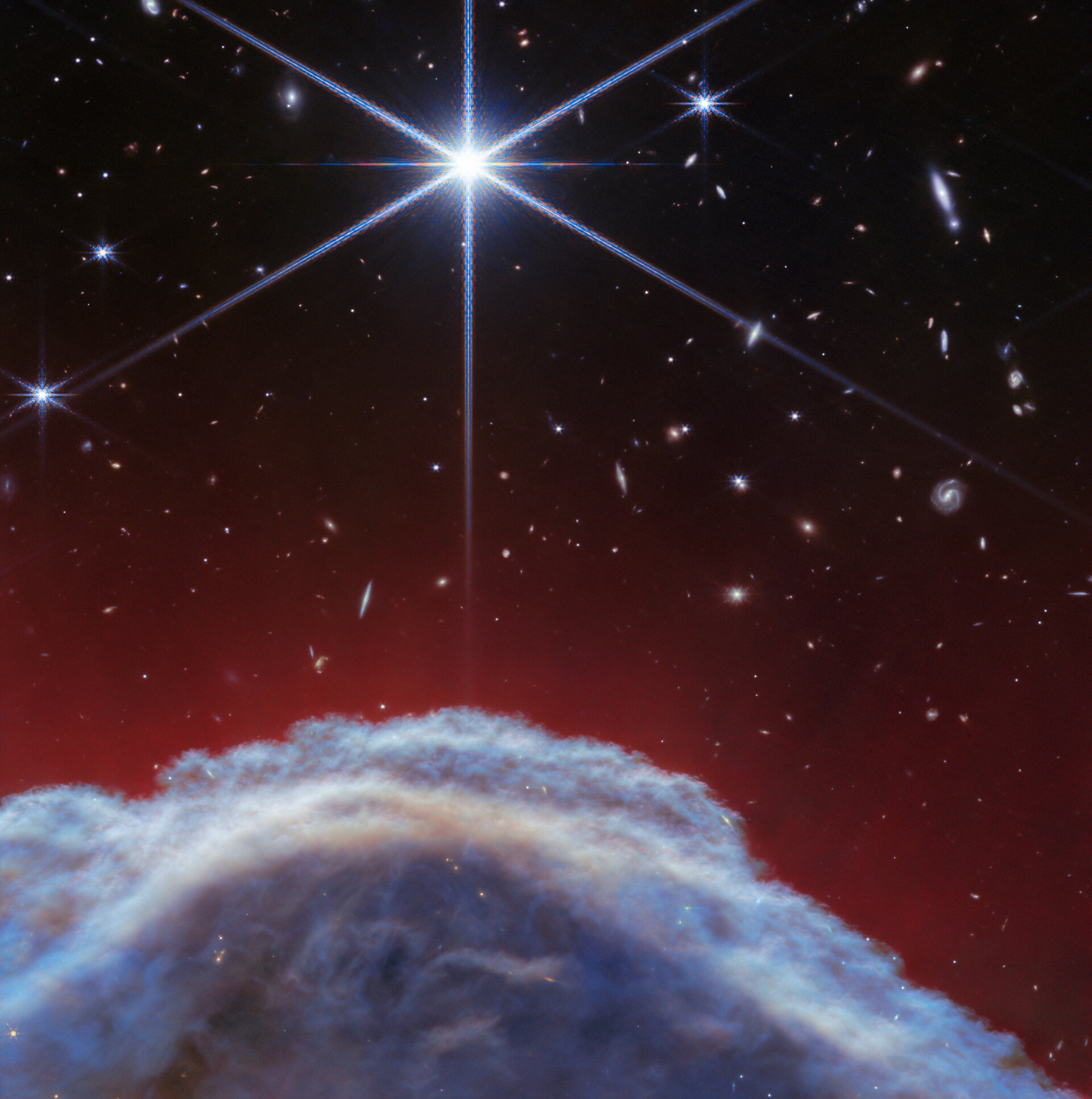
Wow. The NIRCam image is probably going to be the most exciting new photo, but I can't get over how well MIRI reveals the internal structure of the nebula. NIRCam: https://www.esa.int/ESA_Multimedia/Images/2024/04/Horsehead_... MIRI: https://www.esa.int/ESA_Multimedia/Images/2024/04/Horsehead_... Comparison: https://www.esa.int/ESA_Multimedia/Images/2024/04/Slider_Too...

And when 'zooming in' and seeing the top 2/3 of the photo (https://www.esa.int/var/esa/storage/images/esa_multimedia/im...) I am super amazed that all these small discs showing are galaxies. GALAXIES (sorry for the caps).

How tiny are we (Humans, Earth, Solar system)... less than a speck of dust in the Sahara.

I used to look up in space when I was growing up and there wasn't any light pollution to the small town I was growing up in. At some point I think I started suffering from 'cosmic horror'. In later years I would pay attention only to the moon, and that reduced my stress significantly.

Nowadays (like in this bit of news, with photos) when I stick to the small photo in an article, I feel ok. When I see it in full size and I zoom in, and I realize that "sh*t! these 5-10-50 tiny white marks are GALAXIES.. and I have to change topics/tabs to keep the cosmic horror at bay.

Re: Webb captures iconic Horsehead Nebula in unprecedented detail

#64

Wow. The NIRCam image is probably going to be the most exciting new photo, but I can't get over how well MIRI reveals the internal structure of the nebula. NIRCam: https://www.esa.int/ESA_Multimedia/Images/2024/04/Horsehead_... MIRI: https://www.esa.int/ESA_Multimedia/Images/2024/04/Horsehead_... Comparison: https://www.esa.int/ESA_Multimedia/Images/2024/04/Slider_Too...

Crazy how many galaxies are in that one photo (in the background).

[deleted]

Re: Webb captures iconic Horsehead Nebula in unprecedented detail

#65
post #38

Gorgeous and upsetting that I'll never be able to visit it. 13 billion years before me, potentially trillions of years after me. Seems like such a waste of the spark of awareness that I can't take that awareness and experience the galaxy in all its glory.

Isn't a nebula a cloud of dust? I'm not sure how dense it gets, but would someone even notice if they were inside of the nebula?

> Isn't a nebula a cloud of dust?

Yes.

> I'm not sure how dense it gets, but would someone even notice if they were inside of the nebula?

https://physics.stackexchange.com/questions/26326/how-dense-...

(Google is your friend.)

Re: Webb captures iconic Horsehead Nebula in unprecedented detail

#66
post #61
post #33

Earlier quoted context omitted.

"A lot" is the number of fish in a swarm maybe. This is so far away from our concept of counting things that the mind just gives up. There's no comparison, no dumbing down to X amount of football fields, just nothing. I find it depressing, confusing but also inspiring and fascinating at the same time.

I heard comparisons of the number of stars in the observable universe to the number of all grains of sand on Earth's beaches, or the number of molecules in a bottle of air. Not sure if that helps anyone, though.

The radius of the observable universe is estimated to be about 46.5 billion light-years. The Horsehead Nebula that they zoom into in the video is 0.000001375 billion light-years from Earth. I'm doing mind acrobatics to try to understand the scale but... nope! :)

Re: Webb captures iconic Horsehead Nebula in unprecedented detail

#67

Wow. The NIRCam image is probably going to be the most exciting new photo, but I can't get over how well MIRI reveals the internal structure of the nebula. NIRCam: https://www.esa.int/ESA_Multimedia/Images/2024/04/Horsehead_... MIRI: https://www.esa.int/ESA_Multimedia/Images/2024/04/Horsehead_... Comparison: https://www.esa.int/ESA_Multimedia/Images/2024/04/Slider_Too...

Crazy how many galaxies are in that one photo (in the background).

Number of stars in the Milky Way: 100 billion

Number of galaxies in the universe: 200 billion to 2,000 billion

Re: Webb captures iconic Horsehead Nebula in unprecedented detail

#68
post #16

Earlier quoted context omitted.

> Of course there are other lifeforms out there, it's statistically implausible for it to be otherwise. I'll grant you that once we have found a single other planet with life. Until then we're doing statistics on a single data point and no, the number of planets and galaxies etc are not sufficient to statistically determine the prevalence of life because as yet none of them are confirmed to have life. This is wishful…

This is only true if we believe Earth is special, which we have no bases. So I'll stick to statistics for now, thank you very much.

Why does that make the earth special?

Is the single one in a million dimensional one-hot vector special? Why?

If only intelligent life can have this conversation then it will always be "but why us?!?!" well, it was random. Just the other random values don't get to ask the question...

Re: Webb captures iconic Horsehead Nebula in unprecedented detail

#69

Earlier quoted context omitted.

Crazy how many galaxies are in that one photo (in the background).

Number of stars in the Milky Way: 100 billion Number of galaxies in the universe: 200 billion to 2,000 billion

Is 2,000 billion some theoretical limit or something else? Thanks.

Re: Webb captures iconic Horsehead Nebula in unprecedented detail

#70

Wow. The NIRCam image is probably going to be the most exciting new photo, but I can't get over how well MIRI reveals the internal structure of the nebula. NIRCam: https://www.esa.int/ESA_Multimedia/Images/2024/04/Horsehead_... MIRI: https://www.esa.int/ESA_Multimedia/Images/2024/04/Horsehead_... Comparison: https://www.esa.int/ESA_Multimedia/Images/2024/04/Slider_Too...

And when 'zooming in' and seeing the top 2/3 of the photo ( https://www.esa.int/var/esa/storage/images/esa_multimedia/im... ) I am super amazed that all these small discs showing are galaxies. GALAXIES (sorry for the caps). How tiny are we (Humans, Earth, Solar system)... less than a speck of dust in the Sahara. I used to look up in space when I was growing up and there wasn't any light pollution to the small town I…

Interesting. I've also always had a visceral response to particularly clear night skies - but it's only ever been a profoundly positive feeling. It kind of erases the idea that my "problems" have any significance at all.
Post reply on HN