And this is what keeps Jenkins afloat, despite it being a consistent source of CVEs both in core and in its myriad of plugins that don't bother to follow semantic versioning so every upgrade is playing Russian roulette with your company.
The worst thing about Jenkins is that it works (2019)
61–70 of 275 posts
Re: The worst thing about Jenkins is that it works (2019)
#62There are always issues, and like the author, it's "only" about 25% of the time. A quarter of all builds fail due to things absolutely not related to that specific build.
> oh, we were resource constraint at that one second, retry and it'll probably work
> oh, we can't replicate that error message from a tool that you have no visibility over, retry and it'll probably work
> oh, we have no idea why something timed out, retry and it will probably work
Now when I have a failed build I don't actually trust the build before I don't trust that there was an edge case in an integration test that failed. Because it's almost always something outside of the code.
[Edit] downvotes but no constructive responses? The issue isn't necessarily Jenkins, it's the type of people who use Jenkins to roll their own everything.
Re: The worst thing about Jenkins is that it works (2019)
#63The whole post can be summed up as he had very little CICD experience. Made lots of beginner mistakes, which is easy to do in Jenkins. Then decided to write a post where all his complaints about Jenkins are not only wrong but are the issues that plague all the other CICD tools.
> So instead of writing Bash directly, you’re writing Bash inside Groovy
Why are you doing that? You have a fully featured programming language and you are running `sh('npm install')`. You could do this instead https://github.com/DontShaveTheYak/jenkins-std-lib/blob/mast... . How is bash inside of YAML better?
> The trouble is: Groovy is a much, much worse language for executing commands than Bash. Bash is interpreted, has a REPL that is great for experimentation, does require a ton of imports, and has lightweight syntax. Groovy has none of these things.
Groovy has a language server, linters and a vscode IDE plugins. They are probably not as stable or full featured as the bash ones, but they are available and very few take advantage of them. Again, how is YAML+Bash better?
> The way that developers test their Groovy steps is by triggering a job on the remote Jenkins server to run them. The feedback loop is 2 orders of magnitude slower than it is for just executing Bash locally.
This is a rookie mistake. For about 60-75% of pipelines you can run them locally in a docker container on your local machine. You can even set up hot code reload so as you change your pipeline the Jenkins reloads it. You can also configure the job to kick off a build when it reloads the code. When Jenkins is configured correctly it has the fastest feedback loop of any CICD tool on the market. GitHub actions comes in a close second since it can also be run locally but you cant run a "clone" of what you run in production, like having the same secrets, so it gets second place. Beside Jenkins and GitHub actions, I dont know of any solutions for the other tools.
You can run a GitHub action on Jenkins. It's a very deep and complex system. It's like an iceberg and so many engineers dont leave the surface before deciding it sucks and one of the YAML CICD tools is better. Sure the YAML alternatives are EASY to get started with and to do basic stuff with. But they are Terrible at anything complex. While Jenkins is not easy to get started with, once mastered, you can build complex pipelines with ease.
I get that I'm a Jenkins fanboy. Most of the things I mentioned above, I either contribute to or I'm the author of. I know Jenkins has issues. I know it has hurt lots of people, I read the complaints online. But it's still the best out there. The best software in the world is not written in bash or yaml and the same is true of the best CICD pipelines in the world. It's a shame very few people get to see/use those pipelines.

Re: The worst thing about Jenkins is that it works (2019)
#64My issues with Jenkins:
1. Groovy is a really annoying language to configure stuff in. I’ve never written it for other things but it has so many little idiosyncrasies that catch you out.
2. Jenkins doesn’t have much in the way of resource management. It’s easy for a job to take over the entire node and Jenkins doesn’t have the smarts out of the box to monitor this and put things in a different node.
3. So many random job killing bugs that boil down to poor job isolation and resource tracking. Every now and then killing one job can take down another.
4. The UI and UX is bad. I know there are better interfaces for it, but they all just have such limited interface exposure of state beyond “running” and “failed”. Estimate time is useless because it aggregates failed jobs.
5. Inter job dependency management and tracking is poor and annoying to setup. It’s doable, but really should be a better first class citizen.
In many ways, I start looking to other tools to fill my CI need that aren’t meant for CI: Render farm managers.
Film farm rendering is largely similar to CI at a structural level. But they have much higher throughput of individual jobs and have built around making the most of that. There’s better inter job dependency tracking and resource management because of that, and they’re built to expose more information up front to help non-tech savvy artists or render wranglers who need to see status quickly at a glance on a few hundred jobs at once.
Re: The worst thing about Jenkins is that it works (2019)
#65Jenkins works... No it dosen't or maybe it does for java which I don't care about. The ui looks like from the 90s. Finding anything in bigger projects/companies is impossible... I have browser bookmarks to find anything. The log view is annoying at best. I have nothing good to say about jenkins, it feels like it is stuck in the 2000s and refuses to change.
The 90s were the last actual advance in UI design anyway. Design has drifted in a terrible direction, in the past decade or two especially. Some of this is justified (by some) by optimizing for mobile, but that’s precisely the kind of thing I wouldn’t want creeping into my CI tooling anyway. I don’t do that on a phone.
Is the Space Jam website peak UI design? What about Microsoft’s “hell of tabs” settings dialog boxes?
Or the original Amazon home page: https://www.versionmuseum.com/images/websites/amazon-website...
What link do I click to find my order status? Where do I go to search for a book by keyword? What will happen if I click the link for “first time customers click here?”
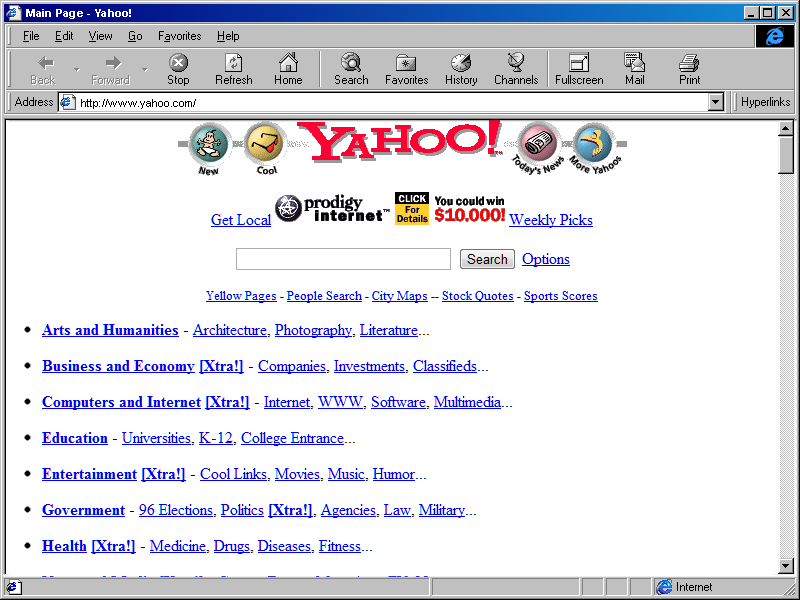
Same deal with Yahoo!, what to the “new” and “cool” and “more yahoos” buttons do? http://2.bp.blogspot.com/-JAp1M-Q_0_Y/TkAwsyueWxI/AAAAAAAAAM...
If I want to check a build status on my phone what’s the excuse for the web page to not display nicely on that device? You really think there’s no good reason for me to want to do that? Doesn’t modern CSS allow you to completely customize the viewing experience for both platforms in the same codebase?
Re: The worst thing about Jenkins is that it works (2019)
#66All of the test runners have their issues. I've had as much problems with Jenkins as I've had with Github Runners and similar solutions. The best way out of this is to subdivide responsibilities: - Put all build/publish/test logic in Makefiles or scripts in the repo. This means that devs can run it locally as well. The only interaction between a test runner and the codebase should be running `make `. - Put all permis…
This is critical!
In many teams Devs are "lazy", if any errors or weirdness happens in CI they just wave their hands and say "not a feature, not my problem". Even though they know exactly what's in the test code, the deploy code, and can see the issue.
Letting Devs see and run the CI scripts locally gives them _ownership_. They don't have to fix the issues, but they have control and understanding which radically reduces the arguments and pipeline drama :)
Re: The worst thing about Jenkins is that it works (2019)
#67Jenkins is rock solid. Been using it for three years to deliver highly critical software. The development experience is the worst of all ci tools since no one wants to setup jenkinspipelineunit to test the pipelines. Dagger might be the salvation here, but even that tool didn't support Jenkins out of the gate. And for those that are reading this, the statement about pipeline groovy being a trap is exactly right. Avoi…
Oh ye keep it simple. I worked as a Jenkins admin for half a year and one day I woke up from a nightmare and realized that I've made some sort of parallelization batch job processor communicating via outputting bat-files, in Groovy, to cut down build times.
Re: The worst thing about Jenkins is that it works (2019)
#68Gitlab CI is still the best CI in the game IMO, but GitHub Actions gives it an incredible run for it's money because of how easy action re-use is. I meant to make a blog post about this, but here's a good a place as any: GitLab absolutely innovated many hard parts of CI/CD as a platform-native piece, but it feels like they lose slightly to GitHub on what GitHub does best -- social virality for developers. The problem…
As someone who only used GitLabs CI briefly when it initially launched, what hard parts did they innovate on exactly?
As far as I could tell, it's a run-of-the-mill CI/CD platform, for better or worse, but nothing I'd call "innovative".
But again, maybe since the first time I tried it when it launched, it has changed, and I missed something really cool they did.