Live data from Hacker News

Framework Laptop 16

frame.work

61–70 of 378 posts

Re: Framework Laptop 16

#61
post #43

Earlier quoted context omitted.

You're wrong. It's a 16:10 screen. CEO: https://news.ycombinator.com/item?id=35280523

Ugh. After over a decade of work, everything was finally adapted to or made for 16:9, now they're going after hipster ratios? Not a deal breaker but a bummer. Interesting that phones are going the other way, so now we can enjoy letterboxes on both platforms and not be able to reach the notification drawer. What was so wrong with 16:9 that we needed another competing standard that's just slightly off...

I welcome the extra vertical space and couldn't care less about watching video content full screen.

Do that many people buy these laptops as portable Netflix players?

Re: Framework Laptop 16

#62
post #19

This is starting to be a really interesting choice compared to sticking to thinkpads. The dream would be to have 6 expansion cards in the laptop 13. 4 really is a bummer for a work laptop, it's definitely not enough for me… And while you can easily carry other expansion cards and switch at will, it's kinda like carrying adapters, you easily forget them.

Are there any 13" laptops on the market with more than 4 ports? None that come to my mind. My macbook air has only 2 x USB C and I've never come across a situation where I needed more. For a 13" 4 ports is more than most people require and it wouldn't make sense for a small start up to only target extremely niche use cases.

thinkpad x13, hp 835 g9, dell latitude… and if you go for a 14" laptop, connectivity is even better while still having a small device.

I'm not sure more than 4 ports is _extremely_ niche use case especially for a work device, but yeah I get that most people would be okay with it and I understand Framework's choice.

Re: Framework Laptop 16

#63
post #19

This is starting to be a really interesting choice compared to sticking to thinkpads. The dream would be to have 6 expansion cards in the laptop 13. 4 really is a bummer for a work laptop, it's definitely not enough for me… And while you can easily carry other expansion cards and switch at will, it's kinda like carrying adapters, you easily forget them.

Are there any 13" laptops on the market with more than 4 ports? None that come to my mind. My macbook air has only 2 x USB C and I've never come across a situation where I needed more. For a 13" 4 ports is more than most people require and it wouldn't make sense for a small start up to only target extremely niche use cases.

I have an Acer travelmate spin b3, which is a 11" convertible laptop.

Left side: * barrel jack charging port * HDMI * microSD slot * USB-C (also usable for charging) * Gigabit ethernet

Right side: * USB-A * 3.5mm jack

Even discounting the microSD slot and the barrel jack, this is 5 ports. On a 11" laptop.

Granted, it's not exactly thin, but I really don't care.

Re: Framework Laptop 16

#64
post #27
post #19

This is starting to be a really interesting choice compared to sticking to thinkpads. The dream would be to have 6 expansion cards in the laptop 13. 4 really is a bummer for a work laptop, it's definitely not enough for me… And while you can easily carry other expansion cards and switch at will, it's kinda like carrying adapters, you easily forget them.

I want framework to succeed and they are targeting folks who want sleek and customizable computers (which they’ve nailed) but compared to a thinkpad the build quality isn’t great.

Disagree. I switched to Framework from a Thinkpad X1, I've actually been very impressed by the quality - feels super sturdy, keyboard is a significant improvement, it's great.

Re: Framework Laptop 16

#65
post #3

Playing with configurator what surprise me is that a Windows 11 Pro licence cost 259 Euro. Micro$oft still make a lot of money with windonws =)

>what surprise me is that a Windows 11 Pro licence cost 259 Euro. Micro$oft still make a lot of money with windonws =)

Not really. Windows 11 Pro retail is $199 today which might sound steep but in comparison Windows XP Pro retail was $299 in 2001 which adjusted for inflation would be $500 today. Ouch!

Windows 95 retailed at a whopping $205 in '95 or ~$400 in today's money, while a retail Win 11 Home is $139 now.

So Windows has actually gotten massively cheaper, which is weird considering that OS complexity, update frequency has increased and SW dev salaries and expenses have gone up since then.

Re: Framework Laptop 16

#66
post #51
post #43

Earlier quoted context omitted.

Ugh. After over a decade of work, everything was finally adapted to or made for 16:9, now they're going after hipster ratios? Not a deal breaker but a bummer. Interesting that phones are going the other way, so now we can enjoy letterboxes on both platforms and not be able to reach the notification drawer. What was so wrong with 16:9 that we needed another competing standard that's just slightly off...

16:10 has been around and relatively popular for at least 17 years. The original 2006 MacBook Pro had a 16:10 1440x900 panel

IIRC it's so since Titanium PowerBooks which were the first to go widescreen at Apple, so it's 2001. Then aluminum PowerBooks with 16:10 screens, too. Intel MacBook Pros continued the trend.

Re: Framework Laptop 16

#67
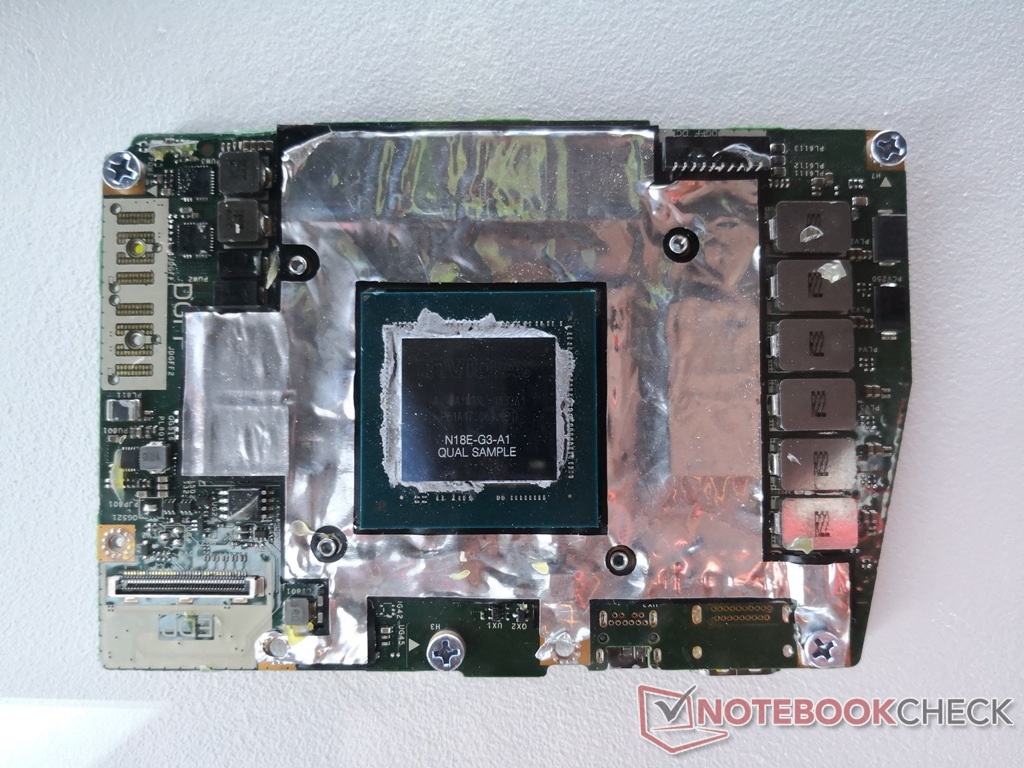
At a notebook-specific forum I frequent[1], a user has noticed that the Framework 16 modular discrete graphics solution uses a connector first used by Dell in its Precision 7530 and 7730 workstation notebooks, released in 2018. The connector is called 'Dell Graphics Form Factor' (DGFF), and is the array of gold LGA pads on the motherboard seen in the bottom-right screenshot in a photo, at the above link. Dell has been using DGFF ever since, in all Precision 7XXX notebooks and the Alienware Area-51m, to facilitate modular GPUs.

However, Dell changes its notebook layout every two years, so these GPUs are not upgradeable after two generations (so a 7530 could be upgraded to a GPU from a 7540, but not a GPU from a 7550, released in 2020).

It's going to be interesting how Framework adapts the connector for its own use. The Dell cards are fairly high-powered; in the most recent 7770 (17" workstation), the RTX 3080 Ti and Quadro RTX A5000 cards may draw up to 130 W.

Some examples of previous and current DGFF discrete cards (all by Dell, for Dell notebooks) are here[2][3][4][5]. Notice the difference to the previous mobile GPU connection standard, MXM 3[6], which was used by Dell in its Precisions until 2018, when it changed to DGFF, HP in its ZBooks until about 2020 when it changed to a soldered solution. Other notebook ODMs like Clevo and Tongfang still use MXM cards in their desktop replacement notebooks. I'm not sure if Clevo still sells these monsters; they had a 780 W power brick, itself heavier than many slimmer notebooks.

[1]: https://notebooktalk.net/topic/873-precision-7680-precision-...

[2]: https://imgur.com/aMal40L : Quadro P3200 (Pascal), Quadro RTX 3000, Quadro RTX 5000 (latter two Turing)

[3]: https://www.notebookcheck.net/fileadmin/Notebooks/News/_nc3/... : GTX 1080? in Dell Alienware Area-51m

[4]: https://dl.dell.com/content/guides/public/Html/precision_756... : new form factor for 7X50 and 7X60 generations

[5]: https://dl.dell.com/content/guides/public/Html/precision_767... : newer still form factor for 7X70 and now 7X80 generation

[6]: https://i.imgur.com/Exp6w0g.png : MXM GPUs
Re: Framework Laptop 16

#68
post #51
post #43

Earlier quoted context omitted.

Ugh. After over a decade of work, everything was finally adapted to or made for 16:9, now they're going after hipster ratios? Not a deal breaker but a bummer. Interesting that phones are going the other way, so now we can enjoy letterboxes on both platforms and not be able to reach the notification drawer. What was so wrong with 16:9 that we needed another competing standard that's just slightly off...

16:10 has been around and relatively popular for at least 17 years. The original 2006 MacBook Pro had a 16:10 1440x900 panel

16:10 goes ALL the way back to some of the earliest widescreen LCDs. The original Apple Cinema Display was 1600x1024 in 1999. This was predated by the SGI 1600SW with the same resolution in 1998.

Re: Framework Laptop 16

#69

Alas, it's got a 16:9 screen with its infamous ugly chin :-( I'd like a chinless 16:10 or 3:2 goodness (or 4:3), even if it was at a hefty markup. UPD: it's a 16:10 display, but the chin is still ugly.

Isn't the point of these that you can modularly customise everything? Or does that not include the screen?

You cannot just pop in any panel that you like. The whole assembly needs to accommodate for it. I think your company would have to be obscenely rich to afford such a supply chain so it could offer different display assemblies for the same laptop.

Re: Framework Laptop 16

#70
post #3

Playing with configurator what surprise me is that a Windows 11 Pro licence cost 259 Euro. Micro$oft still make a lot of money with windonws =)

>what surprise me is that a Windows 11 Pro licence cost 259 Euro. Micro$oft still make a lot of money with windonws =) Not really. Windows 11 Pro retail is $199 today which might sound steep but in comparison Windows XP Pro retail was $299 in 2001 which adjusted for inflation would be $500 today. Ouch! Windows 95 retailed at a whopping $205 in '95 or ~$400 in today's money, while a retail Win 11 Home is $139 now. So…

They make money on OS ads now to subsidize the cost
Post reply on HN