Live data from Hacker News

Moore’s Law is dead – Long live the chiplet

semiwiki.com

61–70 of 123 posts

Re: Moore’s Law is dead – Long live the chiplet

#61
post #37

Earlier quoted context omitted.

> Have clock speeds really plateaued? Pentium 4 HT 3.8F, November 2004, 3.8GHz, 115W TDP Core i9-13900KF, October 2022, 3.0GHz, 125W TDP Of course, the latter does give you 8 performance cores and 16 efficiency cores so performance-per-watt has clearly improved; and it has 'turbo boost'. But in terms of sustained single-core performance? It's clear Intel's attention has been elsewhere. Such as on the laptop market, w…

CPUMark single threaded score for the P4: ~620 CPUMark single threaded score for the 13900K ~4800 So obviously a lot has changed and improved.

Right. But not clock speed.
Re: Moore’s Law is dead – Long live the chiplet

#62
post #38

Lotta people here not reading the article: > However, as it has in the past, the semiconductor ecosystem is adapting and as Chiplet technology builds traction, we will very likely see a period of accelerating innovation and new market opportunities opening as we move forward. The whole premise is that chip innovation (and overall computing power) is continuing to accelerate, even though "Moore's Law as we've known it…

I'd say that the premise of the article is captured in the title perfectly. One needn't to read the article to get it. So, we can strengthen your assertion and to say that "lotta people here are not reading the title." People react to the first part of the title. Seems they are really exasperated by all these repeated deaths of Moore's law.

Does Moore's law require transistors to double on a chip made from a single die?

Re: Moore’s Law is dead – Long live the chiplet

#63
post #53

Unless I’m missing something, the article did mention Moore’s law proper with transistor density doubling every 18 months, but then meandered to talk about other things. M1 has 16 billion transistors thanks to TSMC. Each new node has delivered on Moore’s law with AMD and Apple. I don’t doubt that Moore’s law will stop. I can even say that it Moore’s law may have failed from time to time, but the spirit of the law liv…

Moore's law is:

Transistor density doubling every 18 months for a similar cost.

https://t7m8e9c8.rocketcdn.me/wp-content/uploads/2020/09/pre...

https://en.wikipedia.org/wiki/Moore%27s_law#cite_note-Moore_...

By those terms, Moore's law is totally extinct.

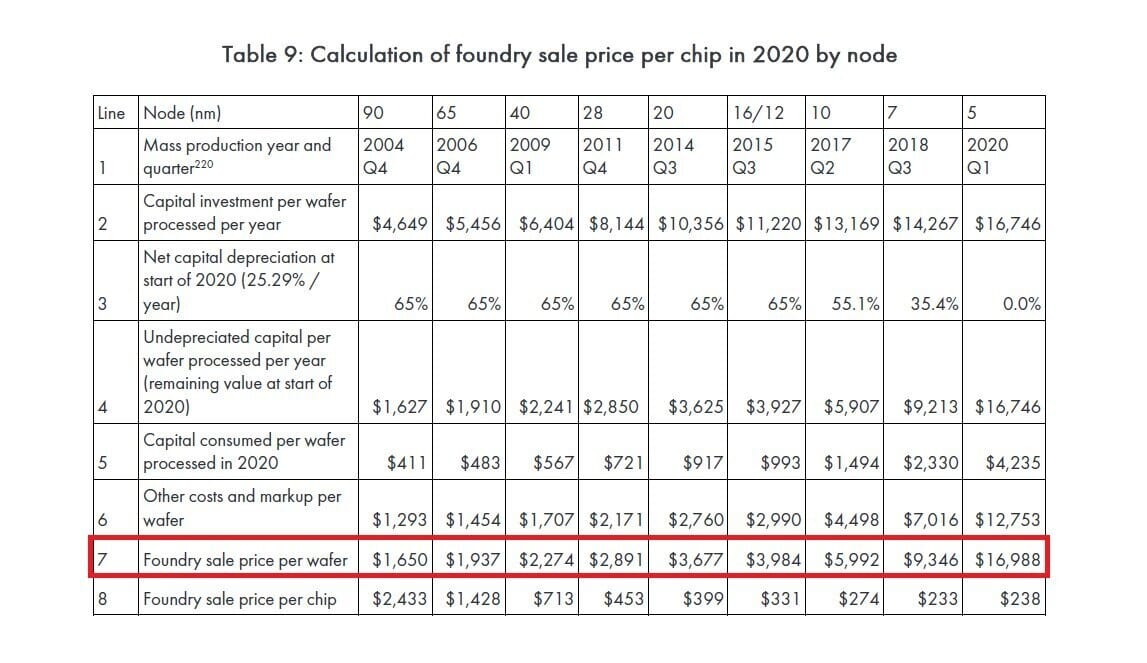
Folk haven't noticed however, because the "leading edge" logic manufacturers have 60% gross margins. The vast majority of their costs are in design, distribution and overhead.

Price rises of 30% to 100% have disguised that the cost of manufacturing the silicon is an order of magnitude more than a decade ago.

Granted, the above numbers are not the actual inflation adjusted wafer cost for leading edge nodes.

But, $16,000 for a 300mm wafer is extraordinary.

Re: Moore’s Law is dead – Long live the chiplet

#64
post #58

Earlier quoted context omitted.

Is silicon manufacturing done entirely in a vacuum yet? Because a vacuum pretty eliminates dust - with no air, dust just falls towards either the ground (if it is uncharged), or towards a positive or negatively charged surface (if the dust particle itself is charged).

No (at least not entirely: some steps are done in a vacuum or very low pressure), in part because it's harder to get a vacuum than clean enough air. Also it would cause a lot of other problems as well as not solving the whole problem: a lot of processing steps involve applying chemicals to the surface of the wafer, washing off those chemicals, or otherwise handling liquids which would boil in a vacuum. Those chemical…

Search "tsmc contamination" for real-life examples although don't expect any details. I'm sure it's not just TSMC but it's the best place to start.

Re: Moore’s Law is dead – Long live the chiplet

#65
post #49

I am not convinced moore's law no longer holds true, consider that there is a third dimension that no one has yet figured out. I am no silicon engineer but I suspect a chip that fully takes advantage of the third dimension would be something like a sponge full of built in channels for the working fluid to remove heat. First however I suspect you will see chiplets arranged vertically like heatsink fins and the whole c…

https://3dfabric.tsmc.com/english/dedicatedFoundry/technolog...

What you're describing is called 3D stacking, and it works.

It's just extraordinarily complex to resolve the intra-die latency issues, and many others, when going vertical. Hence expensive.

Re: Moore’s Law is dead – Long live the chiplet

#66
post #18

Moore’s law was a marketing road map for intel. It was basically a monopolistic warning from one of the founders not to release new products too fast so the company wouldn’t burn out. It worked. But it’s not some scientific or physical law and I hate when people refer to it as such.

Did Moore law apply to other chip manufacturers too? Intel can't dictate the technology advances of other competitors

Moore's law applied to transistor density, period. So memory and logic equally.

Re: Moore’s Law is dead – Long live the chiplet

#67

Even if the Moore's law is not dead, single-thread performance and clock frequency have plateaued 10 years ago. This is the key factor. Because of heating even if you squeeze more transistors onto a chip you need to reduce the clock, so even if you may get higher computational throughput the latency will go down. And this is another argument for chiplets or any other alternative computational architectures.

I really hope there are breakthroughs that allow us to use other, trickier, semiconductors like GaN for chips, IIUC their efficiency could allow us to hit much higher frequencies for the same heat output. That said, I doubt we'd see 3nm processes for something like that.

Re: Moore’s Law is dead – Long live the chiplet

#68
post #61
post #37

Earlier quoted context omitted.

CPUMark single threaded score for the P4: ~620 CPUMark single threaded score for the 13900K ~4800 So obviously a lot has changed and improved.

Right. But not clock speed.

Which only goes to show how meaningless clock speed is in isolation

Re: Moore’s Law is dead – Long live the chiplet

#69
post #65
post #49

I am not convinced moore's law no longer holds true, consider that there is a third dimension that no one has yet figured out. I am no silicon engineer but I suspect a chip that fully takes advantage of the third dimension would be something like a sponge full of built in channels for the working fluid to remove heat. First however I suspect you will see chiplets arranged vertically like heatsink fins and the whole c…

https://3dfabric.tsmc.com/english/dedicatedFoundry/technolog... What you're describing is called 3D stacking, and it works. It's just extraordinarily complex to resolve the intra-die latency issues, and many others, when going vertical. Hence expensive.

3D is already being used for ram/flash IC's. That's possible because most memory cells aren't being used in a memory chip - so heat density is reasonable.

3D is also used in AMD's 3D cache.

But 3D logic on logic is more complicated because of heat issues. AFAIK there's no workable technical solution for that yet.

Re: Moore’s Law is dead – Long live the chiplet

#70
Moore’s law is alive but the benefits are diminishing.

Until 2005 or so, shrinking transistors automatically increased speed and reduced power consumption. When that ran out of steam, the industry went to multi core and massive parallelism with GPUs.

Until recently each shrink also lowered the cost per transistor, but that seems to have run out also and has something to do with why Intel was stuck at 14nm for so long and why new GPU prices are so insane despite a collapse in demand and resolution of the supply chain crisis for high end chips.

Chiplets at best are neutral with regard to cost. If manufacturing overhead is low, two chiplets give you twice the transistors at twice the cost. The industry did not pursue chiplets with a lot of vigor until now because it was a less competitive approach to scaling than shrinking transistors until now.

Post reply on HN