It's a shame there are not very many devices working in audio range (sub 100khz). You still have to scout eBay for a device from the 80s-90s and they are still expensive as hell.
Many people use quality audio cards plus software to do this. http://kokkinizita.linuxaudio.org/linuxaudio/ Look for Jaaa, near the end of the page. Also interesting, although semi-unknown: https://www.sillanumsoft.org/
NanoVNA: Low-cost handheld 4GHz vector network analyzer
61–70 of 72 posts
Re: NanoVNA: Low-cost handheld 4GHz vector network analyzer
#62It's a shame there are not very many devices working in audio range (sub 100khz). You still have to scout eBay for a device from the 80s-90s and they are still expensive as hell.
Many people use quality audio cards plus software to do this. http://kokkinizita.linuxaudio.org/linuxaudio/ Look for Jaaa, near the end of the page. Also interesting, although semi-unknown: https://www.sillanumsoft.org/
Yeah, the niche seems to be filled by software and either sound cards or equivalent USB acquisition hardware.
Re: NanoVNA: Low-cost handheld 4GHz vector network analyzer
#63Earlier quoted context omitted.
>That's about as simple as it can be explained without resorting to baby talk. Can't say I'm not interested in what that would sound like.
who's a good wittle antenna? Dats wight! You are! You a good wittle antenna!
Re: NanoVNA: Low-cost handheld 4GHz vector network analyzer
#64Earlier quoted context omitted.
Do you realize you just admitted to a crime?
as a crime it may a be a small one. As a totally lacking empathy a*hole who denied a hearing impacted grandma her favorite show he is definitely a big one though.
Sometimes the only way to deal with an asshole is serve them their own medicine.
And in no way does age or disability excuse poor behaviour. I know that as a parent of a disabled child with mental health issues...
Re: NanoVNA: Low-cost handheld 4GHz vector network analyzer
#65Earlier quoted context omitted.
Be careful, this isn't something you should talk about/admit in public at all. Feds really don't like it when people mess around licensed bands.
That's on a shared antenna so no significant broadcast going on, just interfering on the local coax. Never heard of antennas being shared between homes before like that but if it is what he says then it'd be too low power to matter outside of what's directly connected.
Re: NanoVNA: Low-cost handheld 4GHz vector network analyzer
#66Earlier quoted context omitted.
That's on a shared antenna so no significant broadcast going on, just interfering on the local coax. Never heard of antennas being shared between homes before like that but if it is what he says then it'd be too low power to matter outside of what's directly connected.
Interfering with her reception of broadcast TV is what is illegal. It doesn't need to impact more than one person. Cable is a different matter, you could try for civil damages but I see that as unlikely to get anywhere. That said, being too loud is interfering with someone's life, so personally seems fair.
Being respectful of your neighbours is a little understood concept for some people and age and/or disability doesn't exclude your social responsibility to others.
Re: NanoVNA: Low-cost handheld 4GHz vector network analyzer
#67Earlier quoted context omitted.
That's on a shared antenna so no significant broadcast going on, just interfering on the local coax. Never heard of antennas being shared between homes before like that but if it is what he says then it'd be too low power to matter outside of what's directly connected.
Interfering with her reception of broadcast TV is what is illegal. It doesn't need to impact more than one person. Cable is a different matter, you could try for civil damages but I see that as unlikely to get anywhere. That said, being too loud is interfering with someone's life, so personally seems fair.
That's not illegal, also this was in the U.K. Governments regulate the airwaves, that authority ends at the antenna. As the original poster already stated in a separate comment, he never transmitted anything that would have meaningfully broadcasted any interference on a licensed frequency band. This is no different than cable, especially considering back in the day cable networks were created to distribute broadcast channels from big antennas at their head end.
Re: NanoVNA: Low-cost handheld 4GHz vector network analyzer
#68In ELI5 terms: What is a VNA? What are some exemplary, common things I could do with it?
While mastax's explanation is correct, it's not really "like you're 5." These low end VNAs have two connectors. A signal comes out of connector 1 and goes to connector 2. What happens to that signal is measured, including the change in amplitude (up or down) and phase shift (left or right.) Also, whatever signal bounces back to connector 1 is measured for amplitude and phase. With that you can tune antennas, characte…
- a LC filter might look like this https://www.qsl.net/kp4md/lpfilter2.jpg, by poking the turns of the coil, you change the frequency and width; with a real-time display on a VNA you can fine-tune a filter with a bit of practice (I't maybe better to have linear, not toroid, coils for this)
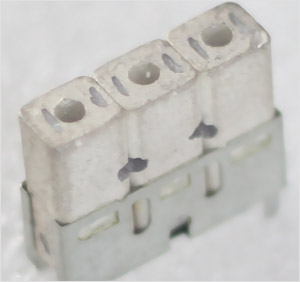
- a ceramic filter might look like this http://www.pro-line.co.kr/base/img/_proline/product/Ceramic_.... We were recently optimizing filters in our radar and I said something like "this filter is cool but it's about 30 MHz (0.5%) too low" and our RF wizard said "no problem we will sand off a tiny bit on one end" [changing the shape and thus the resonant frequency]. Again you observe the characteristics of the filter and poke it and tune it to your needs.
The above is called S21 parameter of the filter. Basically "what goes through and what not" (depending on frequency). https://en.wikipedia.org/wiki/Scattering_parameters
- when you are chaining amplifiers, there is a problem with reflected power - the next stage input will not eat everything, a part of the signal will bounce back, and this will create standing waves https://en.wikipedia.org/wiki/Standing_wave_ratio and either the voltage is rising and something will get destroyed or this will create a resonance in your system and it will oscillate. You can either use isolator https://en.wikipedia.org/wiki/Isolator_(microwave) (a device that allows energy to pass in one direction, and eats it in the other), but that's clumsy and expensive, or you can tune the amplifier/the board. You take a little piece of copper (like a 1x2mm chip 50um thick or so) on a wooden/plastic stick (so it's non-conductive) and try to put it in various places on the microstrip leading to the amplifier. You basically have a 0.01pF capacitor and you are trying to add it to the transmission line so the reflected wave will get exactly attenuated. When you are happy with the position, you solder it down. You can also tune amplifier output power/gain with this technique, I imagine this works by providing the output driver a "buffer" that it can use to temporarily store energy. (the RF wizard tried to teach me this skill, but it apparently needs a lot of practice)
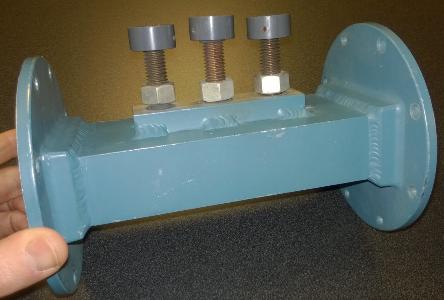
- you can also tune waveguide devices - antennas, circulators etc. - with a device called waveguide stub tuner! https://www.4semi.com/clientresources/768/774/42/77442/19606... It's a piece of waveguide with screws and you can screw them in and out and shape the inner cavity. I have tuned our antenna with this: the antenna has reflection loss (i.e., how much signal reflects back instead of getting radiated into the environment) about -20dB by default (that means that 1% of the power you send into it reflects back). This is very bad for powerful transmitters - for example with our 1.3kW transmitter, about 13W come back and this will fry your sensitive receiver. With the tuner, I can easily get to -30dB (0.1% comes back), so about 1W comes back and this is easy to handle (most low-loss input parts max out at a few Watts).
You can also reflect the reflected power :) with a T/R switch - a cavity filled with neon or similar gas, optionally pre-ionized with a small radioactive source. When the power comes through, it will ignite a discharge (like in a neon lamp), and this will partially eat the energy and partially reflect it. However, buying them is extremely expensive if they are not already in stock, as someone needs to manufacture it for you for your specific frequency/waveguide size, and building them myself is something… not impossible, but I think I have enough of other problems :)
For any of these you technically don't need a VNA as you are not measuring phases, only amplitudes. You only need a scalar network analyzer. However, AIUI, the phase information can be used by some clever algorithms to compensate for various errors - so scalar instruments are not very precise.
Re: NanoVNA: Low-cost handheld 4GHz vector network analyzer
#69Earlier quoted context omitted.
You don't need to sample at the Nyquist rate (i.e. 2x the intended measured frequency) to detect the presence of a particular signal but instead can just measure the overall power within a narrow frequency band of interest. Practically speaking this is done by mixing the sweep frequency down to at or around DC and then either directly measuring the power or sampling at a much lower rate and computing the power digita…
I don't think this is true, otherwise I could see the power on wifi bands with my 2.4ghz rtl-sdr device, instead of only up to 1200mhz.
Much like a VNA, your rtl-sdr is down-converting from (say) 1.2Mhz to somewhere around DC. This is limited not by your sample rate but by the oscillator your rtl-sdr is mixing into your received signal and the general frequency profile of all the analogue bits in between.
Re: NanoVNA: Low-cost handheld 4GHz vector network analyzer
#70Earlier quoted context omitted.
I don't think this is true, otherwise I could see the power on wifi bands with my 2.4ghz rtl-sdr device, instead of only up to 1200mhz.
If you remove the front-end RF filter from your SDR, you can indeed pick up 2.4 GHz with it using harmonics of the ADC clock frequency. But the rest of the signal processing pipeline may be too narrow to receive much energy from a broadband WiFi signal, and what you do receive will probably just look like noise in any event. You could probably observe the leakage from a nearby microwave oven without much difficulty,…
I understand harmonics, but those generally don't work backward, do they? The phrase "subharmonic" comes to mind but i don't know when that actually applies. Does anyone have a link of an explanation?
If this were the case i could tune any of my radios to a subharmonic of an FMBC station and see/hear something, but i generally do not. I have a pure ADC laying around somewhere (for o-scoping), how can i prove this to myself experimentally?