Live data from Hacker News

Can helium be mixed with hydrogen to form a non-explosive mix? (2003)

madsci.org

61–70 of 119 posts

Re: Can helium be mixed with hydrogen to form a non-explosive mix? (2003)

#61

This article popped up on HN a few months ago advocating 100% hydrogen airships for 'crew-less' cargo shipping https://www.thecgo.org/benchmark/bring-back-hydrogen-lifting...

Can a micro satellite be launched from a hydrogen filled balloon?

NASA has calculations of hydrogen balloons up to 90km, carrying a 10kg object. [0]

Wind at that altitude can be as much as ~50 m/s, and occasionally even travel from west to east (important for orbital launching). [1] http://www.ccpo.odu.edu/SEES/ozone/class/Chap_2/2_4.htm

Low Earth orbit requires at minimum ~6.5km/s, so launching from the equator into the right stratospheric wind could allow a 10kg launch into orbit from a balloon if it can accelerate from Earth's natural rotation plus the wind speed, totaling around 500m/s, to 6500m/s. [2]

Traditional small rockets seem to have a lower limit in the 100s of kg total mass. Using a solid microrocket(s) [3], you might be able to get a payload into orbit between 10-500 grams. I know MIT was working on this as well as micro-jet engines... [4]

[0] https://www.grc.nasa.gov/WWW/K-12/Numbers/Math/Mathematical_...

[1] http://www.ccpo.odu.edu/SEES/ozone/class/Chap_2/2_4.htm

[2] https://en.wikipedia.org/wiki/Orbital_speed

[3] https://www-bsac.eecs.berkeley.edu/projects/microrockets/mas...

[4] https://www.semanticscholar.org/paper/Performance-of-a-High-...
Re: Can helium be mixed with hydrogen to form a non-explosive mix? (2003)

#62
post #5

Hydrogen is non-explosive. If you prevent oxygen from mixing in, then it's also not going to rapidly deflagrate.

It's not random detonation that is the problem, the issue is containment failures, or anything that causes one. A collision, or stress fracture for example will allow oxygen into the tank. In an atmosphere with enough oxygen in it like ours, that's always a risk.

Had my house once fill up with natural gas for many weeks. Much to the surprise of the gas company it did not explode. Of course everyone has severe long term effects from that.

Re: Can helium be mixed with hydrogen to form a non-explosive mix? (2003)

#63

Earlier quoted context omitted.

Why would the hydrogen not escape?

Diatomic hydrogen is bigger than helium, less prone to diffusing through a membrane.

Have you worked with hydrogen? Being less prone to leaving than He is an extremely low bar and very far away from the claim that it doesn’t ever diffuse through anything.

Re: Can helium be mixed with hydrogen to form a non-explosive mix? (2003)

#65
post #50
post #43

Earlier quoted context omitted.

But they are still flying bombs, even without crew.

Except, they are not flying bombs. Notably, the only people killed when the Hindenberg blew were on board. And, fewer than half of them. The flames in the film were the (very flammable!) gas bag itself and the kerosene fuel. The escaping gas went up and away. A modern craft would not be made of readily flammable material.

Your comments are filled with misinformation:

The gas-bag and paint theory is debunked: https://www.airships.net/hindenburg-paint/

The "nobody died from the hydrogen" line is debunked: https://www.airships.net/hindenburg/disaster/myths/#advocate...

That the craft is made out of flammable material is debunked: https://www.airships.net/hindenburg/disaster/myths/#flammabl...

Re: Can helium be mixed with hydrogen to form a non-explosive mix? (2003)

#67
post #48

Earlier quoted context omitted.

> In a collision, gas released goes up and out of trouble Except for the cases when there's an open flame nearby or sufficient heat, as is the case in a non-insignificant number of collisions. What if a hydrogen engine collides with a standard petrol engine? Or if the gas becomes exposed to hot surfaces during the oxygen mixing? The gas expansion is also a major cause of explosion. You essentially pull oxygen into th…

What leads you to think that anything would "pull oxygen into the fuel"? H2 under pressure moves outward, and in a containment breach tends to, instead, increase the H2 fraction above the 75% that can sustain a flame until most of the gas has escaped and leapt skyward. H2 explosions are a concern in enclosed, unventilated spaces.

> H2 explosions are a concern in enclosed, unventilated spaces

Well, ignoring one of the largest hydrogen explosions in History which occurred in the open air under the exact circumstances you say are impossible: https://en.wikipedia.org/wiki/Hindenburg_disaster. You mention earlier that this is not the hydrogen, and instead just the fabric. That's been debunked repeatedly: https://www.airships.net/hindenburg/disaster/myths/#hydrogen...

You also mention nobody died in the fire as a result of the hydrogen, which is also debunked: https://www.airships.net/hindenburg/disaster/myths/#hydrogen

"This is probably the most absurd myth about the Hindenburg disaster, yet it is frequently promoted by hydrogen fuel advocates."

In addition, hydrogen tanks are not just sitting there in a vacuum. In order for the hydrogen to "leap skyward", you have to have it, again like I said earlier, not come in contact with anything that will induce combustion. Also, you need a perfectly open environment. Your point about the mixture being above 75% just shows a somewhat naïve understanding of the physical chemistry at play here. All it takes is for an area near the fuel supply to hit the right fuel-air mixture ratio, which leads to combustion, as in common elementary school science experiments (the hydrogen 'pop' demo). This event leads to a pulling in of the air and fuel around it, sustaining the exposition.

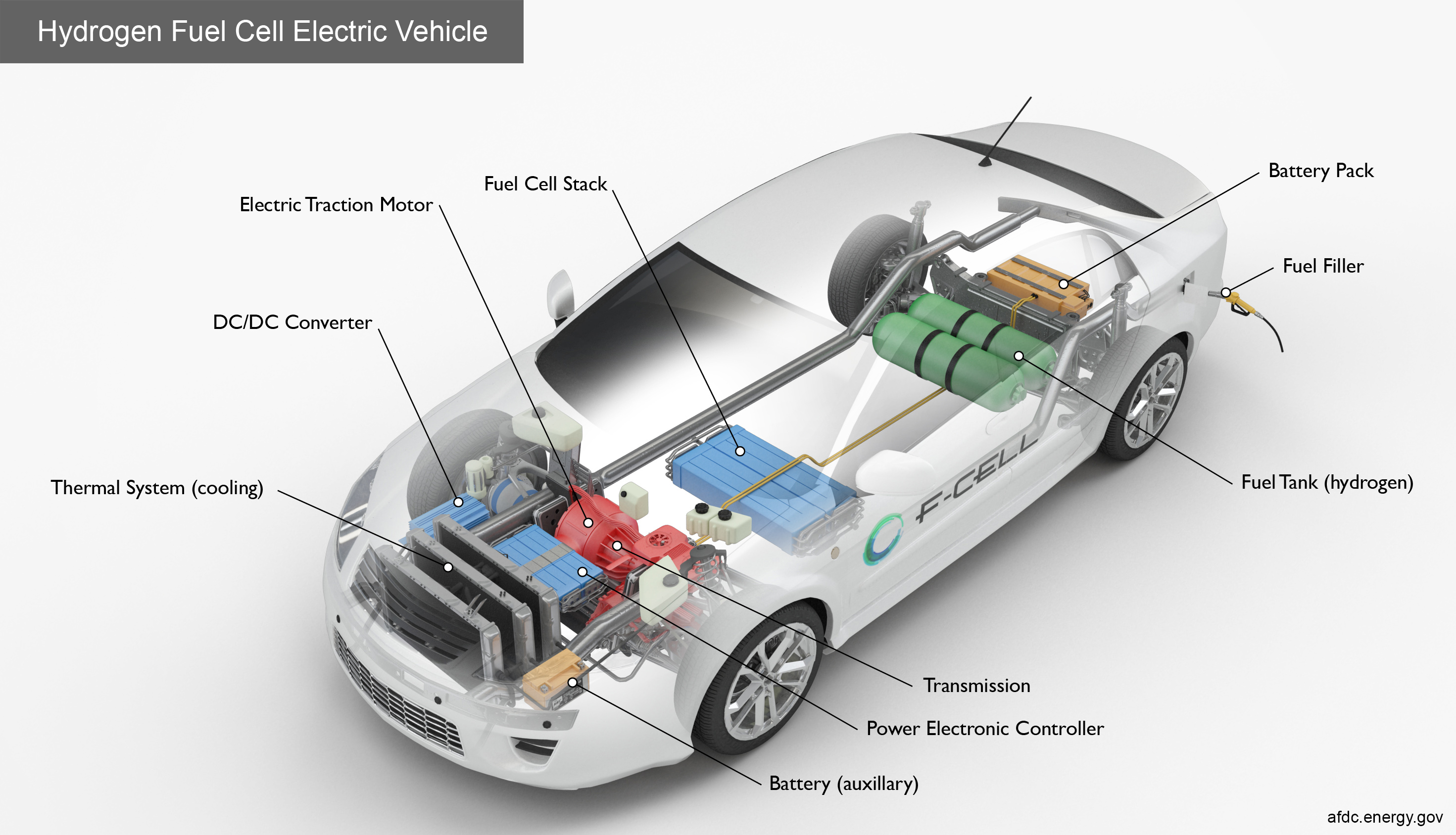
Hydrogen cars have the tanks contained within a sealed environment towards the rear of the car: https://afdc.energy.gov/files/vehicles/hydrogen-high-res.jpg

Re: Can helium be mixed with hydrogen to form a non-explosive mix? (2003)

#68
post #61

This article popped up on HN a few months ago advocating 100% hydrogen airships for 'crew-less' cargo shipping https://www.thecgo.org/benchmark/bring-back-hydrogen-lifting...

Can a micro satellite be launched from a hydrogen filled balloon? NASA has calculations of hydrogen balloons up to 90km, carrying a 10kg object. [0] Wind at that altitude can be as much as ~50 m/s, and occasionally even travel from west to east (important for orbital launching). [1] http://www.ccpo.odu.edu/SEES/ozone/class/Chap_2/2_4.htm Low Earth orbit requires at minimum ~6.5km/s, so launching from the equator into…

So like, a rocket the size of a lamppost launching from a balloon the size of a tractor-trailer to deliver a payload the size of a softball?

Neat!

Re: Can helium be mixed with hydrogen to form a non-explosive mix? (2003)

#69
post #52

Earlier quoted context omitted.

A gas bag that bumped into a building would bounce off. Or rip and the hydrogen shoot up to the sky. So, no, not especially conceivable. Or plausible.

What's to stop the hackers from running the halt and catch fire instruction?

+1 for obscure references

Re: Can helium be mixed with hydrogen to form a non-explosive mix? (2003)

#70
post #61

This article popped up on HN a few months ago advocating 100% hydrogen airships for 'crew-less' cargo shipping https://www.thecgo.org/benchmark/bring-back-hydrogen-lifting...

Can a micro satellite be launched from a hydrogen filled balloon? NASA has calculations of hydrogen balloons up to 90km, carrying a 10kg object. [0] Wind at that altitude can be as much as ~50 m/s, and occasionally even travel from west to east (important for orbital launching). [1] http://www.ccpo.odu.edu/SEES/ozone/class/Chap_2/2_4.htm Low Earth orbit requires at minimum ~6.5km/s, so launching from the equator into…

Rocket launches from high altitude baloons have been done:

https://en.m.wikipedia.org/wiki/Rockoon

If you mainly care about altitude as with a sounding rocket, it can help quite a bit.

Also some launche loop designs have parts of the structure supported by inflatable members.

And there are even plans for a rather exotic airship design that could be flown to orbit with the help of solar powered electric engines:

https://en.m.wikipedia.org/wiki/JP_Aerospace

Post reply on HN