Live data from Hacker News

An Animal’s Place (2002)

michaelpollan.com

61–69 of 69 posts

Re: An Animal’s Place (2002)

#61

Pollan has a tendency to talk himself into pretty weird conclusions, namely that because we can treat an animal well and give it a good life, killing it and consuming it before it naturally dies is somehow good. There is this made up notion that the animal is almost a sacrifice for us: in exchange for a peaceful safe life, it gives us its blood and flesh. But remember, never willingly. It never wants to die. It can n…

> But remember, never willingly. It never wants to die. In what context does an animal die when it wants to die? When do animals want to die? And how would you know what an animal wants? Btw, I remember your username. The last time I communicated with your account, a person behind it threatened me with violence: https://news.ycombinator.com/item?id=27534682 I will give your account the benefit of the doubt that this…

You can’t even concede that animals don’t want to be slaughtered? You are consistently completely unwilling to admit anything in our discussions.

And no, my use of a common figure of speech is not a physical threat.
Re: An Animal’s Place (2002)

#62
post #38

Earlier quoted context omitted.

You’re talking about justifying killing these animals to solve problems that are caused by farming the animals to begin with, which you even say yourself. I can’t say anything about maintaining soil fertility because I know nothing about it, but what is about chickens that preserves the soil, and why can it only come from those chickens? Something about nutrients in the soil I imagine, right?

Since we plant things that we eat and sell (or give away) we are removing nutrients from the soil. Someone has to put them back. We could do that with industrial NPK fertilizer, but that's not very ecological. Chicken manure is a more complete and natural fertilizer, and for the most part the chickens even spread it around for us. They also engage in some pest control (the ducks are especially good at that, without t…

Thank you for your thorough post.

There are alternative models, such as biocyclic veganic agriculture, or in the future, foods created through fermentation [1] (this almost require no arable land). I recommend checking them out if you are interested in cycles in nature. Using animal manure, opposed to "plant manure" from nitrogen fixing plants, it also has its downsides because of the high levels of ammonia it kills most of the soil creatures such as worms, and more tilling and maintenance is required (which releases more carbon).

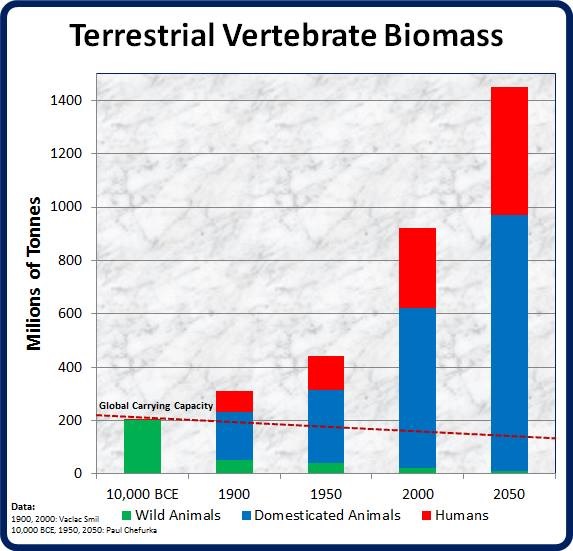
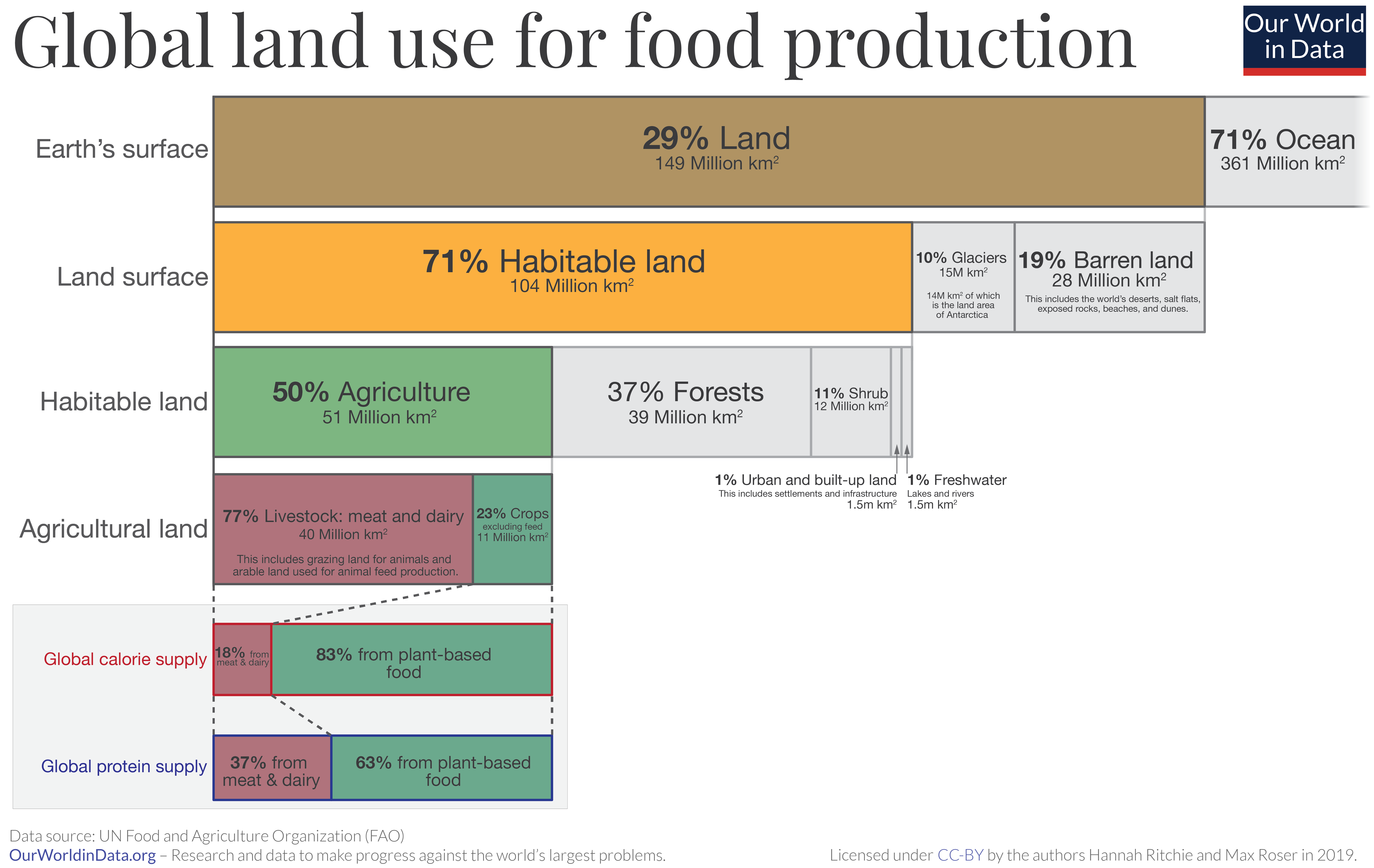
Personally I don't think that using livestock is living with nature, but is its antithesis. Since the earth is (at this moment) bound by the amount of biomass available through photosynthesis there is a limited carrying capacity for biomass. What we have done specifically is reduced the biodiversity by using more and more land mass for livestock and its feed. Of all habitable land, 50% is used for agriculture and 77% of that is used for livestock (while only providing us 18% of calories and 37% of protein) [2]. This has drastically reduced the number of wild animals and biodiversity, which I consider "nature" [3].

Ultimately, using livestock kills living beings (primarily in nature) somewhere else. If you're goals are living closer to nature, and reducing your ecological footprint, and your definition of nature is: "the phenomena of the physical world collectively, including plants, animals, the landscape, and other features and products of the earth, as opposed to humans or human creations.", then living closer to nature would mean rewilding your land and perhaps be a steward of that land. It would be a great means of treating nature and life with more respect :).

[1]: https://www.theguardian.com/environment/2021/jun/21/microbes... [2]: https://ourworldindata.org/uploads/2019/11/Global-land-use-g... [3]: https://peakoilbarrel.com/wp-content/uploads/2017/11/Terrest...

Re: An Animal’s Place (2002)

#63

Earlier quoted context omitted.

Usually, killing another being in order for you to survive (outside of self-defense) is not considered morally right. Either way, even by your logic, tigers may be morally neutral, but bears or wolves should still be considered evil.

Well the first part of what you said seems just completely untrue. I don’t think if someone was starving and they needed to eat an animal to survive that anyone would say they acted immorally. As to your second point: no. Those animals lack the moral reasoning ability to make a choice between eating meat and not eating meat. We don’t, though. If I ever meat a bear who is able to make nuanced moral considerations like…

> I don’t think if someone was starving and they needed to eat an animal to survive that anyone would say they acted immorally.

Sure, just like most people don't view killing an animal to enjoy its taste as immoral either.

But as a general principle, the ultimate moral good is sacrificing your own life and happiness for another. Killing someone else to save your own life is not usually praised (as long as we're not discussing self defense, which is another matter).

Still, reading your other replies, I understand your position to be that there is a hierarchy of life worth - human > animal > plant[...], you just draw the line differently on killing than most people. I have to agree that this is also perfectly coherent.

Re: An Animal’s Place (2002)

#64

Earlier quoted context omitted.

> Those animals lack the moral reasoning ability to make a choice between eating meat and not eating meat. But how can you say that? You can't know what choices an animal makes or doesn't make. In fact, if you have pets or been around animals for some time, it would be blindingly obvious that animals absolutely make choices between whether to eat something or not, be it meat or anything else. For example, the cats in…

All I'm saying is that I don't think non-human animals should be expected to need to comprehend the nature of suffering in sentient begins. You're saying that's unfounded and uninformed. I don't even know how to respond because I almost feel like you're messing with me. > The dogs know it's wrong to eat food that is for humans and that there will be repercussions if they do so. No, they know they get scolded when the…

> You're saying that's unfounded and uninformed. I don't even know how to respond because I almost feel like you're messing with me.

Yes, I appreciate it's difficult to understand why not everybody automatically agrees with everything you say.

Just out of curiousity and my apologies if I'm prying, but, do have a personality disorder? I mean, have you had a diagnosis and all? I don't want to be unfair to you.

Re: An Animal’s Place (2002)

#65
post #58

Earlier quoted context omitted.

> First, only one party in this "deal" has a full understanding of what the deal consists of and the endless cruelties and indignities inherent in it. These "endless cruelties and indignities" exist in one way of farming only, the factory farms found in modern industrialised nations and spreading slowly like a rot throughout the world as we speak because capitalilsm is a disease that we don't know how to cure, like c…

No need to apologize, I appreciate the thoughtful (and passionate) reply. To clarify one of my points: when I said the terms of the deal have changed I didn’t mean just for animals. The existence of plant-based alternatives for every type of animal product has also changed the terms for us. We no longer need domesticated animals, even if we maintain our agricultural ways. I also agree with you about unfettered capita…

You're right that animals are not only treated inhumanely in CAFOs, I have seen that kind of thing too. Even simple things, like killing a chicken before cutting its throat seem to never cross some peoples' minds. It's a different problem that has to do with education and generally standards of living and I think in the end it all loops back to the main reason that some people lack basic education, not to mention many other material needs: capitalism, again (and now I sound like a broken record). But again that's not the case everywhere. It is possible to raise animals without causing unnecessary suffering and it does happen, around the world.

I think we agree on the need, or the want even, to minimise suffering. Maybe we disagree on what that entails? I think that small-scale farming can achieve this, which of course means that much of the world will need to eat much less meat and even (gulp!) dairy products than currently.

I don't agree that we're not part of the natural order, but that's a bigger conversation I think.

Yeah, thanks for the level-headed discussion also.

Re: An Animal’s Place (2002)

#66

Earlier quoted context omitted.

All I'm saying is that I don't think non-human animals should be expected to need to comprehend the nature of suffering in sentient begins. You're saying that's unfounded and uninformed. I don't even know how to respond because I almost feel like you're messing with me. > The dogs know it's wrong to eat food that is for humans and that there will be repercussions if they do so. No, they know they get scolded when the…

> You're saying that's unfounded and uninformed. I don't even know how to respond because I almost feel like you're messing with me. Yes, I appreciate it's difficult to understand why not everybody automatically agrees with everything you say. Just out of curiousity and my apologies if I'm prying, but, do have a personality disorder? I mean, have you had a diagnosis and all? I don't want to be unfair to you.

Wow, you're terrible!

Re: An Animal’s Place (2002)

#67
post #14

Earlier quoted context omitted.

Rubbish . By this logic, we can just say that we shouldn't upset the "balance" of the slave owners -- they were able to to "maintain the balance needed to maintain the ecosystem that it is a part of".

Slaves were (are!) humans. Slavery has nothing to do with killing or not killing non-human animals, because it doesn't affect non-human animals, it affects other humans. There is just no sensible comparison that can be drawn between what we do to other animals and what we do to other humans and once more I'm struck by the surrealism of the positions taken in this kind of conversation. It's as if the obvious has to be…

You are perhaps misunderstanding what animal welfare advocates are up to. No one wants to give animals the right to vote. We don't want to treat animals as humans in every respect. We just don't want, for example, for animals to be considered property (meaning anyone can abuse the shit out of an animal with no repercussions).

Reflect on this yourself, do you think it should be permissible, in our modern society, to buy a dog in a store, lock it up in the basement, and beat it to death over the course of several weeks?

Re: An Animal’s Place (2002)

#68

Earlier quoted context omitted.

> You're saying that's unfounded and uninformed. I don't even know how to respond because I almost feel like you're messing with me. Yes, I appreciate it's difficult to understand why not everybody automatically agrees with everything you say. Just out of curiousity and my apologies if I'm prying, but, do have a personality disorder? I mean, have you had a diagnosis and all? I don't want to be unfair to you.

Wow, you're terrible!

Not at all. I'm asking whether you have a diagnosis of a personality disorder because in all the conversations I've had with you and in all the conversations I've seen you have with others you seem to be incapable of seeing the other person's point of view even just to disagree with it and you don't seem to appreciate how the most disurbing parts of your interaction come across. That, to me, speaks of an uncommon state of mind compatible with a personality disorder.

As I say, I don't want to be unfair. If you do have a personality disorder there's no point in me being upset at your behaviour.

Re: An Animal’s Place (2002)

#69
post #67

Earlier quoted context omitted.

Slaves were (are!) humans. Slavery has nothing to do with killing or not killing non-human animals, because it doesn't affect non-human animals, it affects other humans. There is just no sensible comparison that can be drawn between what we do to other animals and what we do to other humans and once more I'm struck by the surrealism of the positions taken in this kind of conversation. It's as if the obvious has to be…

You are perhaps misunderstanding what animal welfare advocates are up to. No one wants to give animals the right to vote. We don't want to treat animals as humans in every respect. We just don't want, for example, for animals to be considered property (meaning anyone can abuse the shit out of an animal with no repercussions). Reflect on this yourself, do you think it should be permissible, in our modern society, to b…

Wow, that escalated quickly: from buying a dog to locking him or her in a basement and beating him or her to death over weeks...

Can I think that one of those things is permissible, but not the others, or do they necessarily come in a package?

And I don't understand what you mean that if animals are considered property "anyone can abuse the shit out of an animal with no repercussions". There are laws against this in many places around the world -animal cruelty laws. In most jurisdictions where there are laws against animal cruelty, laws also consider animals as property, so it's clear that both can work together.

> You are perhaps misunderstanding what animal welfare advocates are up to.

I don't. It's the animal rights advocates that are confused about what is meant by "rights". Animals have no concept of rights, theirs or others, so it's only humans that can choose what animal rights laws should exist. But those are not really animal rights, they're human rights: rights that humans have, or don't have, to behave towards animals in certain ways. For example, I have no right to abuse an animal (and that's as it should be) but that is not a right that an animal has, it's a right that I don't (as I shouldn't).

Rights only make sense as laws of human socieities, but how are animals part of human societies? How can they participate in human societies, if they can't own property, vote, work to support themselves, etc? The absurdity that is obvious in granting animals such rights, that they can't even understand, let alone benefit from, makes it clear why the entire idea of "animal rights" is absurd.

Legislation to protect animals is welcome and much more of its kind is needed, but "rights"? That's "nonsense on stilts".

Post reply on HN