Live data from Hacker News

Simple Personal Finance Tracking with GnuCash

csun.io

61–70 of 323 posts

Re: Simple Personal Finance Tracking with GnuCash

#61

Until the open source options have direct download options that 'just work', Quicken is the best. I've tried GnuCash and Skrooge, can't ever get the direct downloads to work for more than two months without breaking.

Quicken died for me ten ir so years ago, as did many other personal finance software applications. It is the syncing between devices that’s imperative these days, and this is where Quicken is failing, especially when your database gets larger: it syncs, but as your database grows its latency becomes ever more apparent. Quickbooks Online, which I have been using for a little over a year, does syncing exceptionally wel…

Quicken is out from under the Intuit Monster now, so it may be worth looking at again.
Re: Simple Personal Finance Tracking with GnuCash

#62
post #9

I tracked my finances for a while with GnuCash and found myself in the category he describes here: > If you’re happy with just knowing that your credit card balance is less than a certain amount each month, that’s great! You don’t need GnuCash. I'm curious what fraction of people track personal finances versus those who don't. I don't know if I'm in a big majority, small majority, big minority, small minority, or wha…

I did for a couple of years - actually wrote my own small CLI app to take care of my very basic student needs :D

At some point I dropped the habit, more out of laziness than anything else. I still have a budget spreadsheet with a rough plan for my monthly finances, I just don‘t track the actual expenses anymore. Reading this makes me think I ought to start again...

Re: Simple Personal Finance Tracking with GnuCash

#63
Importing records in GnuCash is a pain.

Credit card payments end up with two records of the payment, one from the credit card and another from your bank.

There's no way to merge records in GnuCash, ideally you would be able to mark them as the same record, but keep them both to keep the import logic happy.

Re: Simple Personal Finance Tracking with GnuCash

#64
"For my stocks and non-money assets, I opt not to track them super closely in order to avoid having to update the values of each stock every time."

GnuCash's Price Editor can fetch values automatically. It used to be able to use Yahoo finance, but they cut that off a while back. There is a replacement, but I cannot remember what it is at the moment (and am on the work laptop).

GnuCash is actually pretty easy to use, once you get used to the double-entry system and how it handles some things. I have a moderately complex situation (and it's been stupid complex in the past), and I don't spend more than a few minutes a month on it (unless I'm trading stocks; it can take more time to set up each stock's account for proper tracking).

Re: Simple Personal Finance Tracking with GnuCash

#66

I tried GnuCash and generally liked it. However, it was a little more complicated than I wanted. In addition, I wanted to be able to access via the web, when I was away from my computer. (cause at the time, I thought it was only available locally) I also wanted my life partner (my lovely wife) to participate. This was going to be the hard part. Behavior modification. So I built a very simple "tracker".(php/codeignite…

> The trick is doing a manual entry for each transaction. Kind of like a spending journal, food journal or just a journal. There still seems to be power in manually entering a transaction, although it might not be by pen and paper.

This was a big realization for me. I tend to prefer getting the "robots" to do things for us (in other words, automate things). Developing an intuition of what's happening with your money is hard when you use an automated tool though.

The process of managing the ledger bi-weekly really adds something more for me. Working on each entry to determine a category, writing down amounts, noticing how many entries I've entered into a category each session, and looking at it in aggregate afterward gives me some greater sense of how my financial life works. I can almost picture writing the transactions in GnuCash before I even do it.

I get what you mean about it being complicated though. I learned the bits I needed to get by and mostly stick to that. So that works for me. In the long run, the double-ledger manual style is what I think is most important.

Re: Simple Personal Finance Tracking with GnuCash

#67
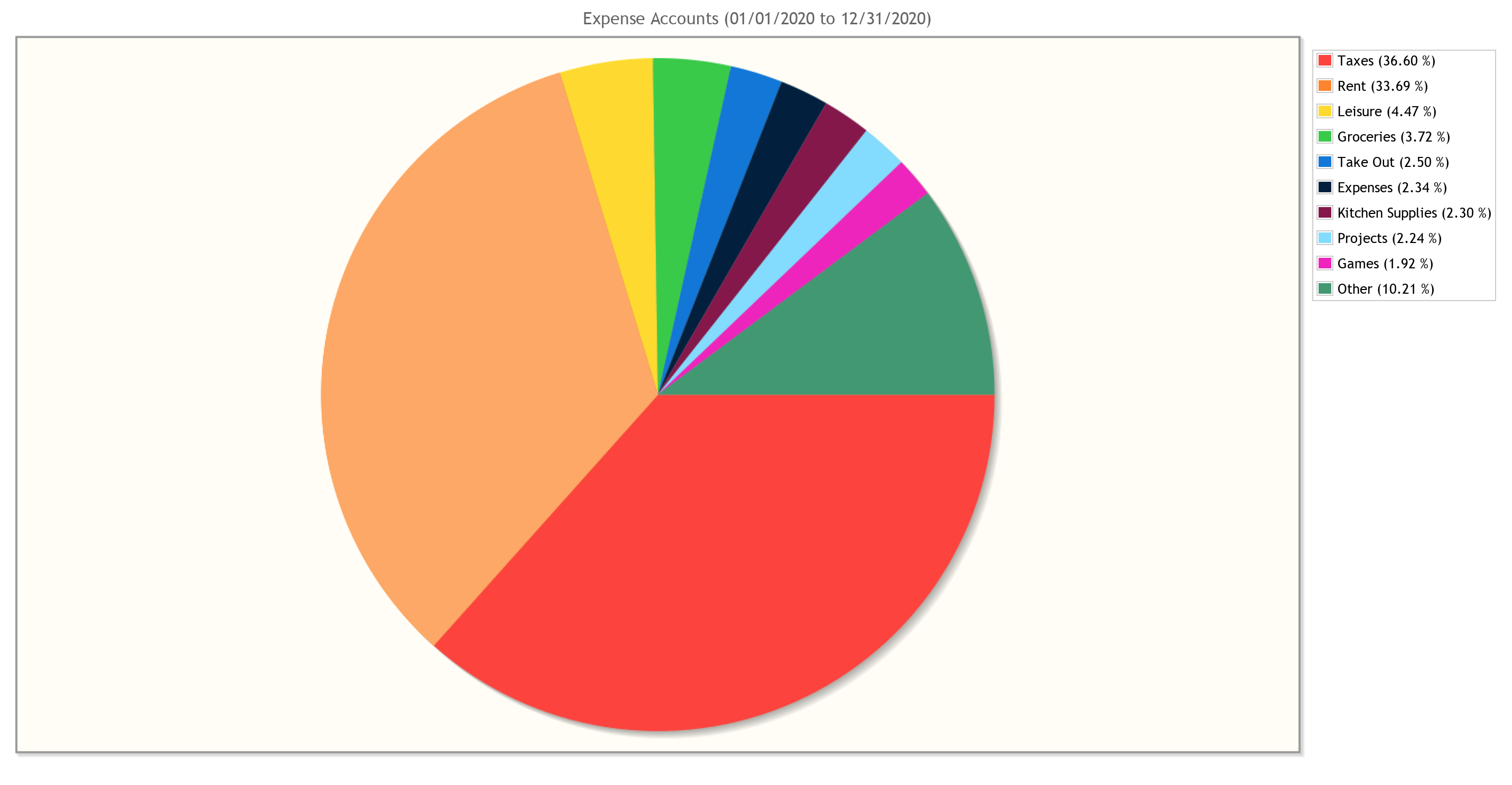
In the first pie chart [0], am I the only one having a hard time with colours in the legend? For example, the second colour in the legend is #ff851b [1], but that doesn't appear in the pie chart. Going by the amount (33.69%), it must be the segment with colour #ffa85f [2].

[0] https://www.csun.io/images/gnucash/expenses_piechart.png

[1] https://www.color-hex.com/color/ff851b

[2] https://www.color-hex.com/color/ffa85f

Re: Simple Personal Finance Tracking with GnuCash

#68
post #15

I've been playing around with ledger[1] recently. On one level, it is the simplest of tools requiring only a command line and a text editor. But once you wade into the documentation[2] you will begin to see it quite differently. Its capabilities are staggering... [1] https://www.ledger-cli.org/index.html [2] https://www.ledger-cli.org/3.0/doc/ledger3.html

I looked in to switching from GnuCash to Ledger about 5 years ago, and found that it would have been too painful to use for manually inputting the thousands of transactions I had because it just didn't have the nice auto-complete and GUI nicities that GnuCash had. I'm a hardcore command-line and keyboard-only power user, so I would have absolutely loved to have made Ledger work for me rather than use the mouse-heavy…

+1 for ledger.

I switched from GnuCash to ledger about 8 years ago and never looked back.

I have a script that pulls my bank account using aqbanking [1] and icsv2ledger.py [2]. The latter can match transactions to templates and set transaction accounts and payees automatically. It also supports autocompletion of account names when a transaction is not matched by a template.

For cash entries, I use ledger-mode in Emacs. (I also use Org mode, so I spent a lot of time in Emacs anyway.) ledger-mode also supports autocompletion.

I only use the command line for reporting and have aliases for the most common reports. These mostly revolve about showing my current budget.

[1] https://wiki.gnucash.org/wiki/AqBanking [2] https://github.com/quentinsf/icsv2ledger

Fun fact: The second program I wrote was a database in Turbo Pascal to keep track of my loose change.

Not so fun fact: I lost my GnuCash files after I made the switch. Ten years of accounting gone. :(

Re: Simple Personal Finance Tracking with GnuCash

#69
post #9

I tracked my finances for a while with GnuCash and found myself in the category he describes here: > If you’re happy with just knowing that your credit card balance is less than a certain amount each month, that’s great! You don’t need GnuCash. I'm curious what fraction of people track personal finances versus those who don't. I don't know if I'm in a big majority, small majority, big minority, small minority, or wha…

I've sporadically tracked my finances for the past 14 years (started using commercial software on OS X before getting fed up of some of the software and writing my own open source finance app to learn Objective C / Cocoa back in 2009 to do it which I still use), and over the past 6 years have been tracking it rather meticulously, which I find helpful for two reasons:

1. I'm a contractor now, so need to do tax filings, and having detailed finances helps with that.

2. I find it quite interesting (but not always that useful!, although it sometimes is) what my expenditures are each month, i.e. how much I spend on electronics/gear vs holiday vs other, compared to potential savings.

Re: Simple Personal Finance Tracking with GnuCash

#70
post #64

" For my stocks and non-money assets, I opt not to track them super closely in order to avoid having to update the values of each stock every time. " GnuCash's Price Editor can fetch values automatically. It used to be able to use Yahoo finance, but they cut that off a while back. There is a replacement, but I cannot remember what it is at the moment (and am on the work laptop). GnuCash is actually pretty easy to use…

You need to setup an AlphaVantage API key. See here: https://wiki.gnucash.org/wiki/FAQ#Q:_Why_doesn.27t_online_qu.... I set it up a few years ago and it seems to keep work. If I break my setup messing around, I'll just copy the values directly from my investment site into GnuCash.

This is definitely one of the clumsier parts of GnuCash. Still works though.

Post reply on HN