Live data from Hacker News

Rising US Inequality: How We Got Here, Where We're Going

gsb.stanford.edu

61–70 of 122 posts

Re: Rising US Inequality: How We Got Here, Where We're Going

#61

A large portion of what reduced inequality was the destruction of wealth during World War II and the fact that the U.S. benefited afterward from being the last standing industrial economy. I seriously doubt that. We shipped essentially all able-bodied men off to war, so much so that we filled a lot of jobs with women. Birth rates were low because the men were physically absent. People were encouraged to grow Victory…

I'm not sure what you mean by that last sentence. Are you saying if only the poor were better with money they'd stop being poor?

I'm saying there were large-scale forces at work during WW2 that forced many people into that pattern. It's much harder to do on an individual basis without those forces, but can be done sometimes.

Among other things, I paid down debt while homeless. My last student loan payment was made in July 2017. I was back in housing in September the same year.

Of course, your framing sounds like I'm being accused of blaming the poor. I'm not. I'm just questioning the assertion of the article because it honestly doesn't fit with what I have read of history.

The Baby Boomer generation is the children of the WW2 veterans. It was a very widespread phenomenon.

There are factors at play now that are definitely different from then. Most new houses in the 1950s were about 1200 sqft. Now they are nearly 2500 sqft.

We desperately need to do something about our housing supply. But most people don't want to.
Re: Rising US Inequality: How We Got Here, Where We're Going

#62
post #21

Earlier quoted context omitted.

Use your educated populace to design robots to dig ditches. It's not "math" that humans have to engage in undesirable labor, under brutal conditions. We have thousands of years of developing tools that are contrary to that statement. It is a collective social decision to say that an hour of someone's time is worth less than building a robot. That's the only reason why cashiers still exist.

It's still math. If you go that route, then the people who build and program the robots will necessarily be paid less. Today that is likely a top 10% job. (More likely a top 5% job if we're being honest.) In a world where everyone has a college degree and there are 30 times the number of people who can program those things because the tools have gotten just that easy... well, you do the math. At the extreme, you can'…

>At the extreme, you can't just pay 100% of the labor market more money because they have a college degree. It just doesn't work like that.

Actually this is exactly what should happen. Maybe the increase in wages isn't as extreme as 100% but it should be at least 2% per year. The problem is that it didn't happen during the last decade.

Re: Rising US Inequality: How We Got Here, Where We're Going

#63
post #4

“But the last 50 years have been terrible for people with lower skills. Adjusted for inflation, the average earnings of a man who didn’t go to college is lower now than it was 50 years ago. That’s unheard of.” How much of this effect is the vastly higher percentage of people who now go to college? If you line up 100 people by vague estimation of their likely earning potential in 1970 and do the same today, but now 2.…

Income inequality comparisons are full of problems like this. Reflecting your intuition, I’d imagine most people would conceive of increasing income inequality to mean increasing gaps between people in the same station in life across two time periods.

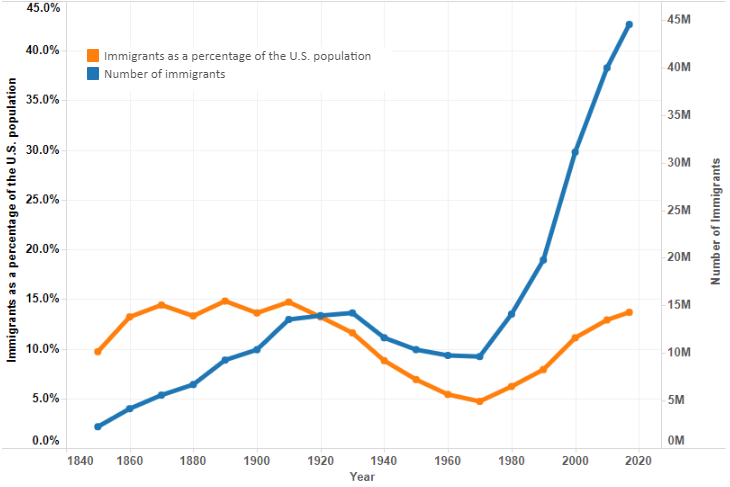
But demographics have changed dramatically since 1970. For example, immigrants make up almost 3x as large a fraction of the population (from 5% to almost 15%) than in 1970. Obviously, if you add a large number of (typically) economically disadvantaged people to the population, income inequality is going to go up, even if there is no change in incomes for everyone else: https://www.migrationpolicy.org/sites/default/files/source_i....

Likewise, peoples’ incomes increase with age. The population overall has grayed significantly. Again, even if wealth inequality wasn’t increasing for people of any given age, changing the age distribution of the population will affect income inequality.

Finally, a larger fraction of the population now comprises historically disadvantaged minorities. While the income gap between races in the US is a huge problem, it’s a different problem than “income inequality” genetically, deserving more targeted solutions. (And even that income gap is hard to analyze, because the ages of people of different races in the US differ quite dramatically). The median age of non-Hispanic whites is 42. The median age of Hispanic people is 28. The median age of African Americans is 33: https://www.pewresearch.org/fact-tank/2016/07/07/biggest-sha...).

Income inequality probably is going up. But I’ve never seen a study that actually holds demographic changes constant so the result reflects peoples’ perception of what income inequality means.

Re: Rising US Inequality: How We Got Here, Where We're Going

#64

Living standards have gone down and life has become much more economically insecure for most working people as a result of the policies that economists recommend. This includes globalization, free trade, low taxes, destruction of labor unions, and the like. The authors support these policies. These changes have been accompanied by a political system that no longer represents the left behind. So of course the losers a…

Economists have not necessarily been blind to social needs - policy makers and politicians benefiting from a revolving door of oligarchs enabled by various institutions culturally stationed to manipulate a larger population into working under these few for smaller and smaller pieces of power. Milton Friedman made it quite clear that a free market doesn’t provide a social safety net in any way and that a population that doesn’t succeed in the market should need some basic way to survive or we’s face huge social unrest. While America had social security and Medicare early on, we’ve dismantled their efficacy with a toothless, captured government while private sector has gained in power enormously in the form of multinational corporations the Founding Fathers all distrusted (they were no fans of the British East India Company).

I think we’ll have one or two more larger scale revolutions before people around the globe learn that consolidated power of any sort whether it comes from religions, the public masses (populism), government, corporations, or perhaps even science is dangerous.

Re: Rising US Inequality: How We Got Here, Where We're Going

#65
post #26

Earlier quoted context omitted.

I think that's an un-generous interpretation of the quote. Yes, I think there is good evidence that if you are in a poverty-stricken family and you don't get very early intervention, that by mid-elementary school it is too late for your average poor kid. The reason being that the rest of your environment of poverty is going to be pretty much pulling against you the rest of your childhood, so intervention while your h…

I largely agree with you. But the following line from the article is devastating, "For a lot of children, when they’re 8 years old, it’s too late." And this mawkish line is published under the banner of Stanford, an arbiter of the truth. I expect better. edit: My comments seem to have sparked a nerve. I simply wanted to point out bad rhetoric that undermines the cause and weakens an institution of trust. The situatio…

It is possible for both to be true: For many children, if they have not had early childhood intervention, by 8 years old it is too late, but that for any individual child, they can still improve their lot later in childhood (or even, of course, well into adulthood).

As a similar example, it is extremely likely that a child who is overweight or obese by middle school will be overweight or obese their entire life, and many scientists and clinicians believe that it is much easier to prevent childhood obesity than try to correct the weight imbalance later on. That doesn't mean that some people who are overweight kids won't eventually lose the weight and keep it off.

Hanging on to the hope that people can change at any point in life does not mean we should ignore the fact that many of our personality and social "guiderails" are laid down pretty early.

Re: Rising US Inequality: How We Got Here, Where We're Going

#66
post #63
post #4

“But the last 50 years have been terrible for people with lower skills. Adjusted for inflation, the average earnings of a man who didn’t go to college is lower now than it was 50 years ago. That’s unheard of.” How much of this effect is the vastly higher percentage of people who now go to college? If you line up 100 people by vague estimation of their likely earning potential in 1970 and do the same today, but now 2.…

Income inequality comparisons are full of problems like this. Reflecting your intuition, I’d imagine most people would conceive of increasing income inequality to mean increasing gaps between people in the same station in life across two time periods. But demographics have changed dramatically since 1970. For example, immigrants make up almost 3x as large a fraction of the population (from 5% to almost 15%) than in 1…

I also suspect that some of these "oversights" aren't mistakes at all, but rather intentional obfuscation of facts.

Take note of how often you hear/read something like "incomes haven't risen in 30 years, but prices have gone up over 50% over that period". [Almost?] Inevitably, the income will be real income [inflation adjusted] and the prices nominal prices.

Re: Rising US Inequality: How We Got Here, Where We're Going

#67
post #6

The credibility of the article is undermined by hyperbolic statements such as, "For a lot of children, when they’re 8 years old, it’s too late. If your parents aren’t engaged in the education system, in 10 years you’ll be competing in the labor market against people whose parents sent them to violin lessons and summer programs in the Dominican Republic. There’s inequality of opportunity." It's too late for "a lot of…

It's probably too late by the time the child was born. Those stupid violin lessons or summer programs are not really a sign of competence. They are just a status symbol of rich families that can afford to let their children enroll in private school and an expensive ivy league college.

If you were to ask me then honestly it's only too late when you're 16 years old. At that point you should already know what type of college degree you want and you should have at least some experience in whatever you're going to spend 4-5 years of your life studying. But this has more to do with "finding yourself" than economic opportunity. If all you want to be is a corporate drone with a paycheck then you just need to look at the average salaries and the dropout rate to make sure you don't fail at something you're not passionate about.

Re: Rising US Inequality: How We Got Here, Where We're Going

#68
post #4

“But the last 50 years have been terrible for people with lower skills. Adjusted for inflation, the average earnings of a man who didn’t go to college is lower now than it was 50 years ago. That’s unheard of.” How much of this effect is the vastly higher percentage of people who now go to college? If you line up 100 people by vague estimation of their likely earning potential in 1970 and do the same today, but now 2.…

This suggests that everyone going to college is doing well. That isn't the case. There are people who have master's degrees, but are earning $15/hour. I agree with your point that populations can change over time. Fifty years ago, many people didn't get degrees and made good money. Today, people without degrees (and some with) don't make good money. So instead of trying to segment in groups (the college educated vs.…

In a consumer driven economy, with a savings rate of around 7%, most people are spending the vast majority of their income on consumption [competing with other consumers for some scarce goods], why would we think that median real income should increase significantly faster than inflation?

Re: Rising US Inequality: How We Got Here, Where We're Going

#69

Earlier quoted context omitted.

This suggests that everyone going to college is doing well. That isn't the case. There are people who have master's degrees, but are earning $15/hour. I agree with your point that populations can change over time. Fifty years ago, many people didn't get degrees and made good money. Today, people without degrees (and some with) don't make good money. So instead of trying to segment in groups (the college educated vs.…

In a consumer driven economy, with a savings rate of around 7%, most people are spending the vast majority of their income on consumption [competing with other consumers for some scarce goods], why would we think that median real income should increase significantly faster than inflation?

Because of the huge productivity gains over the past 42 years. The profits from those gains all collect at the top.
Post reply on HN